Last Updated: October 21, 2026
Quietest aquarium filter searches usually produce a list of models, when the genuinely useful answer is a short list of noise sources instead. Aquarium filters make sound in four quite distinct ways, and three of those four can be fixed on the equipment you already own without spending any money at all.
As an Amazon Associate we earn from qualifying purchases.
As an Amazon Associate we earn from qualifying purchases at no extra cost to you.





By David Nguyen
Four Noise Sources, Three You Can Fix Free
Filters are not loud in absolute terms. A quietest aquarium filter search is really about a specific room at a specific hour, and the sound that keeps someone awake at 2 am is rarely the motor everyone blames.
The Four Noise Sources, and Which One You Actually Have
The quietest aquarium filter is simply one where all four are handled. Motor hum is continuous, low pitched and comes from the impeller assembly. Vibration transmission is the same sound amplified by whatever the unit touches, which is why a canister on a hollow cabinet floor is far louder than one on a mat.
Splash is water falling from a hang-on-back lip into the tank, and it gets louder as evaporation drops the water level, which is why filters seem to grow noisier through the week. Air pump buzz is a separate, higher pitched sound entirely.
Identifying which you have takes two minutes. Top the tank up and listen again, then lift the unit slightly off its resting surface and listen once more. Whichever change quietens the tank tells you what to fix.
Manufacturer decibel figures are rarely useful for this. They are measured under conditions that bear little relation to a filter mounted on a specific cabinet in a specific room, and none of them account for splash, which is the most common complaint of all.
The Mechanism: Why Noise Increases With Age
Impellers wear at the shaft and the bearing surfaces, developing play that turns a smooth hum into a rattle. That process is gradual over months, which is why people often describe a filter as having become loud without any single event.
Debris is the other cause. A grain of substrate or a snail shell drawn into the impeller chamber produces an immediate grinding noise, and that is one of the few filter faults that appears overnight rather than developing slowly.
Air pump diaphragms stiffen with age, which raises pitch and volume together. Air stones clog at the same time, increasing back pressure on the pump, so a two year old sponge filter setup is usually noticeably louder than it was when new.
Trapped air is the canister-specific version. After a service, pockets of air work their way through the housing and produce a distinct gurgling, which usually clears within a day as the unit purges itself and is not a fault.
Noise by Filter Type, With What Fixes It
The table below sets each type against its dominant noise source. Match your situation to the row rather than shopping by model, because most of these are addressable without replacing anything.
| Filter type | Main noise source | Character | What reduces it |
|---|---|---|---|
| Canister | Motor hum, vibration | Low, continuous, from the cabinet | Foam mat under housing, check for air trapped inside |
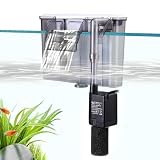
| Hang on back | Splash, then motor | Trickling water, rises through the week | Keep water level topped up, extend outflow |
| Internal power filter | Vibration against glass | Buzz transmitted through the tank | Reseat suction cups, replace perished ones |
| Sponge filter | Air pump buzz | Higher pitched, constant | Foam under the pump, replace the air stone |
| Sump | Overflow gurgle, return pump | Water noise plus hum | Adjust the overflow, submerge the return |
What This Means in a Real Tank
Which is the quietest aquarium filter in practice depends on the room, the stand and how the tank is maintained. The same unit can be inaudible in one setup and intrusive in another a metre away.
Tank Size, Placement and Fit
What the equipment rests on matters more than the equipment. A canister on a hollow flat-pack cabinet floor turns the whole cabinet into a soundboard, while the same unit on a foam mat inside a solid stand becomes close to inaudible.
Placement in the room decides how much noise reaches you. A tank against a bedroom wall transmits vibration through the wall, and a corner position reflects sound rather than absorbing it. Moving the tank a metre often does more than changing the filter.
Measure before you order: cabinet interior height and floor area against the canister plus a mat underneath it, 4-6 in (10-15 cm) behind the tank for a hang-on-back, and stand capacity against roughly 10 lb/gallon (about 1 kg/L) filled.
How This Differs Across 10, 20 and 55 Gallon Tanks
Small tanks are usually noisier per gallon because they sit closer to people. A 10 gallon (38 L) tank on a bedside table puts a hang-on-back outflow a metre from your head, where the same unit on a 55 gallon (208 L) tank across a living room disappears.
Evaporation makes small tanks worse over the week. A 10 gallon tank loses proportionally more water, so the drop from outflow to surface grows faster and the splash increases noticeably between top-offs.
Larger tanks favour canisters for a structural reason. A 55 gallon tank almost always has a cabinet, which is where a canister belongs, while a 10 gallon tank on an open shelf leaves the housing exposed and audible.
Lids and covers help more than expected. A glass lid over a hang-on-back outflow area muffles splash considerably and reduces evaporation at the same time, which addresses the cause and the symptom together for the price of one accessory.
How Room, Season and Stocking Change the Picture
Bedrooms and studios are where the quietest aquarium filter question really matters, and they are also where most nano tanks end up. Anything continuous becomes noticeable at night, so the sound that matters is the one at 2 am rather than the one at noon.
Stocking affects it indirectly. A heavier bioload needs more turnover, and more turnover means either a larger unit or a second one, so the quietest arrangement for a lightly stocked tank stops being available as fish are added.
Summer changes the calculation for a lot of tanks. Warm water holds less dissolved oxygen, so many keepers add an air stone through the hottest months, and the pump buzz that follows undoes most of the quiet a canister was bought for.
Common Mistakes and Myths to Retire
Three assumptions about the quietest aquarium filter send people shopping when the problem is fixable. Each treats noise as a property of the model rather than of the installation.
Myth: Buying a Quieter Model Is the Fix
Replacing a rattling hang-on-back with a new one fixes a worn impeller, and it does nothing about splash or vibration, which are installation problems. People frequently buy twice before addressing the water level.
The replacement sequence: top the tank up, put foam under the unit, check for debris in the impeller chamber, and only then consider whether the model is the problem. Three of the four noise sources cost nothing to address.
Myth: Canisters Are Silent
Canisters are the quietest powered option and they are not silent. They hum, they transmit vibration into whatever they sit on, and air trapped inside the housing after servicing produces a distinct gurgling that persists until it works its way out.
The realistic expectation: a canister on a mat in a solid cabinet is close to inaudible from a metre away. The same unit on a hollow cabinet floor is clearly audible across a room, and that difference is the mat rather than the model.
Myth: Turning the Filter Off at Night Is Reasonable
This one causes real harm. Nitrifying bacteria need oxygen and flow, and a filter switched off for eight hours every night starves the colony and lets stagnant water sit in the housing, producing ammonia readings within days.
The replacement approach: fix the noise source instead. If the tank genuinely cannot be made quiet enough for the room, move the tank rather than switching off the equipment that keeps the fish alive.
The same applies to timers and smart plugs used on filters. They are excellent for lights and actively harmful on filtration, since any interruption longer than a few hours starves the bacterial colony and can push stagnant water back into the tank on restart.
Keeping It Quiet Long Term
Noise creeps back as equipment wears and water evaporates, so the quietest aquarium filter setup is one with a maintenance routine rather than one with a particular badge on it.
What to Do on a Schedule
Top the tank up weekly so the outflow drop stays short, using pure water for evaporation rather than tap. Rinse mechanical media monthly in a bucket of tank water, since a clogged filter works harder and hums louder.
Clean the impeller chamber every few months. Debris, biofilm and calcium deposits all build up around the shaft, and a quick clean with a soft brush restores smooth running before wear becomes permanent.
Check suction cups and mats at the same time. Perished cups let internal filters buzz against the glass, and a foam mat compresses over a couple of years until it no longer isolates the housing from the cabinet floor.
Gear That Degrades and How It Shows Up
Impellers and shafts wear over one to three years, turning hum into rattle. Suction cups perish and let internal filters vibrate against the glass. Air pump diaphragms stiffen, and air stones clog into larger bubbles and higher back pressure.
Filters also lose 30-50% of rated flow as media loads, which makes the motor work harder for less result. A unit that has become loud and weak at the same time usually needs the impeller cleaned or replaced rather than the whole housing.
Keep a note of when parts were last changed. Impeller wear, diaphragm stiffening and mat compression all happen slowly enough that a date written on the cabinet is more reliable than memory when something starts sounding wrong.
Every powered device beside water belongs on a GFCI outlet with a drip loop and should carry a UL or ETL mark. An air pump sitting below the waterline also needs a check valve to prevent back-siphoning if it stops.
The Twelve-Month Running Cost
The recurring items are mechanical floss, an occasional impeller or air stone, foam matting once, and continuous electricity. None of it is expensive, and the impeller is the part most worth having on hand before it fails.
Prices change constantly, so check at the time of purchase. The comparison worth making is the twelve-month running total including wattage, since any filter draws power every hour of the year for the life of the tank.
Spare parts availability is the quiet cost saver here. A manufacturer selling individual impellers, shafts and suction cups lets you fix a noisy unit for a fraction of a replacement, while one that only sells whole assemblies does not.
Frequently Asked Questions
These five come up most often once a tank has moved into a bedroom and the noise has become the main topic of conversation.
Which filter type is genuinely quietest?
A canister in a solid cabinet on a foam mat, because the motor is sealed and the return is submerged so there is no splash. An internal filter is next, and a hang-on-back is the loudest unless the water level is kept high.
Why did my filter get louder over time?
Usually a worn impeller or a dropping water level. Top the tank up first and listen again, then clean the impeller chamber. If the rattle persists after both, the impeller has worn and a replacement part is cheaper than a new unit.
Are sponge filters quiet?
The sponge is, the air pump is not. Pump buzz is higher pitched than motor hum and travels through furniture, so placing the pump on foam and away from hard surfaces matters more than which pump you bought.
Does a fuller tank really reduce noise?
Substantially, for hang-on-back units. The splash comes from water falling into air, so a shorter drop is quieter. Weekly top-offs with pure water fix the most common noise complaint at no cost at all.
Can I insulate the cabinet?
Foam or a rubber mat under the housing addresses vibration, which is the largest single improvement available. Do not seal the cabinet fully, since equipment needs airflow, and never restrict ventilation around a powered device.
See More:
The Bottom Line on Filter Noise
The quietest aquarium filter in practice is a canister in a solid cabinet, sitting on a foam mat with a submerged return so there is no splash. Before buying anything, though, work through the four sources: top the tank up to shorten the outflow drop, put foam under the unit, clean the impeller chamber, and move the air pump off any hard surface. Three of those cost nothing, and never switch a filter off overnight to solve a noise problem.

6 Best Water Filters For Aquarium Tank 2026
8 Best Budget Aquarium Sponge Filters for Fry Tanks