Last Updated: October 4, 2026
Put side by side, the jbj arctica vs hailea aquarium chiller question looks simple because both sit at 1/4 HP. The real differences are elsewhere: flow windows, voltage variants sold by region, how each publishes thermal data, and a price gap near $440.
As an Amazon Associate we earn from qualifying purchases.
As an Amazon Associate we earn from qualifying purchases at no extra cost to you. Prices and availability are accurate as of the date shown and are subject to change.
By David Nguyen
Quick answer: For most people in 2026, the best jbj arctica vs hailea aquarium chiller is the Compressor class — our #1 rated choice. See the full ranked comparison, alternatives and buying advice below.
How to Choose Between JBJ Arctica and Hailea
Matching horsepower hides more than it reveals. Work through four things instead: what the shared 1/4 HP rating does and does not tell you, the flow each unit requires, which voltage version you are actually buying, and how far the published cooling claims can be compared. Those four points decide the purchase far more than the shared horsepower figure does.
Same Horsepower, Different Machines
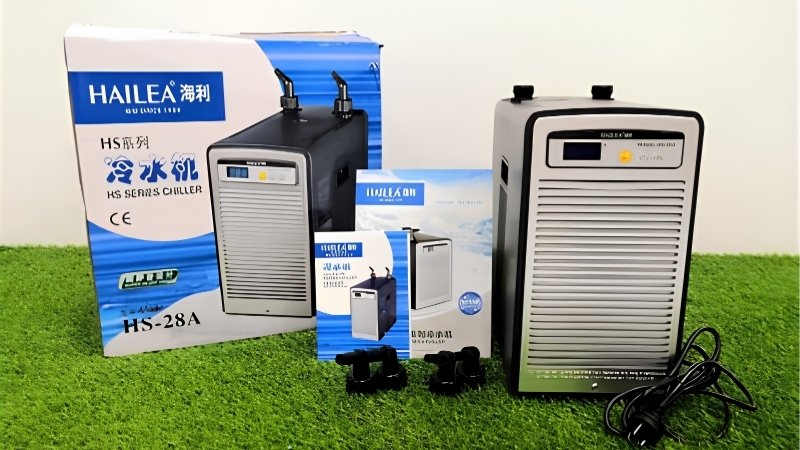
The JBJ Arctica DBE-200 and the Hailea HC-300A are both rated 1/4 HP, and both use R134a refrigerant. That shared class sets a rough expectation of capability, but it does not mean the two deliver identical cooling in your system. Both are also aimed at broadly similar tank sizes, though each brand states that range differently.
Horsepower describes the compressor, not the finished machine. Exchanger design, fan and condenser sizing and control electronics all shape the result, which is why two units with the same HP label can behave differently on the same tank. Parts availability and service support differ as well, which matters on a device expected to run several summers.
Flow Windows Differ Substantially
The JBJ DBE-200 accepts 480 to 1,920 GPH through its titanium exchanger, an unusually wide range. Hailea specifies 1,000 to 2,500 litres per hour for the HC-300A, which converts to roughly 264 to 660 GPH. The JBJ range spans a wider spread in absolute terms, covering roughly four times its own floor.
That difference reshapes your pump choice. The JBJ accommodates most return-class pumps at real head, while the Hailea suits a smaller dedicated pump, and either needs delivered flow calculated after lift, hose and fittings rather than box ratings. Litres per hour and GPH are different units, so convert before comparing anything between the two listings.
Confirm the Voltage Version
This is where Hailea buyers get caught. The HC-300A is sold in a 220 to 240V version drawing 1.8A and a 110 to 120V version drawing 3A, and listings often fail to make the distinction obvious.
The JBJ DBE-200 is sold as a US model at 115V drawing 6A, so there is no ambiguity. Before ordering a Hailea unit, confirm the variant in writing, since the wrong version is useless without a transformer and may void support. Running a 220V unit through an adapter also complicates any future warranty claim.
Read the Thermal Claims Carefully
JBJ publishes 3,000 BTU per hour for the DBE-200. Hailea’s US listing states 395W of thermal cooling capacity, which converts arithmetically to roughly 1,348 BTU per hour, but the two figures come from different testing protocols. Neither listing states ambient temperature, water temperature or the pull-down used to reach its figure.
That means the gap cannot be read as a performance ranking, and no honest percentage says one is stronger. Use the numbers as rough class indicators, then weigh flow windows, electrical documentation, parts support and price. Ask each seller for the test condition behind its figure, and treat a missing condition as a reason for caution.
JBJ Arctica vs Hailea by Use Case
Neither unit wins outright; each fits a different buyer. These four cases map the choice onto how your loop is plumbed, what documentation you need, and how much you want to spend.
| Factor | JBJ Arctica DBE-200 | Hailea HC-300A | Best For |
|---|---|---|---|
| Compressor class | 1/4 HP | 1/4 HP | Matched on paper |
| Required flow | 480-1,920 GPH | 1,000-2,500 L/h (~264-660 GPH) | Wide pump choice -> JBJ |
| Electrical | 115V at 6A (US model) | 110-120V at 3A or 220-240V at 1.8A | No variant confusion -> JBJ |
| Published cooling | 3,000 BTU/h | 395W thermal (~1,348 BTU/h) | Stated in BTU -> JBJ |
| Price (09/2026) | ~under $1,000 | ~under $500 | Lower entry cost -> Hailea |
JBJ for Wide Flow Flexibility
Choose the Arctica when your loop already has a pump or when you want options. Its 480 to 1,920 GPH window covers most return pumps at real head, so you can often feed the chiller from existing hardware instead of buying a dedicated pump. On a mixed reef with a sump return already in place, that can remove an entire purchase from the project.
That flexibility costs money: roughly $900 as of 09/2026, about 88.0% above the Hailea, a gap near under $450. If your plumbing is simple and low-flow, you are paying for range you may not use. Check whether your existing pump lands inside the window at real head before assuming the flexibility helps.
JBJ for Documented US Specifications
The DBE-200 is sold as a US-market unit at 115V and 6A with a titanium exchanger, R134a refrigerant and a stated 3,000 BTU per hour rating. For buyers who want everything specified in familiar units, that consistency removes guesswork.
Note that 115V times 6A gives 690VA, which is a volt-amp figure rather than verified real watts, so it cannot be compared directly against a wattage number from another brand. Treat it as an indicator for circuit planning only. Leave ventilation clearance regardless, since both units exhaust removed heat into the cabinet.
Hailea for a Lower Entry Price
At roughly $500 as of 09/2026 the HC-300A sits about 46.8% below the JBJ for the same 1/4 HP class, which is a substantial saving on a device many reefers run only a few months a year. For a seasonal problem lasting a few weeks each summer, that saving is genuinely persuasive.
The trade-offs are documentation and support. Thermal capacity is published as 395W rather than a BTU figure with stated conditions, and regional voltage variants make listings easy to misread, so verify the exact version before ordering. Budget a little extra for shipping and possible support friction on regional listings.
Hailea for Lower-Flow Loops
If your system uses a modest dedicated pump, the 1,000 to 2,500 litre per hour requirement, roughly 264 to 660 GPH, may suit it better than the JBJ’s higher floor of 480 GPH. Smaller pumps cost less and add less heat to the water. A smaller pump also draws less power across a long cooling season.
Check delivered flow at your actual head before committing, since a pump rated above 264 GPH on the box can fall below it through hose and fittings. Keep a valve in the line so you can trim into the window as the exchanger fouls. Fouling raises resistance over months, so recheck delivered flow annually rather than only at installation.
Frequently Asked Questions
Four questions decide most of these comparisons: what the shared HP rating means, whether the cooling figures can be compared, which voltage to order in the US, and how the flow difference affects your pump budget.
Are both really 1/4 HP?
Yes, both the JBJ DBE-200 and the Hailea HC-300A carry a 1/4 HP rating and both use R134a refrigerant, so they compete in the same class on paper. Both also use titanium-grade exchanger construction suited to saltwater loops.
That does not make them interchangeable. Flow requirements, electrical variants and published thermal data all differ, and those practical details decide which one suits your plumbing and your room. Read the class as a starting filter rather than a verdict.
Can I compare 3,000 BTU to 395W?
Not directly. Converting 395W gives roughly 1,348 BTU per hour arithmetically, but the two manufacturers do not publish matched test conditions, so the comparison has no verified basis. One brand reports thermal watts and the other reports BTU per hour, which are not interchangeable without matched testing.
Use each figure within its own context and weigh the rest: flow window, voltage clarity, refrigerant, warranty and parts availability. Where conditions are missing, a bigger headline number proves very little. Model generations refresh regularly here too, so confirm the listing matches the current production unit.
Which voltage should I order in the US?
The 110 to 120V Hailea version drawing 3A, not the 220 to 240V version. The JBJ DBE-200 is already a US model at 115V and 6A, so that question only arises with the Hailea. Ordering the wrong variant leaves you with hardware that cannot be plugged in safely.
Confirm the variant with the seller in writing before purchase. Regional listings for Hailea frequently mix specifications from both versions, which is the single most common source of confusion in this comparison. Screenshot the specification page at the time of purchase in case the listing changes.
Does the flow difference change my pump budget?
Often yes. The JBJ’s 480 GPH floor generally needs a larger pump than the Hailea’s roughly 264 GPH floor, and that difference can add to the total cost of a fresh installation. Pump cost, hose and fittings all belong in the comparison alongside the chiller itself.
Work out delivered flow at your real head first, then compare total system cost rather than chiller price alone. A cheaper unit needing a new pump can end up closer in price than the sticker gap suggests. Large cooling equipment discounts hardest around Prime Day and Black Friday, which can shift the maths further.
Final Thoughts
In the jbj arctica vs hailea aquarium chiller decision, JBJ buys a wide flow window and clearly documented US specifications near under $1,000, while Hailea saves roughly $440 for the same 1/4 HP class. Confirm the voltage variant and delivered flow before letting the price gap decide.
Ready to decide? Our #1 pick for 2026 is the Compressor class.
Live price & availability on Amazon.
Related Reviews & Guides

Best Aquarium Siphon for Water Changes: Top Top Picks

Quick Picks: Best Aquarium Water Conditioners and…