Last Updated: October 21, 2026
A 24-inch tank is not one shape, so the best reef led light for a 24 inch tank depends on the real width, depth and coral target, not the length alone, since a 24-by-12 shallow, a 24-by-18 and a 24-inch cube each need a different light and spread over the coral.
As an Amazon Associate we earn from qualifying purchases.
By David Nguyen
How to Choose a Reef LED for a 24 Inch Tank
Length alone cannot pick a light, because a 24-by-12 tank and a 24-inch cube are different lighting problems. Measure the whole footprint first, match the coral target’s PAR, keep mounting height tied to any coverage claim, and verify the result with a PAR map at coral depth.
Measure the Whole Footprint
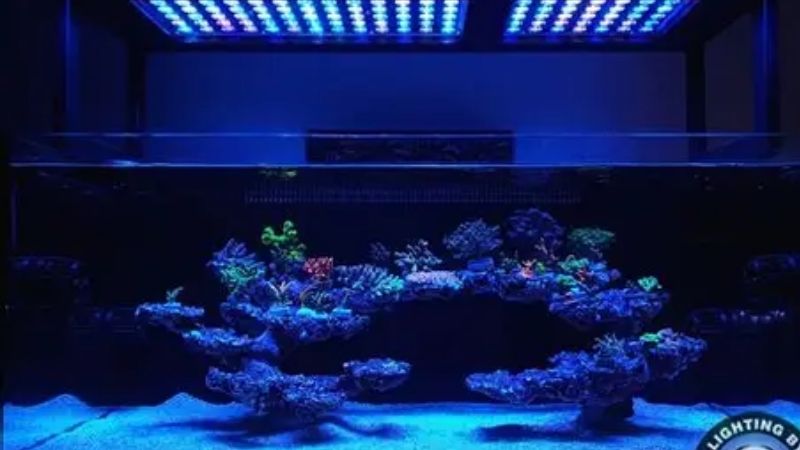
The primary axis is the actual footprint, not the nominal length. A 24-inch tank may be 24 by 12 and shallow, 24 by 18, or a 24-by-24-by-24 cube, and the width and depth change how much spread a fixture must deliver and how deep its light must reach usefully.
So start by measuring length, width and height together. A single puck that covers a narrow 24-by-12 easily may leave the corners of a 24-inch cube dim, which is why the geometry, not the label on the box, decides whether one fixture can light the whole tank.
Match Coral Target
Coral type sets the intensity you need at depth. BRS planning ranges are roughly 75 to 150 PAR for soft and LPS corals and 200 to 350 PAR for SPS, so an SPS cube demands far more usable light at the sand bed than a soft-coral tank of the same footprint.
Use those ranges as targets, not fixture ratings, and confirm them with a meter. A light that lands a soft-coral tank comfortably in range may fall short for SPS in the same 24 inches, so let the corals you plan to keep, not the tank size, drive the intensity requirement.
Keep Mounting Height With Coverage
Coverage claims only hold at their stated height. The AI Hydra Edge 44HD reaches up to 30 by 30 inches mounted 9 inches above the water, and Red Sea’s ReefLED G2 115 24-by-24 PAR test used a mounting height around 8 inches, so those figures belong to those specific setups.
Change the height and the numbers change, since raising a light broadens spread but loses intensity. Keep the mounting height attached to any coverage or PAR claim, and plan your own height from the fixture’s guidance rather than assuming a 24-inch tank automatically gets the rated spread.
Verify With a PAR Map at Coral Depth
Manufacturer coverage is a shortlist tool, not proof of uniform light. A stated 24-by-24 coverage does not guarantee coral-ready PAR at every corner and depth, so treat it as a way to narrow candidates rather than a promise that the whole footprint is evenly lit for coral.
Confirm the real distribution with a PAR meter at coral depth once the light is up. Different metrics — coral-specific coverage, tank-span guidance and depth-specific PAR — are not comparable one to one, so a measured map at your own corals is the only way to prove a fixture is enough.
Top Picks
These four lights map to different coral targets and evidence types rather than one universal winner, since the keyword does not fix the tank’s geometry or corals. Each lists verified specs, a relative price tier, and the drawback that matters most when a 24-inch tank can mean several shapes.
| Product | Best For | Key Spec | Watch Out For |
|---|---|---|---|
| Red Sea ReefLED G2 115 | Best published 24-cube evidence | 24×24; 115W; 150 PAR at 20-in test depth | Result is condition-specific |
| AI Hydra Edge 44HD | Best soft/LPS 24-in cube example | 95W; BRS uses 1× on 24×24×24 soft/LPS | High-demand SPS may need more |
| Kessil A360XE | Best mixed-reef point source | 24×24 mixed; 20×20 SPS; 90W | SPS footprint is smaller |
| Radion XR15 G6 Pro | Best premium control ecosystem | 95W; EcoTech 24–30 in suitability | BRS high-demand guidance is conservative |
Red Sea ReefLED G2 115
The Red Sea ReefLED G2 115 is the pick with published cube evidence, a 115-watt fixture rated for 24-by-24 coverage with a measured 150 PAR at 20 inches of depth in a 24-by-24 test tank. For a 24-inch cube buyer who wants a number, that measured result is the strongest evidence here.
At about $459 as of 09/2026, read the figure with its condition attached: the test mounted the light around 8 inches above the water. Do not generalize one center-and-depth result to every coral or corner, so verify PAR across your own footprint before assuming full coverage everywhere.
AI Hydra Edge 44HD
The AI Hydra Edge 44HD is the soft-and-LPS cube example, a 95-watt fixture that BRS uses as a single-light solution on a 24-by-24-by-24 soft and LPS cube, and which reaches up to 30 by 30 inches mounted 9 inches above the water. For that use case, one unit can light the tank.
At about $400 as of 09/2026, its limit is the coral target: high-demand SPS is a different problem that may need more intensity or coverage than a single 44HD provides on a cube. Match it to soft and LPS as BRS does, and step up the plan if the goal is SPS.
Kessil A360XE
The Kessil A360XE is the mixed-reef point source, a 90-watt fixture rated 24 by 24 for mixed reef and 20 by 20 for SPS from a compact 4.3-inch diameter. Its shimmer and small form suit a 24-inch mixed tank where a single point source is the desired look.
At about $499 as of 09/2026, note that its SPS footprint of 20 by 20 is smaller than a full 24-by-24 square. One unit gives the manufacturer’s mixed coverage, but for SPS across the whole 24 inches you would verify the corners, since the SPS rating does not span the full tank.
Radion XR15 G6 Pro
The EcoTech Radion XR15 G6 Pro is the premium control pick, a 95-watt fixture EcoTech describes as suitable for tanks 24 to 30 inches wide or deep, backed by the Radion ecosystem’s control and app. For a keeper who wants deep programmability, it anchors a 24-inch reef well.
At about $500 as of 09/2026, weigh the scope tension: BRS notes the effective spread can be nearer 18 by 18 for higher-demand use, and a 24-inch cube may need an XR30 for demanding SPS. So verify PAR at coral depth rather than assuming the broad suitability figure covers SPS.
Frequently Asked Questions
Buyers lighting a 24-inch reef ask a consistent set of questions. Each answer opens with the practical call, then the condition that changes it, so you can size the light to the real footprint and coral target rather than to the tank’s nominal length on the label.
Is one reef LED enough for a 24-inch tank?
Sometimes, depending on shape and coral. BRS uses a single AI Hydra 44HD as its example for a 24-by-24-by-24 soft and LPS cube, and Kessil rates the A360XE at 24 by 24 for mixed reef, so one fixture is plausible for many mixed and soft systems at this size.
SPS goals narrow the answer. A single point source often covers a smaller SPS footprint than the tank’s full square, so for demanding coral verify the corners at depth, since one light being enough for soft or mixed does not prove it is enough for SPS in the same 24 inches.
How much PAR should a 24-inch reef have?
Use the coral target, not the tank length. BRS planning ranges are roughly 75 to 150 PAR for soft and LPS and 200 to 350 for SPS, so the number you need depends entirely on what you keep, not on the fact that the tank happens to measure 24 inches along its longest side.
Then confirm it at coral depth with a meter. Those ranges are planning targets rather than fixture ratings, so a light that hits them at the top of the rock may fall short at the sand bed, which is why a measured map matters more than any coverage claim.
Does a higher wattage mean a stronger light?
Not as a direct conclusion. The ReefLED G2 115 draws 115 watts against 95 for the Hydra and Radion and 90 for the Kessil, but maximum AC draw and delivered PAR distribution are different metrics, so the bigger wattage does not automatically mean more usable coral light.
Optics, spectrum and mounting height all shape what reaches the coral. Compare measured PAR and coral-specific coverage with their conditions attached rather than watts, since a lower-wattage fixture with efficient optics can deliver comparable usable light on the same 24-inch footprint.
Why can one light claim both broad and narrow coverage?
Because the claims use different conditions and use cases. EcoTech’s 24-to-30-inch suitability for the XR15 describes general coverage, while BRS’s roughly 18-by-18 effective spread applies to higher-demand coral, so both can be true for the same fixture under different assumptions.
That is why the coral target must be explicit. A broad suitability figure suits soft or mixed reef, but demanding SPS shrinks the usable footprint, so read each coverage number with its use case attached and verify the intensity your specific corals need at depth.
Final Thoughts
For a 24-inch reef, pick the light by the real footprint, depth and coral target, since 24 inches alone can mean a shallow tank or a demanding cube. One fixture is plausible for many mixed and soft systems, but verify PAR at coral depth before assuming a single light is enough for SPS.
6 Best Chillers For Saltwater Aquarium 2026

Aquarium Salt Marine Mix Reef Review