Last Updated: September 25, 2026
A mesh lid is only as good as its smallest opening. The best mesh lid for aquarium use matches the mesh to your smallest fish, since a smaller opening reduces the escape path — and a finer 1/8-in mesh is not simply twice as safe as 1/4-in, just sized for smaller bodies.
As an Amazon Associate we earn from qualifying purchases.
By David Nguyen
Quick answer: For most people in 2026, the best mesh lid for aquarium is the IM SafeScreen — our #1 rated choice. See the full ranked comparison, alternatives and buying advice below.
How to Choose a Mesh Aquarium Lid
A mesh lid is judged by mesh opening against your smallest fish, exact rim fit and light transmission read in context. The smaller the opening, the shorter the escape path, so start with your livestock, not the light claim.
Start With Smallest Fish
Size the mesh to your smallest species. The IM SafeScreen uses 1/4-in mesh for most community fish, while the BRS 1/8-in suits very small fish that would slip through a coarser screen — the mesh must be smaller than the fish. Even one small fish, like a young rasbora or a dwarf goby, can slip a 1/4-in gap, so plan for the smallest body.
The selected mesh is out of range if a fish body fits through it. So match the opening to the smallest livestock, not the biggest, since one small jumper is all it takes. Shrimp and fry need especially fine mesh, so a nano tank often calls for 1/8-in rather than the common 1/4-in.
Know Mesh Opening
Mesh sizes are not interchangeable. The order runs 1/8 in (0.125) under 1/4 in (0.25) under 5/16 in (about 7.94 mm) — the Red Sea 5/16 is the coarsest here, suited to larger fish only. Read the exact fraction on the listing, since a jump from 1/4 to 5/16 in noticeably widens the gap a fish can pass.
A larger opening loses less light but stops fewer small fish. Read the exact fraction, since a smaller opening blocks smaller bodies, and the difference between 1/8 and 1/4 is real, not marketing. The tradeoff is real: coarser mesh brightens the tank but only suits larger, non-slender fish that cannot fit through.
Match Rim Style
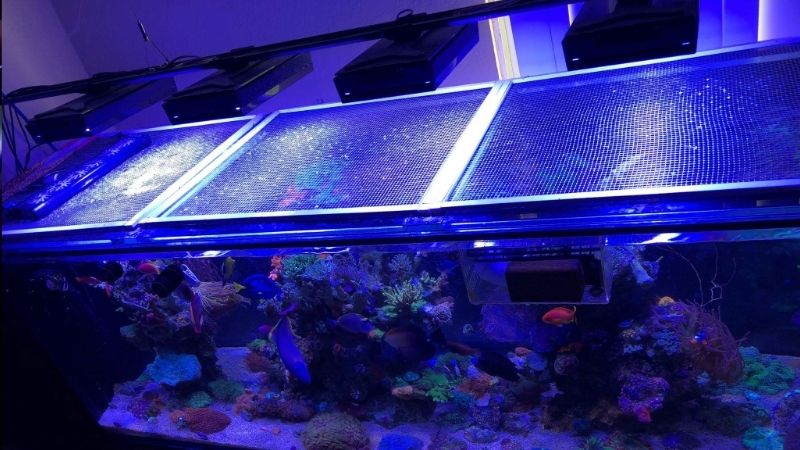
The screen must fit your rim. The IM SafeScreen fits rimmed and rimless tanks, while the Red Sea mounts inside or on the rim with an equipment cutout — confirm your tank rim style before buying. Rimmed tanks give a lip for a framed screen, while rimless tanks need a screen that rests flush or clips to the glass.
A rimless tank needs a screen that seats without a plastic rim to grip. Match the mounting to your rim, since a misfit leaves gaps that undermine the mesh entirely. A DIY kit that trims to size is often the cleanest solution for a rimless tank with no standard frame to match.
Treat Light Tests Carefully
Light claims are product-specific and not comparable. The BRS cites about 99% transmission and the D-D about 2.5% reduction, but those are different tests, so they cannot be lined up as a ranking. A 99% transmission figure and a 2.5% reduction figure come from different tests, so lining them up tells you nothing.
So do not compare a transmission percentage from one lid to a reduction figure from another. For light-hungry corals, use the finest-strand mesh your fish size allows, and treat any single figure as specific to that product. For a bright reef, choose the finest strand with the largest open area your fish size allows to limit shading.
Top Picks
Four DIY mesh lids span fine to coarse openings and soft to rigid frames, differing in mesh and light claims, not a comparable test. Mesh size is set by your fish, so weigh that first. Prices are relative and shift over time.
| Product | Best For | Key Spec | Watch Out For |
|---|---|---|---|
| IM SafeScreen | Best Overall | 1/4 mesh; 24×24-48×24; rimmed/rimless; ~$48 | Fine fish need 1/8 |
| BRS DIY 1/8 | Best for very small fish | 1/8 mesh; 2-6 ft kit; ~99% claim; from ~$46 | Claim is product-specific |
| Red Sea DIY 24 | Best for larger fish | 5/16 (~8mm) mesh; equipment cutout; ~$65 | Coarse; not for nano fish |
| D-D Jumpguard | Best for rigid frame | Aluminum; ~2.5% light reduction; ~$47 | Exact mesh size unverified |
IM SafeScreen
The IM SafeScreen earns Best Overall as a versatile 1/4-in DIY screen in 24×24, 36×24 and 48×24 sizes for rimmed and rimless tanks, around $48 as of 09/2026 [IM/BRS, 2026]. It covers most community tanks. Its 1/4-in mesh suits most community fish, and the trim-to-fit kit adapts to nearly any standard footprint.
Very small fish can pass 1/4-in, so pair it with a finer mesh for nano species. As a broad, tank-agnostic screen, though, it is the default pick for typical jumpers. At about $48 it is the value pick, and it trims to cover rimmed and rimless tanks from 24 to 48 inches wide.
BRS 1/8
The BRS DIY 1/8 is the pick for very small fish, a 1/8-in mesh kit from about $46 with a stated near-99% transmission claim [BRS, 2026]. The finer opening stops fish a 1/4-in screen would not. Its near-99% transmission claim also makes it a strong choice where both fine mesh and bright light are needed.
Its 99% transmission claim is product-specific and not comparable to other lids figures. Choose it when your fish are small enough to need 1/8-in, accepting a slightly finer strand. For nano fish, shrimp and fry, the 1/8-in opening is the safe choice despite the slightly finer, denser strands.
Red Sea DIY 24
The Red Sea DIY 24 uses a coarser 5/16-in (about 8 mm) mesh, around $65 — roughly 35% above the IM [Red Sea/BRS, 2026], with an equipment cutout. The larger opening loses less light but stops only larger fish.
It is out of range for nano species that would pass 5/16-in. For larger fish where light matters, it is a strong choice, but match the coarse mesh to fish that cannot fit through it. For larger community or display fish, though, its brighter, more open weave is a genuine advantage over finer mesh.
D-D Jumpguard
The D-D Jumpguard is the rigid-frame pick, a DIY aluminum frame around $47 citing about 2.5% light reduction. The metal frame holds shape over a large opening better than a soft screen.
Its exact mesh size is unverified, so confirm the opening suits your fish before relying on it. The rigid frame is its draw on a big tank, with light loss as a product-specific figure. The rigid aluminum frame is its strength, holding shape over a wide span where a soft screen would sag.
Frequently Asked Questions
Mesh-lid questions center on opening size and light. Each answer opens with the verdict, then the practical detail for keeping fish in.
1/8 better than 1/4?
It is safer only for smaller fish, not universally twice as safe. A 1/8-in mesh stops fish that pass 1/4-in, but for larger fish the coarser mesh is fine and loses less light.
Match the mesh to your smallest species. The smaller opening blocks smaller bodies, so choose 1/8-in when your fish need it rather than as a blanket upgrade. The smaller the fish, the finer the mesh; a tank of small tetras needs 1/8-in even if larger tankmates would be fine at 1/4.
Red Sea mesh size?
The Red Sea DIY 24 uses 5/16-in mesh, about 8 mm — the coarsest option here. It suits larger fish and loses less light, but not nano species.
Confirm your fish cannot fit 5/16-in before choosing it. For small fish, a 1/4 or 1/8-in mesh is the safer opening.
Light blockage?
It varies by product and is not comparable across lids. The BRS cites about 99% transmission and the D-D about 2.5% reduction, but those are different tests, so they do not line up.
For most tanks the loss is minor. If corals need maximum light, use the finest-strand mesh compatible with your fish, and treat any figure as specific to that lid. A low-light or shade-tolerant tank will not notice mesh shading, so light loss mainly concerns bright reef setups.
Cut around equipment?
Yes — most DIY mesh lids accommodate cutouts. The Red Sea includes an equipment cutout, and DIY kits let you trim around filters and cords.
Keep the cutout as small as the equipment allows, since the largest gap is the escape limit. A tight cutout preserves the jump protection the mesh provides. A ragged or oversized cutout becomes the escape route, so cut precisely around the filter and cords.
Final Thoughts
The best mesh lid for aquarium use is the one whose opening is smaller than your smallest fish, fitted cleanly to your rim. The IM SafeScreen leads as a versatile 1/4-in DIY screen, the BRS 1/8 suits very small fish, the Red Sea 5/16 fits larger fish, and the D-D adds a rigid frame. Size the mesh to your livestock first, keep cutouts tight, and treat each lid light figure as product-specific rather than comparable.
As an Amazon Associate we earn from qualifying purchases at no extra cost to you. Prices and availability are accurate as of the date shown and are subject to change.
Ready to decide? Our #1 pick for 2026 is the IM SafeScreen.
Live price & availability on Amazon.
Related Reviews & Guides

How to Choose a Protein Skimmer: Complete Buying Guide (2026)
Glass Canopy vs Hood Which Is Better: Top Compared Setup Guide