Last Updated: November 22, 2026
Disclosure: As an Amazon Associate, I earn from qualifying purchases.
Loaches are bottom-feeding omnivores with a strong carnivore lean. In the wild, clown, yoyo, zebra and dojo loaches sift the substrate for insect larvae, worms, small crustaceans and snails, while kuhli loaches pick through leaf litter for the same fare. In a community tank they are routinely outcompeted: food that floats or drifts down slowly is intercepted by tetras, barbs and gouramis long before it reaches the bottom, and the loaches end up thin on a diet of scraps. The best loach food sinks fast, leads with animal protein, and is sized to the species in front of it.
This guide compares five foods that cover the full loach size range: a high-protein carnivore pellet, a whole-seafood shrimp pellet, a grazing gel, an extra-large pellet for adult clown loaches, and a gammarus tablet. Each is judged on protein content, main ingredients, form and size, and sinking behavior.
How to Choose the Best Loach Food
Protein comes first. Most loaches do best on a staple with roughly 38 to 47 percent protein from animal sources. Check that the first ingredients are named animal proteins such as fish meal, krill, shrimp or whole fish rather than wheat and soy. Loaches graze plant matter and biofilm as well, and hillstream loaches need far more of it, but a plant-heavy food is a side dish for the common botia and kuhli species, not the staple.
It has to sink, and sink fast. A pellet that takes half a minute to reach the substrate in a tall community tank is a mid-water food wearing the wrong label. Look for dense pellets, tablets and gels that drop straight down and stay where they land, so you can place food in the loaches’ corner instead of broadcasting it to the whole tank.
Size must match the mouth. Loaches range from slender kuhlis that struggle with anything over a few millimetres to adult clown loaches that handle large pellets whole. Small species need mini pellets, crumbled tablets or soft gel they can mouth and rasp at. A food that is too big does not get eaten slowly; it gets abandoned, and then it rots.
Grazing time matters. Loaches are methodical feeders, and the shy species often wait until the tank calms down or the lights go out. Foods that hold together in water, such as firm tablets and set gel, let them feed over an hour or more. Fast-dissolving foods vanish into the substrate and feed the nitrate level instead of the fish.
Rotate rather than rely on one food. A sinking staple plus a weekly rotation of frozen bloodworms, daphnia or blanched zucchini rounds out the diet and keeps picky fish interested. Feed in the evening where possible, drop the food onto a clear patch of substrate or a feeding dish, and remove anything left by morning.
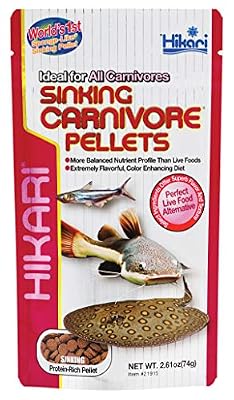
Hikari Sinking Carnivore Pellets
Specs
- Crude protein: 47% minimum
- Main ingredients: fish meal, krill meal, brewers dried yeast
- Form: hard sinking pellets, approximately 3.5 to 4.0 mm
- Sinking behavior: sinks rapidly, then absorbs water and softens while holding its shape
- Pack size: 2.61 oz (74 g)
Hikari developed these pellets for bottom-feeding carnivorous fish and names loaches and catfish among the intended species, which shows in the formula: at 47 percent protein built on fish meal and krill meal, this is the most protein-dense everyday pellet in this guide. The pellets drop quickly, then soften to a meaty texture that loaches can rasp pieces from instead of having to swallow whole.
Pros:
– Highest protein level here alongside the Massivore Delite
– Softens in water, so mid-sized loaches can graze a pellet down gradually
– Small pellets suit yoyo, zebra and dojo loaches straight from the bag
Cons:
– Too large for kuhli loaches and juveniles, which mostly ignore them
– Contains Red 3, an artificial color some keepers prefer to avoid
– The small bag runs out quickly in a tank with a group of hungry botias
Who it suits: Keepers of mid-sized botia loaches who want one dense, fast-sinking staple pellet.
Omega One Sinking Catfish Pellets with Shrimp

Specs
- Crude protein: 38% minimum
- Main ingredients: salmon, whole herring, whole shrimp
- Form: large sinking pellets, approximately 8 mm
- Sinking behavior: dense pellets that sink on contact in most tanks
- Pack size: 8.25 oz jar
Omega One builds this food on whole seafood rather than meals: salmon, whole herring and whole shrimp lead the ingredient list, with no fish meal at all. The guaranteed analysis is more modest than the Hikari pellets at 38 percent protein, but the protein comes from whole fish, and the formula is low in ash, which means less indigestible filler passing through the fish.
Pros:
– Whole salmon, herring and shrimp instead of generic fish meal
– Low ash content for a cleaner tank when fed as directed
– Natural color enhancers in the form of astaxanthin and canthaxanthin
Cons:
– At roughly 8 mm, the pellets are too big for small loaches and need breaking or pre-soaking
– Some jars produce pellets that float briefly before sinking, which frustrates community-tank feeding
– The preservative system includes ethoxyquin, BHA and BHT, which some keepers avoid on principle
Who it suits: Keepers of medium and large loaches who prioritise whole-fish ingredients over a headline protein number.
Repashy Community Plus

Specs
- Crude protein: 40%
- Main ingredients: whole krill meal, spirulina algae, black soldier fly larvae meal
- Form: gel premix powder, mixed with hot water and set before feeding
- Sinking behavior: cut cubes or strips sink immediately and stay stable in water for 24 hours or more
- Pack size: 6 oz jar of powder
Community Plus is a powder you mix with hot water and let set into a firm gel, then cut into cubes or smear onto wood and rock. The format is the point: the gel sinks straight down, holds together for a day or more, and lets shy and nocturnal loaches graze at their own pace instead of competing in a two-minute scramble. Krill meal leads the formula at 40 percent protein, and the same cube that feeds a group of kuhlis also works smeared thin for grazing hillstream loaches.
Pros:
– Grazing format suits shy, small and nocturnal species better than any dry pellet here
– Can be spread on hardscape for hillstream loaches or cut small for kuhlis
– No starch or gelatin binders, and leftovers hold together instead of clouding the water
Cons:
– Needs mixing, setting and refrigeration, so it is the highest-effort food in this guide
– The powder has a strong smell while mixing that some keepers dislike
– Some loaches take several offerings before they recognise the gel as food
Who it suits: Keepers of kuhli and hillstream loaches, and anyone whose loaches lose out at feeding time in a busy community tank.
Hikari Massivore Delite

Specs
- Crude protein: 47% minimum
- Main ingredients: fish meal, krill meal, brewers dried yeast
- Form: extra-large sinking pellets for big carnivorous fish
- Sinking behavior: sinks rapidly, absorbs water and softens while keeping its shape
- Pack size: 13.4 oz (380 g)
Massivore Delite is the Sinking Carnivore formula scaled up for genuinely large fish, and it earns its place here for one group: adult clown loaches and other big botias that treat standard pellets as crumbs. The protein level matches the smaller Hikari pellet at 47 percent, the pellets soften as they take on water, and Hikari positions each pellet as a substantial meal, so a few pellets feed a big loach rather than a scattering of small ones.
Pros:
– Pellet size finally matches adult clown loaches and large weather loaches
– High protein supports growth in big, active botias
– Softening texture lets large fish tear pieces off instead of gulping dry food
Cons:
– Far too large for kuhli, zebra and young loaches of any species
– Ash runs as high as 17 percent, the highest in this guide
– Very easy to overfeed, since a single pellet is a large meal and leftovers foul water fast
Who it suits: Keepers of adult clown loaches and other large bottom feeders in big tanks, and few others.
Sera Viformo Nature

Specs
- Crude protein: 37.3%
- Main ingredients: fish meal, sea algae, gammarus (4%), spirulina, krill
- Form: firm sinking tablets
- Sinking behavior: sink immediately and hold together while fish graze
- Pack size: 250 ml container
Sera’s Viformo Nature is a tablet food built for catfish and loaches, and its ingredient list reads like a loach’s natural menu: alongside fish meal it includes 4 percent gammarus, the freshwater shrimp that wild loaches hunt, plus sea algae, spirulina and krill. The tablets sink at once and stay firm, so a group can gather and rasp at one tablet over an extended feeding instead of chasing pellets around the tank. As part of Sera’s Nature line it is made without dyes and preservatives.
Pros:
– Gammarus content matches what loaches eat in the wild and draws a strong feeding response
– Firm tablets hold together for group grazing and are easy to portion by the half
– No dyes or preservatives in the formula
Cons:
– Lowest protein of the five, so it works better in a rotation than as the only staple
– Whole tablets are wide for small kuhli loaches and usually need breaking
– Contains milk powder and wheat flour, which are filler ingredients the other pellets here use less of
Who it suits: Keepers of mixed loach groups who want a dye-free tablet staple to rotate with a higher-protein pellet.
Comparison Table
| Product | Protein | Form | Size | Sinking behavior | Best for |
|---|---|---|---|---|---|
| Hikari Sinking Carnivore Pellets | 47% min | Hard pellets | 3.5 to 4.0 mm | Sinks fast, softens in place | Mid-sized botia loaches |
| Omega One Sinking Catfish Pellets with Shrimp | 38% min | Large pellets | About 8 mm | Sinks on contact | Medium and large loaches |
| Repashy Community Plus | 40% | Set gel cubes | Cut to size | Sinks at once, stable 24 hours | Kuhli and hillstream loaches |
| Hikari Massivore Delite | 47% min | Extra-large pellets | XL pellets | Sinks fast, softens in place | Adult clown loaches |
| Sera Viformo Nature | 37.3% | Firm tablets | Breakable tablets | Sinks at once, holds together | Mixed loach groups |
FAQ
How often should I feed my loaches?
Once or twice a day, in the evening where possible, offering only what the group finishes within a few hours for tablets and gels, or a few minutes for pellets. Loaches are built for steady grazing rather than one huge meal, and uneaten food left overnight is the most common cause of fouled water in loach tanks.
Can loaches live on algae and leftover flake food?
No. Common loaches such as clowns, yoyos and kuhlis are omnivores that need regular animal protein, and leftovers in a community tank are usually the plant-heavy fraction the faster fish rejected. Loaches kept on scraps alone typically lose weight slowly and become more prone to skin and parasite problems.
What size food do kuhli loaches need?
Small and soft. Kuhlis manage mini pellets around 1 to 2 mm, crumbled pieces of tablet, frozen daphnia and baby brine shrimp, and thin strips of set gel they can mouth and rasp. Any dry food over about 3 mm is effectively decoration to a kuhli until it breaks down.
Do hillstream loaches need a different food from other loaches?
Yes. Hillstream loaches are aufwuchs grazers that scrape biofilm and algae from rock and glass, so they need a mature tank with grazing surfaces plus algae-based foods and gel smeared on stones. The high-protein carnivore pellets that suit botia loaches should only be an occasional supplement for them, not the staple.
Conclusion
Feed loaches like the bottom-feeding hunters they are: a fast-sinking, animal-protein staple, sized to the species, delivered where the loaches actually live. For most community tanks the Hikari Sinking Carnivore Pellets are the simplest staple, with the Omega One pellets the pick for keepers who want whole-fish ingredients. Add Repashy Community Plus when small or shy species are losing out, step up to Massivore Delite only when your clown loaches are genuinely large, and keep Sera Viformo Nature in the rotation as the grazing tablet. Match the food to the fish in front of you, feed after the tank settles, and your loaches will hold condition instead of fading on leftovers.
Best Freshwater Shrimp Food: 5 Picks for Healthy Colonies
Best Aquarium Specimen Containers for Safe Fish Handling