Last Updated: October 4, 2026
Picking a fixture by wattage alone is why so many planted tanks stall. The best full spectrum aquarium light for plant growth is the one with verified PAR at leaf depth, a spectrum that drives photosynthesis, and coverage that matches your tank footprint rather than a bright box that only photographs well.
As an Amazon Associate we earn from qualifying purchases.
By David Nguyen
How to Choose a Full-Spectrum Plant Light
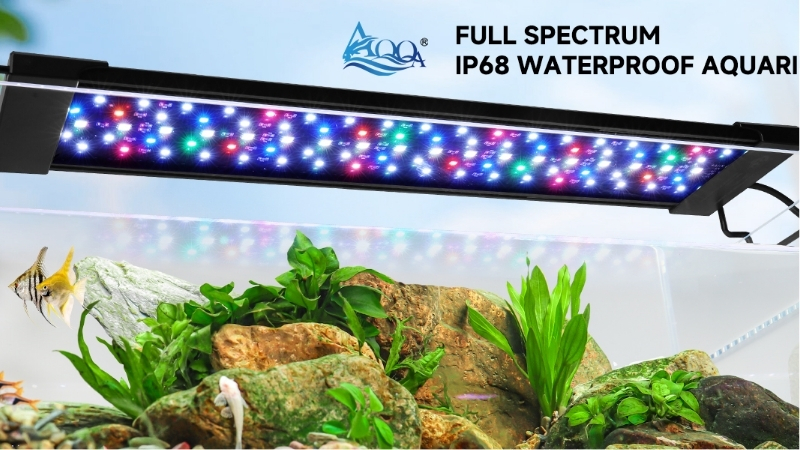
Full spectrum is a label, not a guarantee of growth. What separates a carpet-capable fixture from a display light is measurable photon delivery where the leaves sit, a spectrum that supports photosynthesis, and a housing sized to your tank. These four criteria keep the choice grounded in numbers you can verify.
PAR at Plant Depth
PAR is the photon count reaching the plant, and it falls fast with depth. The Fluval Plant 3.0 32W is rated 453 µmol/m²/s at 3 inches, 252 at 6 and 107 at 12 (Fluval, 2026), so a strong surface reading can fall to low-light levels at a tall tank’s substrate.
Match the number to your plants and depth. Low-light species like Anubias and Java fern are comfortable in the roughly 30–50 range many stock lights hit, while carpeting and stem plants often want higher usable PAR at depth. Any single PAR figure is meaningless without the distance it was measured at.
Spectrum Matters, But PAR Still Matters
Plants use mostly red and blue wavelengths, so a spectrum carrying both plus some green supports growth and color together. The Fluval mixes 3000K, 6500K and 15000K diodes with pink and 460/480nm channels across 168 LEDs (Fluval, 2026), a blend built for growth and viewing rather than one flat color temperature.
Spectrum shapes how plants look and fills gaps, but it does not replace intensity. A pleasing spectrum at too little PAR still starves demanding plants, so read spectrum and photon delivery together. RGB systems add tuning, though whether that beats a fixed blend for growth depends on how you set the channels.
Match Fixture Length to Tank
Coverage is a footprint, not just a length. The Fluval 3.0 32W fits 24–34 inch tanks (model 14521, Fluval 2026), while the Aqueon Planted Clip-On is rated for tanks up to 20 gallons. A fixture shorter than your tank leaves dim ends where plants thin, and the wrong width under-lights the front glass.
Buy for the tank you have, not the one you might upgrade to. A clip-on spotlight suits a nano or a plant corner; a full-length bar suits a planted display where even coverage matters. If your tank sits between sizes, size up in length and dim down rather than stretch a short fixture across.
Waterproofing and Mounting
Splash resistance and submersibility differ. The Fluval 3.0 carries an IP67 rating (Fluval, 2026), covering heavy splash and brief immersion, which is useful over open-top tanks and paludariums. A clip-on light instead relies on a clamp, so check that your rim thickness matches the bracket before buying.
Mounting affects both safety and PAR. Raising a fixture widens coverage but lowers intensity at the substrate, so a fixture on tall legs may need a higher setting to hit target PAR. Always run the cord with a drip loop and use a GFCI outlet near water.
Best Full-Spectrum Aquarium Lights for Plants
These four span a verified-output display bar to a budget clip-on. The picks are separated by what they deliver at depth and how they mount, not by which box looks brightest at the surface. Prices move constantly, so treat the ranges below as relative tiers rather than fixed figures.
| Product | Best For | Key Spec | Watch Out For |
|---|---|---|---|
| Fluval Plant 3.0 32W | Best overall | 107 PAR @12 in; IP67 | Premium tier; overkill for low-light nanos |
| Chihiros WRGB II | High-tech aquascapes | RGB, 3 app channels | Same-geometry PAR not published |
| Chihiros WRGB II Slim | Best value Chihiros | ~40–50% dimmer than WRGB II | Less headroom for deep tanks |
| Aqueon Planted Clip-On | Small planted tanks | 35 avg PAR @12 in, 16×16 in | Rated only up to 20 gal |
Fluval Plant 3.0 32W
The Fluval Plant 3.0 32W earns the top slot because its output is published by depth: 453 µmol/m²/s at 3 inches, 252 at 6 and 107 at 12 (Fluval, 2026). That verified curve, plus a 2,350-lumen rating and a 168-LED array, makes it the clearest match for the PAR-at-depth axis this search is about.
It fits 24–34 inch tanks and carries an IP67 rating, so it suits open-top planted displays. Expect a premium price, around $200 and up depending on retailer as of 09/2026, and note it is more light than a low-light nano needs. For a mid-to-tall planted tank, it is the safest overall call here.
Chihiros WRGB II
The Chihiros WRGB II runs three individually adjustable RGB channels through an app (Chihiros, 2026), which is why it suits high-tech aquascapes where you want to dial color and simulate a sunrise. Pricing sits around $225 on the official site as of 09/2026, length-dependent, placing it in the premium tier.
The tuning is real, but one catch matters here: Chihiros does not publish PAR under the same test geometry as Fluval, so its output is not directly comparable on the axis buyers care about. Choose it for control and aquascaping flexibility rather than a verified depth number, and set channels conservatively to limit algae.
Chihiros WRGB II Slim
The WRGB II Slim is the lower-cost way into the Chihiros ecosystem, with the Slim 30 around $150 on the official site as of 09/2026. It keeps the RGB tuning and app control that make the line appealing for planted tanks wanting adjustable color without the full premium spend of the standard model.
The trade-off is intensity: Chihiros rates the Slim roughly 40–50% dimmer than the standard WRGB II (Chihiros, 2026). That is fine for low-to-medium light plants in shallower tanks, but it leaves less headroom for carpeting species at depth. Treat it as a value planted light, not a high-output fixture.
Aqueon Planted Clip-On
For a nano or a plant corner, the Aqueon Planted Clip-On is the practical choice. It uses 60 planted-spectrum LEDs, is rated up to 20 gallons, and gives average PAR of 35 µmol/m²/s, peaking at 63 at 12 inches over a 16×16 inch area (Aqueon manual). It runs around $50 at Petco as of 09/2026.
That output suits low-light plants and small setups, and the clamp mounts in seconds. The limits are honest: it is a spotlight, not a full-length bar, so coverage narrows over wider tanks, and 35 average PAR at a foot is not enough for demanding carpets. Within its 20-gallon lane, it is a strong budget pick.
Frequently Asked Questions
A few questions come up on nearly every planted-light purchase, usually around PAR targets, whether wattage tells you anything useful, and how waterproof ratings translate to a real tank. Here are the short answers first, followed by the practical exceptions that tend to change the call.
How much PAR do aquarium plants need?
It depends on the plants. Many low-light species do well from roughly 30–50 µmol/m²/s at the leaf, while medium plants want more and carpeting or stem plants push higher, especially at depth. Because a fixture can read 107 at 12 inches but far more near the surface, always target PAR where the leaves sit.
Push intensity too high without CO2 and nutrients and algae usually wins before the plants do. A common approach is to start moderate, watch plant and algae response over a few weeks, then raise the photoperiod or setting gradually instead of running maximum output from day one.
Is wattage useful to compare lights?
Wattage tells you electrical draw, not growth. Two 32-watt fixtures can deliver very different PAR depending on diode efficiency, optics and spectrum, so comparing lights by watts alone misleads. The figure that matters for plants is measured photon delivery at a stated distance, which is why depth-specific PAR beats a wattage number.
Watts still help for budgeting running cost, calculated as wattage times hours of use, and for checking a fixture is not underpowered for its length. Use it as a secondary check rather than the deciding spec, and never read a higher wattage as automatically more plant growth.
Can IP67 lights be submerged?
IP67 means protection against dust and brief immersion in shallow water, so a fixture like the Fluval 3.0 handles heavy splash and short accidental dunks. It is not a licence to run the light underwater as a design choice, and continuous submersion sits in a different rating class entirely.
In practice, an IP67 bar is ideal over open-top and rimless tanks where condensation and splash are constant. Still route the cord with a drip loop and use a GFCI outlet, because water and mains electricity together demand that margin regardless of the ingress rating on the housing.
Is RGB automatically better for plant growth?
Not automatically. RGB systems like the Chihiros WRGB II let you tune color and simulate day cycles, which helps appearance and control, but growth still comes down to usable PAR and spectrum balance at the leaf. A fixed full-spectrum bar with strong verified output can outgrow an RGB light set to a weak profile.
Where RGB earns its keep is flexibility: you can boost reds and blues for growth or shift toward a display look for viewing. The risk is choosing a pretty but low-intensity profile that starves demanding plants, so if you buy RGB, tune for photosynthesis first and aesthetics second.
Final Thoughts
The best full spectrum aquarium light for plant growth is the one whose output you can verify at the depth your plants live, not the brightest claim. The Fluval Plant 3.0 leads on published PAR, the Chihiros line adds tuning, and the Aqueon covers small tanks on a budget. Match verified numbers to your tank.
As an Amazon Associate we earn from qualifying purchases at no extra cost to you. Prices and availability are accurate as of the date shown and are subject to change.
Best External Aquarium Temperature Controller: Top Picks
Best 10 Gallon Heater For Fish Tank 2026