Last Updated: October 21, 2026
For a reef, redundancy beats raw flow, so the best aquarium overflow box for saltwater tanks is chosen on its drain architecture and failsafe first, then your actual return flow, the display footprint it costs, and the real installation cost of getting it running.
As an Amazon Associate we earn from qualifying purchases.
By David Nguyen
How to Choose an Overflow Box for Saltwater Tanks
A saltwater build lives or dies on its drain design, so weigh redundancy before capacity. Rank the drain architecture and its failsafe first, then your actual delivered return flow, the footprint the box steals from the display, and the true cost of installing it properly.
Drain Architecture and Redundancy
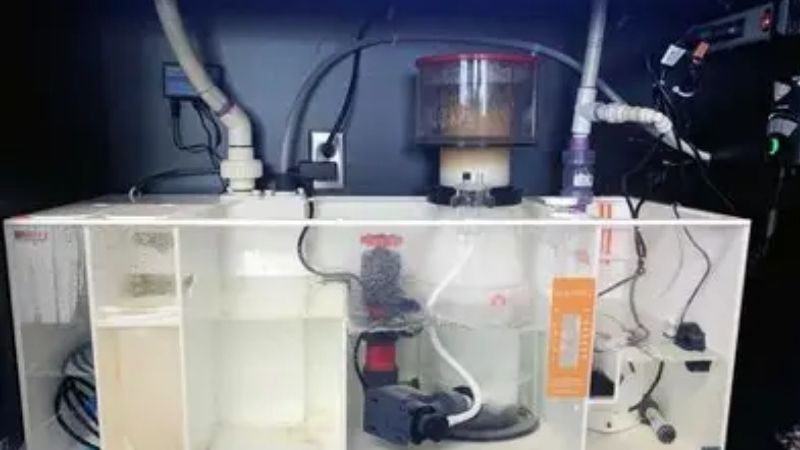
Redundancy is the trait that protects a reef from a flood. A Herbie design pairs a main siphon with an emergency drain, and a BeanAnimal adds a third line, so a single blocked pipe does not overflow the tank. The Fiji Cube EOF-8 and Eshopps Eclipse M both support dual-drain Herbie-style plumbing.
Match that architecture to your risk tolerance rather than a rating. The Xaqua INOUT takes a different, combined overflow-and-return approach, and the Prodigy M is a slim internal box, so confirm each design gives the emergency path a reef needs before you judge it on the headline GPH number.
Actual Return Flow
Size the box to your pump’s delivered flow after head, not its maximum rating. The Fiji EOF-8 and Eclipse M are rated 800 GPH, the Prodigy M up to 700, and the Xaqua up to 660 — a spread where 800 GPH is about 14.3% above 700 GPH using 700 as the base, a capacity gap rather than a verdict.
Read the other end and 660 GPH is about 17.5% below 800 using 800 as the base. These are capacity gaps, not performance verdicts, so pick the class that clears your real return flow with headroom and let drain design, not the biggest number, break the tie between them in the end.
Display Footprint
Footprint decides how much reef real estate the box consumes. The Prodigy M is an ultra-slim internal design at 8 by 0.625 by 6 inches, with an internal depth about 50% shallower than the roughly 1.25-inch wet side of the Eclipse M or Fiji — a depth difference, not a 50% smaller box overall.
The Fiji EOF-8 is a low-profile external overflow that keeps intrusion down while drilled through the back. Weigh how visible each unit is from the display, since on a reef the aquascape and coral placement compete directly with any box sitting inside the tank every day.
Installation Cost
Installation cost is more than the sticker. The drilled Fiji EOF-8 runs about $150 on sale, the Eclipse M near under $150, and the Prodigy M around $175 as of 09/2026, and all drilled boxes add a hole, bulkheads and plumbing to the total before the sump even runs.
The Xaqua INOUT at about $100 is cheaper up front but still requires drilling and works differently from a dedicated multi-drain overflow. Price the complete install — box, drilling, plumbing and any emergency line — rather than comparing stickers, since the drain scheme drives much of the real cost.
Top Picks
These four saltwater overflows are ranked by drain redundancy and display intrusion, not by the biggest GPH figure. Each lists verified specs, a relative price tier, and the drawback that matters most when a failed drain can put your entire reef and floor at genuine risk.
| Product | Best For | Key Spec | Watch Out For |
|---|---|---|---|
| Fiji Cube EOF-8 | Best overall | 800 GPH; dual-drain/Herbie-ready; low-profile | Rating is not required flow |
| Eshopps Eclipse M | Best for a tuned Herbie | 800 GPH; 2-drain Herbie-style | Quiet depends on tuning |
| Eshopps Prodigy M | Best for a slim footprint | Up to 700 GPH; 8×0.625×6 internal | Slim face is not flow sizing |
| Xaqua INOUT | Best for a combined unit | Up to 660 GPH; overflow + return | Different architecture; drilling |
Fiji Cube EOF-8
The Fiji Cube EOF-8 is the saltwater overall pick because it pairs a low-profile drilled external design with dual-drain, Herbie-suitable plumbing rated 800 GPH. For a reef that needs a real emergency drain and minimal display intrusion, that combination covers the priorities that actually matter most.
At about $150 on sale or under $200 regular as of 09/2026, it requires drilling and a sump below. Do not equate its 800-GPH capacity with required return flow; it is a ceiling, so size your pump to the reef and treat the extra headroom as insurance, not a target to hit.
Eshopps Eclipse M
The Eshopps Eclipse M is the tuned-Herbie alternative, a drilled 800-GPH box with a two-drain Herbie-style architecture and a roughly 8-by-1.25-by-6-inch wet side. For a reefer who will dial in a main-and-emergency drain, it delivers the same redundancy in a slightly different package.
At about $150 retail or under $200 from the maker as of 09/2026, its quiet, reliable performance depends on tuning and your return flow. Plan time to balance the siphon and emergency lines, since a Herbie only runs calm and safe once the two drains are properly set against each other.
Eshopps Prodigy M
The Eshopps Prodigy M is the slim-footprint pick, an ultra-thin internal box at 8 by 0.625 by 6 inches rated up to 700 GPH. On a reef where every inch of display counts, its internal depth roughly half that of the wet-side boxes keeps the overflow remarkably unobtrusive.
At about $175 retail or under $200 from the maker as of 09/2026, it is the priciest here, and a slim footprint does not replace flow sizing. Its shallower depth is a footprint advantage, not more capacity, so still size the return to your pump rather than to the thin profile itself.
Xaqua INOUT
The Xaqua INOUT is the combined-unit option, a drilled design rated up to 660 GPH that merges overflow and directional return in one part. For a reefer who wants fewer components to plumb, consolidating the two functions can simplify a saltwater build conceptually and physically.
Around $100 to under $100 currently as of 09/2026, it is the value entry but works differently from a dedicated multi-drain overflow, and it still requires drilling. Weigh whether its combined architecture gives your reef the emergency redundancy you want, since that is the real saltwater priority here.
Frequently Asked Questions
Reef keepers ask a consistent set of questions about a saltwater overflow, usually circling back to safety. Each answer opens with the practical call, then the condition that changes it, so you can weigh drain redundancy against footprint rather than chasing the largest flow number on offer.
What spec should decide this purchase?
Drain architecture and redundancy should decide it, because a reef flood is the failure that matters most. A Herbie or BeanAnimal design with a true emergency drain protects the tank, so choose the architecture your risk tolerance needs before you look at any GPH rating at all.
Once redundancy is settled, weigh return flow, footprint and install cost together. The right box clears your delivered flow with headroom, hides reasonably in the display, and prices out with its drilling and plumbing included, rather than winning on a headline capacity figure alone.
Which numbers are hard facts and which are heuristics?
The GPH ratings, dimensions and September 2026 prices are hard facts, and the capacity gaps — 800 GPH about 14.3% above 700 and 21.2% above 660 on their own bases — are arithmetic on those ratings. They describe ceilings, not tested performance under your own conditions.
The footprint comparison is a fact with a caveat: the Prodigy M is about 50% shallower in internal depth, not 50% smaller overall. Treat these as sizing aids and drain redundancy as a design judgment, since no rating captures how safely a given architecture actually fails.
Is the highest headline number always better?
No. An 800-GPH box does not protect a reef better than a 660 if the smaller one has the drain redundancy you need and your pump flow is modest. Ratings measured under ideal conditions do not translate directly to your plumbing, so capacity alone is a weak guide here.
Reef owners should buy the drain architecture they need, not the biggest GPH number. A well-plumbed dual-drain box sized to your real flow beats a larger unit without a proper emergency path, since redundancy, not raw capacity, is what stands between a reef and the floor.
When might the reader not need this?
If your saltwater tank is an all-in-one with adequate rear chambers and no external sump plan, you may not need an add-on overflow at all. A box exists only to feed a sump safely, so without that external plan the whole redundancy question is largely moot for the tank you are running.
An overflow becomes essential once a reef commits to a sump the display cannot house internally. At that point the drain architecture is not optional, so confirm the sump plan first and then buy the redundancy the reef genuinely requires rather than the flashiest capacity figure on the shelf.
Final Thoughts
The best aquarium overflow box for saltwater tanks is the one whose drain architecture fails safely and whose flow, footprint and install cost fit the build. Buy the redundancy your risk tolerance needs, size to delivered flow rather than the biggest rating, and price the drilling and plumbing before you commit.
Best Reef Light Controller and Wifi Dongle: How to Pick
Best LED Mounting Arm for Reef Lights: How to Choose It