Last Updated: September 25, 2026
Stopping a jumper starts with the mesh opening, not the brand. The best aquarium lid for jumping fish closes every gap smaller than your fish, since the effective escape limit is the largest opening — and a finer mesh is not simply twice as safe as a coarser one.
As an Amazon Associate we earn from qualifying purchases.
By David Nguyen
Quick answer: For most people in 2026, the best aquarium lid for jumping fish is the IM DIY SafeScreen — our #1 rated choice. See the full ranked comparison, alternatives and buying advice below.
How to Choose a Jump-Proof Lid
A jump-proof lid is judged by its smallest opening, its equipment gaps, its rim fit and how much light it keeps. The largest gap anywhere sets the escape limit, so mesh size and cutouts matter more than the label.
Start With Mesh Opening
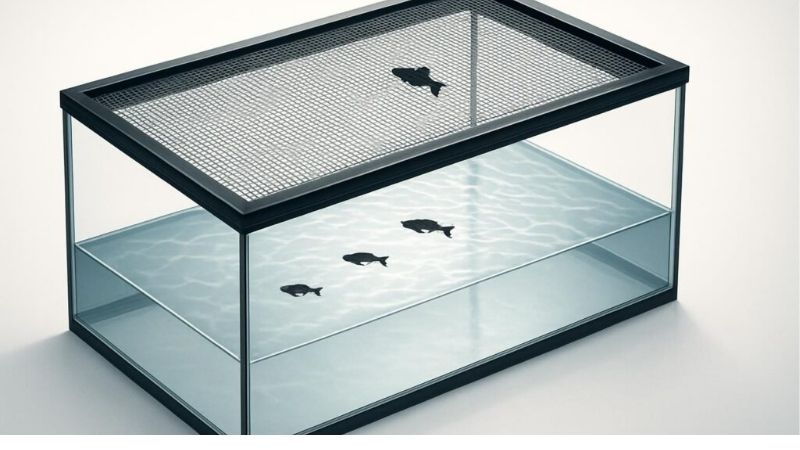
Begin with the mesh, matched to your smallest fish. The IM SafeScreen uses 1/4-in mesh, which suits most community fish, while very small species may slip through and need a finer 1/8-in option. Species like rasboras, killifish and gobies are notorious leapers, so match the mesh to your most determined jumper.
A 1/8-in mesh has half the linear opening of 1/4-in, but that is not twice as safe — it simply blocks smaller bodies. Size the mesh to your fish, since a 1/4-in gap is not safe for every species. The finer mesh costs a little light and a little more, but it is the only safe option for very small fish.
Eliminate Equipment Gaps
Fish escape through the biggest hole, often a cable gap. Filters, cords and overflow slots create openings, so the effective escape limit is the largest gap anywhere on the lid — not the mesh average. A determined fish will find a half-inch corner gap, so the weakest point sets the whole lid effectiveness.
Close cutouts around equipment with foam or a fitted piece. A perfect mesh with a two-inch cord gap is not jump-proof, so seal the equipment openings as carefully as you choose the mesh. Filter-outflow slots and heater cords are the usual culprits, so seal each one rather than trusting the mesh alone.
Match Rim Style
The lid must match your rim. The IM SafeScreen fits both rimmed and rimless tanks, while custom frames like ClearView and Kraken use a rigid polycarbonate frame that seats differently on the rim. Rimmed tanks give a plastic lip to clip onto, while rimless tanks need a frame that rests or fastens without one.
A rimless tank needs a frame that clips or rests securely without a plastic rim to grip. Confirm the lid is made for your rim style, since a mismatched frame leaves gaps a jumper will find. Check the frame edge profile against your glass thickness, since a loose fit leaves a perimeter gap fish exploit.
Light Transmission in Context
Mesh costs some light, but the numbers are product-specific. The D-D Jumpguard cites about 2.5% light reduction in its own test, which does not transfer to other mesh — different products use different transmission tests. For a reef or planted tank, choose the finest strand and largest open area your fish size allows to limit shading.
So treat any single light-loss figure as specific to that lid, not a mesh-wide rule. For most tanks the reduction is minor, but light-demanding corals may want the finest-strand mesh you can use for your fish size. Comparing a transmission percentage from one brand to a reduction figure from another is meaningless, since the tests differ.
Top Picks
Four lids span an affordable DIY screen to custom rigid frames, differing in mesh, frame and light loss, not a comparable escape test. The largest gap sets safety, so weigh mesh and cutouts. Prices are relative and shift over time.
| Product | Best For | Key Spec | Watch Out For |
|---|---|---|---|
| IM DIY SafeScreen | Best Overall | 1/4 mesh; 24×24-48×24; rimmed+rimless; ~$48 | Fine fish may need 1/8 |
| D-D Jumpguard | Best for low light loss | ~2.5% light reduction; ~$57 | Figure is product-specific |
| ClearView (custom) | Best premium custom | 3/8 polycarbonate; 1/8 or 1/4 mesh; ~$122 | Priciest; custom order |
| Kraken (custom) | Best for rigid frame | 3/8 frame; 1/4 mesh; ~$119 | Small-specimen warning |
IM SafeScreen
The IM DIY SafeScreen earns Best Overall as a versatile 1/4-in mesh kit in 24×24, 36×24 and 48×24 sizes for rimmed and rimless tanks, around $48 as of 09/2026 [Innovative Marine/BRS, 2026]. It covers most community setups affordably. At about $48 it is also the value pick, covering rimmed and rimless tanks from 24 to 48 inches wide.
Its 1/4-in mesh may let very small fish through, so pair it with a finer option for nano species. As a broad, tank-agnostic DIY screen, though, it is the easiest first pick for most jumpers. The kit trims to size, so one product adapts to most standard footprints without a custom order.
D-D Jumpguard
The D-D Jumpguard is the low-light-loss pick, citing about 2.5% light reduction in its own test, around $57 [BRS, 2026] for its 47.25 x 29.5-in frame. It suits owners worried about shading corals.
That 2.5% figure is product-specific, so do not apply it to other mesh. For a large tank where light matters, it is a strong choice, though you still size the mesh to your smallest fish. Its rigid aluminum frame also holds shape over a wide opening better than a soft screen that can sag. At about $57 the light-loss claim is its selling point, though you still size the mesh to your smallest fish.
ClearView
The ClearView is the premium custom option at about $122 base, a 3/8-in polycarbonate frame with a choice of 1/8-in or 1/4-in mesh and custom equipment cutouts. The custom fit closes gaps precisely.
The price and custom-order lead time are the tradeoffs. For a demanding or oddly sized tank where a stock screen leaves gaps, though, the tailored cutouts justify the cost. For an oddly shaped rimless tank, though, the tailored cutouts close gaps a stock screen would leave open. Its choice of 1/8-in or 1/4-in mesh also lets you match the opening to nano fish or larger community species.
Kraken
The Kraken is a rigid-frame option at about $119, a 3/8-in frame with 1/4-in mesh. Its structure holds shape over a large opening better than a soft screen. The polycarbonate frame suits a large open-top tank where a soft screen would bow under its own span.
Kraken warns that specimens around 1/4-in diameter or smaller may need finer mesh or a solid option, so heed that for nano fish. Choose it for the rigid frame on a large tank, matching mesh to your livestock. For nano fish and shrimp, step down to a 1/8-in mesh or a solid option rather than the stock 1/4-in.
Frequently Asked Questions
Jump-lid questions center on mesh size, gaps and light. Each answer opens with the verdict, then the practical caution for keeping fish in.
Is 1/4 enough?
For most community fish, yes — but not for everything. A 1/4-in mesh stops typical jumpers, while very small or slender species can slip through and need a finer 1/8-in mesh.
Size the mesh to your smallest fish, not the average. A 1/4-in gap is not safe for every species, so check your livestock before assuming it is enough. A single small tetra can slip a 1/4-in gap, so the smallest body in the tank sets the mesh you need.
1/8 available?
Yes. Finer 1/8-in mesh is available, including on custom frames like ClearView, for small fish that pass through 1/4-in. It has half the linear opening of 1/4-in.
Remember half the opening is not twice as safe, just smaller. Use 1/8-in when your fish are small enough to need it, since it also costs a little more light. It simply blocks smaller bodies, so choose 1/8-in for nano species and accept the modest extra light loss.
Do mesh lids block light?
A little, and the amount is product-specific. The D-D Jumpguard cites about 2.5% reduction in its own test, but that figure does not transfer to other mesh with different strands.
For most tanks the loss is minor. If you keep light-hungry corals, choose the finest-strand mesh compatible with your fish size rather than trusting a single percentage.
What about cable gap?
The cable gap is often the real escape route. The effective escape limit is the largest opening anywhere, so an unsealed cord slot defeats a perfect mesh.
Close cutouts with foam or a fitted piece around equipment. Sealing the gaps matters as much as the mesh, since fish find the biggest hole first. Rechecking the gaps after any equipment change keeps a new filter or cord from opening a fresh escape route.
Final Thoughts
The best aquarium lid for jumping fish is the one whose smallest opening — mesh and cutouts alike — is smaller than your fish. The IM SafeScreen leads as a versatile DIY screen, the D-D Jumpguard minimizes light loss, and ClearView and Kraken offer rigid custom frames. Size the mesh to your smallest species, seal every equipment gap, and treat light-loss figures as product-specific, since the largest gap sets safety.
As an Amazon Associate we earn from qualifying purchases at no extra cost to you. Prices and availability are accurate as of the date shown and are subject to change.
Ready to decide? Our #1 pick for 2026 is the IM DIY SafeScreen.
Live price & availability on Amazon.
Related Reviews & Guides
Best Aquarium Sump for Beginners: Top Expert Buying Guide

Quick Picks: Best Aquarium Sponge Filters for Small and…