Last Updated: October 4, 2026
The honest starting point is that no tank size guarantees fish are safe with a turtle. The best aquarium for turtle and fish together is first and foremost a proper adult-turtle habitat with basking, UVB and heat, because turtles may treat fish as prey, and a bigger tank does not remove that risk.
As an Amazon Associate we earn from qualifying purchases.
By David Nguyen
A Tank Cannot Remove the Compatibility Risk
This is a welfare-first topic, so the tank is chosen around the turtle’s needs and the predation risk, not around a promise of cohabitation. What matters is that turtles may eat fish, that you start at 40 gallons and size to the turtle, that basking, UVB and heat are essential, and that filtration must handle heavy waste.
Turtles May Eat Fish
The defining fact is that turtles may treat fish as prey, depending on species and age (PetMD). No aquarium size prevents this; a bigger tank gives fish more room to flee but does not stop a turtle hunting, so there is no verified best-overall tank for guaranteed safe cohabitation.
Because the risk is behavioral, plan for the likelihood that fish may be eaten and treat any fish as potentially expendable, or keep the turtle alone. Do not believe that a larger tank makes turtles and fish safe together; it changes the odds slightly at best, and the predation risk remains real throughout.
Start at 40 Gallons, Then Size to the Turtle
Aquatic turtles need a substantial habitat, with general guidance of a 40-gallon-plus starting minimum and a common rule of about 10 gallons per inch of turtle length (PetMD). Since adults can reach 5 to 12 inches depending on species, the tank must scale to the adult animal, not the hatchling.
Treat the 10-gallons-per-inch figure as a habitat-capacity rule of thumb, not a fish-safety guarantee, and never assume 40 gallons suits all aquatic turtles. A 6-inch turtle points toward roughly 60 gallons and a large adult far more, so size for the grown turtle from the start to avoid a cramped, unhealthy habitat.
Dry Basking Area, UVB and Heat
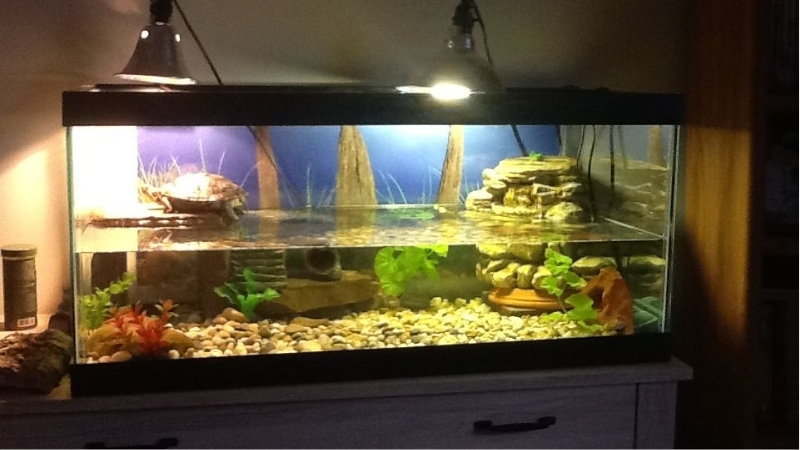
Aquatic turtles are not fish; they need to leave the water. A dry basking area, UVB lighting and a heat source are essential for their health, allowing them to dry off, thermoregulate and process calcium, none of which a fish tank provides by default. This hardware is non-negotiable for turtle welfare.
Plan the setup around a secure basking platform with UVB and heat above it, plus a water heater suited to the species. Skipping these causes serious health problems over time, so a turtle habitat is a more involved build than a fish tank, and the extra equipment is part of the true cost.
Filtration for High Waste
Turtles are messy, producing far more waste than fish of similar size, so filtration must be oversized. Plan for a filter rated well above the tank’s nominal volume to keep water quality manageable, since undersized filtration leads quickly to foul water that harms both the turtle and any fish present.
Robust filtration and frequent water changes are the norm for turtle keeping, not the exception. Budget for a filter with capacity to spare and a maintenance routine to match, because the high bioload is one of the biggest ongoing demands of housing an aquatic turtle properly.
Aquarium Size Classes for Turtles
These size classes are matched to turtle length, not to safe cohabitation, since no tank guarantees fish safety. Keeping turtle and fish apart is often the responsible choice. Confirm current pricing and a heavy-duty stand before buying, as filled turtle tanks are extremely heavy.
| Product | Best For | Key Spec | Watch Out For |
|---|---|---|---|
| Aqueon 40 Breeder | Juvenile minimum class | 36.375×18.25 in; ~455 lb | Outgrown by larger adults |
| Aqueon 75 | Medium larger habitat | 48.5×18.5 in; ~785 lb | Heavy; needs strong stand |
| Aqueon 125 | Large adult class | 72.5×18.5 in; ~1,400 lb | Price varies; verify current |
Aqueon 40 Breeder
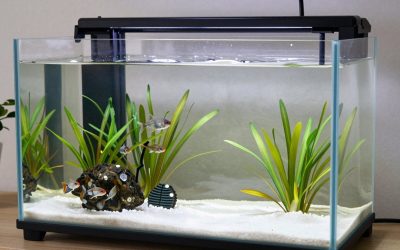
The Aqueon 40 Breeder meets the juvenile minimum class, a 36.375 by 18.25 by 16.94-inch tank at around $150 at Petco as of 09/2026 (Aqueon, 2026). It satisfies the general 40-gallon starting minimum for an aquatic turtle and offers a wide footprint for a basking setup above it.
It suits a juvenile or a small adult turtle, but larger species will outgrow it, so check your turtle’s adult size against the 10-gallons-per-inch rule. At about 455 pounds filled it needs a strong stand. As a starting habitat that meets the minimum, it is a sensible first turtle tank, sized to grow out of.
Aqueon 75
The Aqueon 75 is a medium larger habitat, a 48.5 by 18.5 by 21.125-inch tank showing about $160 on sale against a under-$350 regular price in a Petco snapshot as of 09/2026 (Aqueon, 2026). Its larger volume and floor suit a medium adult turtle, giving roughly 35% more base area than the 40 breeder.
That extra room better fits a growing or medium-sized turtle and gives any fish more space to flee, though it still does not guarantee their safety. It is heavy at about 785 pounds filled, so a robust stand is essential, and the sale price is temporary, so confirm the current figure before buying.
Aqueon 125
The Aqueon 125 is the large adult class, a 72.5 by 18.5 by 21.375-inch tank for a big adult turtle or a species that grows toward the top of the range (Aqueon, 2026). Its length suits a large turtle that needs substantial swimming room, following the 10-gallons-per-inch sizing upward.
A reliable current price was not verified, so confirm it before buying. At about 1,400 pounds filled it demands a heavy-duty, purpose-built stand and a strong floor. For a large adult turtle, this class of tank is what proper long-term housing looks like, with cohabitation still no safer than in smaller tanks.
Separate Tanks When Compatibility Is Uncertain
When you cannot be confident fish are safe, the responsible answer is separate tanks. Because turtles may prey on fish regardless of tank size, keeping the turtle in its own properly equipped habitat and any fish in a separate tank removes the risk entirely rather than gambling on it.
This is often the better choice for both animals, letting you optimize each habitat for its occupant. Rather than treating cohabitation as the goal, treat it as an uncertain arrangement that may fail, and default to separate setups when the fish’s safety cannot be reasonably assured.
Frequently Asked Questions
Turtle keepers ask the same things: whether a turtle will eat the fish, how big a tank a turtle needs, whether it needs basking and UVB, and whether any tank size makes cohabitation safe. Short answers first, then the caveats.
Will a turtle eat my fish?
It may. Turtles can treat fish as prey depending on species and age (PetMD), so there is always a risk, and many keepers find fish disappear over time. No tank arrangement reliably prevents a turtle from hunting, so plan for the possibility rather than assuming coexistence will work.
If you keep fish with a turtle, treat them as potentially expendable and choose fast, robust species at your own risk, or keep the turtle alone. The safest approach for the fish is a separate tank, since the predation instinct is behavioral and not something the setup can switch off.
How big a tank does a turtle need?
Start at 40 gallons and size up with the turtle, using roughly 10 gallons per inch of length as a guide (PetMD). Since adults reach 5 to 12 inches depending on species, a grown turtle can need 60, 80 or more gallons, so plan for the adult size rather than the hatchling.
Treat 40 gallons as a starting minimum, not a universal answer, since it does not suit all aquatic turtles long term. Check your species’ adult size and apply the per-inch rule to avoid a cramped habitat, remembering the figure is about habitat capacity, not fish safety.
Does a turtle need a basking area and UVB?
Yes, both are essential. Aquatic turtles must leave the water to dry off and thermoregulate, so a dry basking platform with UVB lighting and a heat source is required for their health, supporting shell condition and calcium processing that water alone cannot provide.
Build the habitat around a secure basking area under UVB and heat, plus a suitable water heater. These are core welfare requirements, not extras, and omitting them causes serious long-term health problems, which is part of why a turtle setup is more demanding than a fish-only tank.
Can any tank size make turtles and fish safe together?
No. A larger tank gives fish more room to escape but does not stop a turtle from hunting, so no size guarantees safe cohabitation. Believing a bigger tank prevents predation is a common and mistaken assumption; the risk is behavioral and persists regardless of volume.
When you cannot ensure the fish are safe, keep the turtle and fish in separate tanks, which removes the risk entirely. Optimize each habitat for its occupant rather than gambling on coexistence, and treat separate setups as the responsible default whenever compatibility is uncertain.
Final Thoughts
The best aquarium for turtle and fish together is really a proper adult-turtle habitat with basking, UVB, heat and oversized filtration, chosen with the clear understanding that no tank size stops a turtle eating fish. The 40 breeder meets the minimum, the 75 and 125 scale to larger turtles, and separate tanks are often the responsible choice. Put turtle welfare and the predation risk first.
As an Amazon Associate we earn from qualifying purchases at no extra cost to you. Prices and availability are accurate as of the date shown and are subject to change.

4 Best Aquarium Power Strips with GFCI Protection

Aquarium Breeding Mop Spawning Review