Last Updated: October 4, 2026
Finding the best aquarium chiller for axolotl tanks means solving a harder problem than tropical keepers face, because you pull water far below room temperature instead of nudging it. Husbandry guidance puts the target near 60 to 64F, which demands genuine capacity. Capacity, not marketing, decides that outcome.
As an Amazon Associate we earn from qualifying purchases.
As an Amazon Associate we earn from qualifying purchases at no extra cost to you. Prices and availability are accurate as of the date shown and are subject to change.
By David Nguyen
Quick answer: For most people in 2026, the best aquarium chiller for axolotl tanks is the Active Aqua AACH10HP — our #1 rated choice. See the full ranked comparison, alternatives and buying advice below.
How to Choose a Chiller for an Axolotl Tank
Cold-water species change the sizing math entirely. Instead of trimming a degree, the unit runs continuously through summer against a far larger room-to-water gap, so evaluate the temperature goal, the heat load, the required loop flow and your hot-weather margin. Each factor shifts the class you actually need.
The 60 to 64F Target Changes Everything
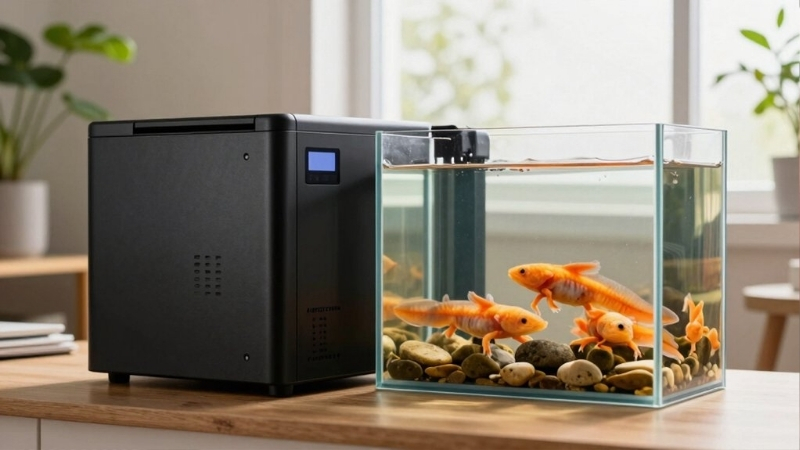
Common husbandry guidance places axolotls around 60 to 64F, or roughly 16 to 18C, a target range rather than a fixed setpoint. That sits far below typical household air, so the compressor removes heat continuously rather than cycling briefly like a reef chiller might. Continuous duty is normal for this species.
A wider gap between ambient and target means longer run times and higher summer power use than tropical systems experience. Watch the range instead of chasing one number, since stability matters more to amphibians than hitting an exact decimal reading on your thermometer. Track the range across a full week.
Calculate Real Heat Load
Volume alone will not size the chiller. The Active Aqua AACH10HP is rated for 10 to 40 gallons and delivers 1,020 BTU per hour, while the larger AACH25HP covers 40 to 92 gallons at 3,010 BTU per hour, and both ranges assume a particular heat load and ambient. Ratings assume conditions you may not have.
Lighting, pump heat and room conditions shift the answer substantially. An axolotl tank in a warm upstairs room with strong lighting behaves unlike the same volume in a cool basement, so measure the daily temperature rise before trusting any published gallon range on a box. Log the peak, not the daily average.
Match Required Loop Flow
Each chiller states the flow window its exchanger needs. The AACH10HP asks for 132 to 396 GPH, the AACH25HP wants 396 to 925 GPH, the JBJ Mini Arctica DBA-050 requires just 110 to 160 GPH, and the JBJ DBA-075 accepts a broad 240 to 960 GPH through its loop. Those windows differ by exchanger geometry.
Those windows describe exchanger design, not cooling strength, so narrow ranges aren’t weaknesses. Published pump GPH assumes zero head, so real delivery drops once water climbs through hose and fittings, so size the feed pump after head loss rather than from the box rating. Verify delivered flow at the chiller inlet.
Leave Margin for Hot Weather
Summer is when cold-water tanks fail, because ambient rises exactly when the chiller already works hardest. A 1/15 HP unit like the JBJ Mini Arctica may hold a small tank comfortably in spring and struggle through a heat wave in the same room without any equipment change. Spring performance predicts little about August.
Build margin instead of sizing for average conditions. Room air conditioning, a lid that allows evaporation and lower lighting all reduce load, often letting a smaller class hold target temperature while cutting the power bill through the hottest months of the year. Lower load usually beats bigger hardware.
Top Picks
These four span small to larger cold-water systems. Each lists manufacturer specifications, a relative price band as of 09/2026 and one genuine drawback, so you can match capacity to a measured heat load rather than guessing from the gallon figure printed on the carton. Confirm current pricing before ordering.
| Product | Best For | Key Spec | Watch Out For |
|---|---|---|---|
| Active Aqua AACH10HP | Best overall value | 10-40 gal; 1,020 BTU/h; 132-396 GPH | Gallon rating assumes a modest heat load |
| JBJ Mini Arctica DBA-050 | Best for small tanks | 1/15 HP; 110-160 GPH required flow | Least headroom during heat waves |
| JBJ DBA-075 | Best flow flexibility | 1/10 HP; 240-960 GPH required flow | Costs more than the Active Aqua 1/10 |
| Active Aqua AACH25HP | Best for larger setups | 40-92 gal; 3,010 BTU/h; 460W | Highest power draw in this group |
Active Aqua AACH10HP: Best Overall Value
The AACH10HP covers 10 to 40 gallons with 1,020 BTU per hour drawing 2.2 amps at 120 volts, listed at 190 watts. Its 132 to 396 GPH flow window is forgiving enough that most small circulation pumps can feed it, and it runs near under $500 as of 09/2026, the budget end here. Service parts remain readily available.
The 40-gallon ceiling assumes a modest heat load, so a brightly lit tank in a warm room may sit closer to the middle of that range in practice. Confirm your measured daily rise before relying on the top of the published span during the hottest stretch of summer. Published ceilings rarely survive heat waves.
JBJ Mini Arctica DBA-050: Best for Small Tanks
Rated at 1/15 HP with a required flow of only 110 to 160 GPH, the Mini Arctica suits compact axolotl setups where a full-size unit is overkill. That low flow requirement means a small pump feeds it easily, keeping the plumbing simple inside a tight cabinet or stand. Simple plumbing also means fewer leak points.
At roughly $600 as of 09/2026 it costs about 18.2% more than the Active Aqua AACH10HP despite less capacity, offering the least headroom in this group. In a room that swings warm during summer, that thin margin is exactly where cold-water keepers get caught out. Margin matters most for cold-water species.
JBJ DBA-075: Best Flow Flexibility
The DBA-075 moves to 1/10 HP and accepts a wide 240 to 960 GPH window, which makes pump selection far easier when your return or circulation pump is already chosen. That flexibility helps on setups where the same pump feeds filtration and the chiller loop together. One pump can serve both jobs cleanly.
At about $800 as of 09/2026 it runs roughly 54.8% above the Active Aqua AACH10HP, roughly $275 for a similar horsepower class. Compare the flow windows and parts availability carefully, because the premium buys plumbing flexibility rather than extra cooling capacity. Flexibility is the real purchase here.
Active Aqua AACH25HP: Best for Larger Setups
For a big axolotl system or a warm room, the AACH25HP covers 40 to 92 gallons with 3,010 BTU per hour, roughly triple the smaller model’s output. It draws 4.7 amps at 120 volts, listed at 460 watts, and requires a stronger 396 to 925 GPH feed through the loop. Stronger feed pumps raise install cost.
A bigger chiller brings higher running cost and more exhaust heat into the room, which matters inside a closed cabinet. At roughly $699 as of 09/2026 it sits about 41.2% above the AACH10HP, so choose it when measured load genuinely demands capacity, not as insurance. Ventilate any enclosed cabinet properly.
Frequently Asked Questions
Cold-water keepers ask four practical questions before buying: what temperature to target, whether the smaller class copes, how much loop flow the unit truly needs, and whether paying for extra capacity actually protects the animals during a genuine summer heat wave. Each answer rests on a measurement you can take.
What temperature should an axolotl tank hold?
Husbandry guidance points to roughly 60 to 64F, or 16 to 18C, as a target range rather than one fixed number. Stability inside that band generally matters more than hitting a precise reading, since repeated swings stress amphibians more than a steady value near either edge. Consistency protects amphibians best.
Verify with a calibrated thermometer away from the chiller return, since water near the outlet reads colder than the tank average. Also check your controller’s differential setting, since a wide hysteresis band can let temperature drift further than the display suggests. Calibrate the thermometer regularly.
Is a 1/10 HP chiller enough for 40 gallons?
Often it is, since the Active Aqua AACH10HP publishes a 10 to 40 gallon range with 1,020 BTU per hour, though that ceiling depends on heat load and room temperature. A cool basement tank sits comfortably inside the range while a warm room pushes the same volume past it. Conditions decide where you land.
Measure the daily rise across a full summer lighting cycle before committing. If the tank climbs several degrees each afternoon, treat 40 gallons as an optimistic ceiling and either reduce the heat load or step up a class rather than hoping the published rating holds. Repeat that check during peak heat.
How much flow does the loop need?
It depends entirely on the chiller model, so the spec sheet matters more than general advice. Required windows in this group run from 110 to 160 GPH on the JBJ Mini Arctica up to 396 to 925 GPH on the Active Aqua AACH25HP, reflecting very different exchanger designs. Read the spec for your exact unit.
Calculate delivered flow after head loss from lift, hose length and fittings, then trim with a valve if you overshoot. Running outside the stated window reduces efficiency at either end, so a pump rated well above the range still needs throttling into the published band. Valves cost far less than a second pump.
Is oversizing worth it for summer?
Extra capacity helps when your measured load is genuinely high, such as a warm upstairs room or large system. The AACH25HP delivers 3,010 BTU per hour against 1,020 on the AACH10HP, roughly triple the output, at about 41.2% more cost and considerably higher power draw. Power draw scales with that capacity.
Unused capacity still costs money and exhausts more heat into the room. Cheaper fixes often work first: cooling the room, reducing lighting hours or allowing surface evaporation can cut load enough that a smaller unit holds the target band through summer without strain. Fix the heat source before upsizing.
Final Thoughts
The best aquarium chiller for axolotl tanks is whichever unit holds roughly 60 to 64F against measured heat load with flow inside its published window. The Active Aqua AACH10HP near under $500 covers most small setups, while the AACH25HP buys real headroom for warm rooms. Measure the load, then choose the class.
Ready to decide? Our #1 pick for 2026 is the Active Aqua AACH10HP.
Live price & availability on Amazon.
Related Reviews & Guides
Best Pond Liner for the Money: Top Expert Picks Compared
Best Filter for 20 Gallon Aquarium Setups: Sized Properly