Last Updated: October 4, 2026
Quick answer: Our top pick in 2026 is the Open-cell aquarium sponge — our #1 rated choice. See the full ranked comparison, alternatives and buying advice below.
The Short Answer
Yes, ceramic filter rings are worth it if your aquarium filter has spare room for biological media and you want a reusable home for beneficial bacteria. They are not a magic upgrade, however: they will not replace regular water changes, remove debris by themselves, or rescue a filter that is too small for the tank.
For many freshwater and saltwater aquariums, ceramic rings are an inexpensive way to add biological filtration. A small bag often costs about $7, while larger packs commonly run from $10 to $25. The value is strongest when you already own a canister filter, hang-on-back filter, sump, or internal filter with a media compartment.
As an Amazon Associate we earn from qualifying purchases at no extra cost to you.

What You Actually Get
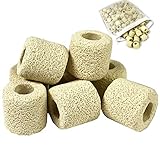
Ceramic filter rings are porous, tube-shaped pieces of fired ceramic. Most are roughly 1/2 to 1 inch long, although sizes vary by brand. The holes and surface texture give beneficial nitrifying bacteria places to attach. Those bacteria help process toxic ammonia into nitrite and then less-toxic nitrate as part of the aquarium nitrogen cycle.
A product such as Sukh Ceramic Rings includes 15 ounces of media divided into three bags and is listed for under $10. Reefing Art’s ceramic media is sold in 1-pound, 2-pound, 4-pound, and 8-pound sizes, with the 1-pound option listed for under $10. The amount you need depends more on the available space and the aquarium’s fish load than on the tank’s gallon rating alone.
The rings are normally placed after coarse mechanical filtration. Water should first pass through a sponge, floss pad, or other material that catches uneaten food, plant pieces, and solid waste. If debris reaches the ceramic media, the pores can become coated and the rings will be less useful as a bacteria-supporting surface.
They do not consume electricity, so the rings themselves have no wattage rating. The pump or filter does. The important question is whether your filter can move water through the media consistently. A quiet 5-watt filter with adequate flow may be more useful than a larger filter that is clogged or poorly maintained. Follow the filter manufacturer’s maximum media-fill guidance rather than packing the compartment tightly.
Pros
- Low purchase price. Basic ceramic rings can add biological media for approximately $7 to $25, depending on the amount and brand. That is modest compared with replacing a filter or buying specialty equipment.
- Reusable for a long time. Ceramic does not normally need to be replaced on a fixed monthly schedule. When the rings become dirty, they can be gently rinsed in removed aquarium water and returned to the filter.
- Helpful bacterial home. The ring shape and porous surface provide attachment points for nitrifying bacteria. This can make biological filtration more stable, especially in a properly cycled aquarium.
- Works with many filter types. Rings can fit in canister filters, sumps, media baskets, and some larger hang-on-back filters. Several small bags are also easier to distribute than one large block.
- Does not chemically alter the water. Standard ceramic rings are generally intended as inert biological media. They do not add medication, fragrance, or water-softening chemicals.
- Easy to scale. You can start with a small quantity and add more if the filter has room. This is useful when moving from a lightly stocked aquarium to a more heavily stocked one.
Cons
- They do not replace mechanical filtration. Ceramic rings will not polish cloudy water, catch fish waste, or remove floating particles as effectively as filter floss or a sponge.
- They are not a substitute for cycling. New rings do not instantly contain a mature bacterial colony. A new aquarium still needs an appropriate fishless cycling process, or established media transferred from a healthy system.
- Benefits depend on flow. If water bypasses the rings, or if the filter is severely clogged, the extra media may provide little practical improvement.
- They occupy valuable space. In a compact filter, replacing a useful sponge with rings can be a poor trade. Mechanical media and adequate circulation may matter more than adding biological media.
- Cleaning can remove bacteria. Rinsing the rings under chlorinated tap water or replacing all media at once can damage the established bacterial population. Use dechlorinated water, ideally water removed during an aquarium maintenance session.
- Quality and size vary. Some rings are very smooth, fragile, or inconsistent in size. Tiny pieces can be awkward to contain in a media bag, while very large rings may not fit a narrow filter basket.
- They cannot solve overstocking. Adding more ceramic media does not make it safe to keep too many fish, overfeed, or skip water changes. Nitrate still accumulates and must be managed.
Who Should Buy It
Ceramic rings are a sensible purchase for aquarium owners with unused media space and a filter that already has basic mechanical filtration. They are particularly useful for canister-filter owners, sump users, and people maintaining tanks with a moderate or heavy fish load.
They can also be worthwhile when setting up a replacement filter. Keeping some established ceramic media in the new filter may help preserve biological continuity, provided the old aquarium is healthy and the media is transferred without drying out. A media bag makes handling easier and keeps loose rings from shifting into the pump intake.
Buyers should match the quantity to the filter compartment. A 15-ounce bag may be plenty for a smaller hang-on-back filter, while a large canister or sump can accommodate 1 to 4 pounds or more. Do not buy an 8-pound package simply because more media sounds better; unused media sitting in a box contributes nothing to filtration.
Who Should Skip It
Skip ceramic rings if your filter has no dedicated media space or if adding them would require removing the only sponge. A good sponge provides both mechanical filtration and biological surface area, so it can be a better all-purpose choice in a small aquarium.
They are also unnecessary for a lightly stocked, established tank that already has adequate sponge, floss, or other biological media. There is no requirement to use ceramic rings specifically. If ammonia and nitrite remain at zero and maintenance is easy, adding another media type may only complicate cleaning.
New fishkeepers should not treat rings as an emergency product for an uncycled tank. Water testing, conservative stocking, regular partial water changes, and patience are more important. Likewise, saltwater aquariums with live rock, live sand, or a well-designed sump may already have substantial biological filtration.
Cheaper Alternatives
| Option | Cost | Trade-off |
|---|---|---|
| Open-cell aquarium sponge | About $5-$15 | Provides mechanical and biological filtration, but can occupy more space and may need frequent rinsing. |
| Filter floss or polyester pad | About $3-$10 per pack | Excellent for catching fine particles, but it clogs quickly and is usually disposable or difficult to clean thoroughly. |
| Lava rock in a media bag | About $5-$15 | Inexpensive biological media, but pieces can be sharp, dusty, irregularly sized, and harder to clean. |
| Plastic or foam bio-media blocks | About $5-$20 | Lightweight and reusable, but may have less usable surface area per inch than a porous ceramic product, depending on the design. |
| Existing filter sponge | $0 if already owned | Often the best value, but the filter may not have enough room or surface area for a heavily stocked aquarium. |
Prices vary by package size and retailer, but the important comparison is cost per usable filter compartment. Ceramic rings are not automatically cheaper than sponge, especially if you must also buy a media bag and replacement mechanical pads. Their advantage is that they are compact, durable, and easy to combine with other media.
FAQ
How many ceramic filter rings do I need?
Use enough to fill the filter’s intended biological-media area without restricting flow. For a small hang-on-back filter, a few ounces may be sufficient. Larger canister filters may use 1 to 4 pounds or more. The manufacturer’s media capacity is a better guide than a generic “one pound per gallon” rule, which does not account for fish size, feeding, plants, or existing media.
Should ceramic rings go before or after the sponge?
They should generally go after coarse mechanical media and before fine polishing media, if your filter layout allows it. The sponge catches larger debris first, helping keep the ceramic surface cleaner. Water should still flow evenly through the rings rather than around them.
How do you clean ceramic filter rings?
Swish them gently in a bucket of removed aquarium water. Do not scrub them until they look new, and do not rinse them under untreated tap water because chlorine or chloramine can harm beneficial bacteria. Clean only when flow is reduced or the media is visibly clogged. Never replace all established biological media at the same time unless you have a specific reason and a safe plan.
Do ceramic rings remove ammonia?
They do not chemically absorb ammonia in the way a specialized ammonia-removing product might. Instead, they provide a surface where bacteria can grow. Those bacteria process ammonia through the nitrogen cycle. New rings need time to become colonized, and they work only as part of a cycled aquarium with adequate oxygen, water movement, and routine maintenance.
Ready to decide? Our #1 pick for 2026 is the Open-cell aquarium sponge.
Live price & availability on Amazon.
Related Reviews & Guides



How to Control White Spot Disease (Ich) in Freshwater Aquariums
6 Best Fish Tank Wood Stands 2026