Last Updated: October 4, 2026
- Separate four ideas that are often bundled together
- Start with actual water volume
- Rated flow falls after installation
- Measure delivered flow carefully
- Map circulation inside the display
- Let livestock behavior set the ceiling
- Flow is not a substitute for media or maintenance
- A sizing workflow that survives real use
- When to escalate
Aquarium Filter Flow Rate: Size Without Chasing Turnover
Filter boxes advertise liters or gallons per hour, and aquarium advice often converts that number into “turnovers per hour.” The arithmetic is easy; the interpretation is not. Rated flow may be measured without dirty media, lift, bends, spray bars, prefilters, or the plumbing used on the aquarium. Livestock experience delivered circulation, not the number printed on a carton.
There is no defensible universal multiplier for every tank. A long river-fish aquarium, a planted betta display, a fry tank, and a messy cichlid system can share volume while needing very different velocity, intake protection, oxygenation, and media capacity. Size the system from functions and observations rather than chasing one ratio.
As an Amazon Associate we earn from qualifying purchases at no extra cost to you.

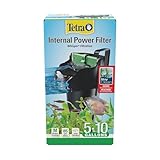


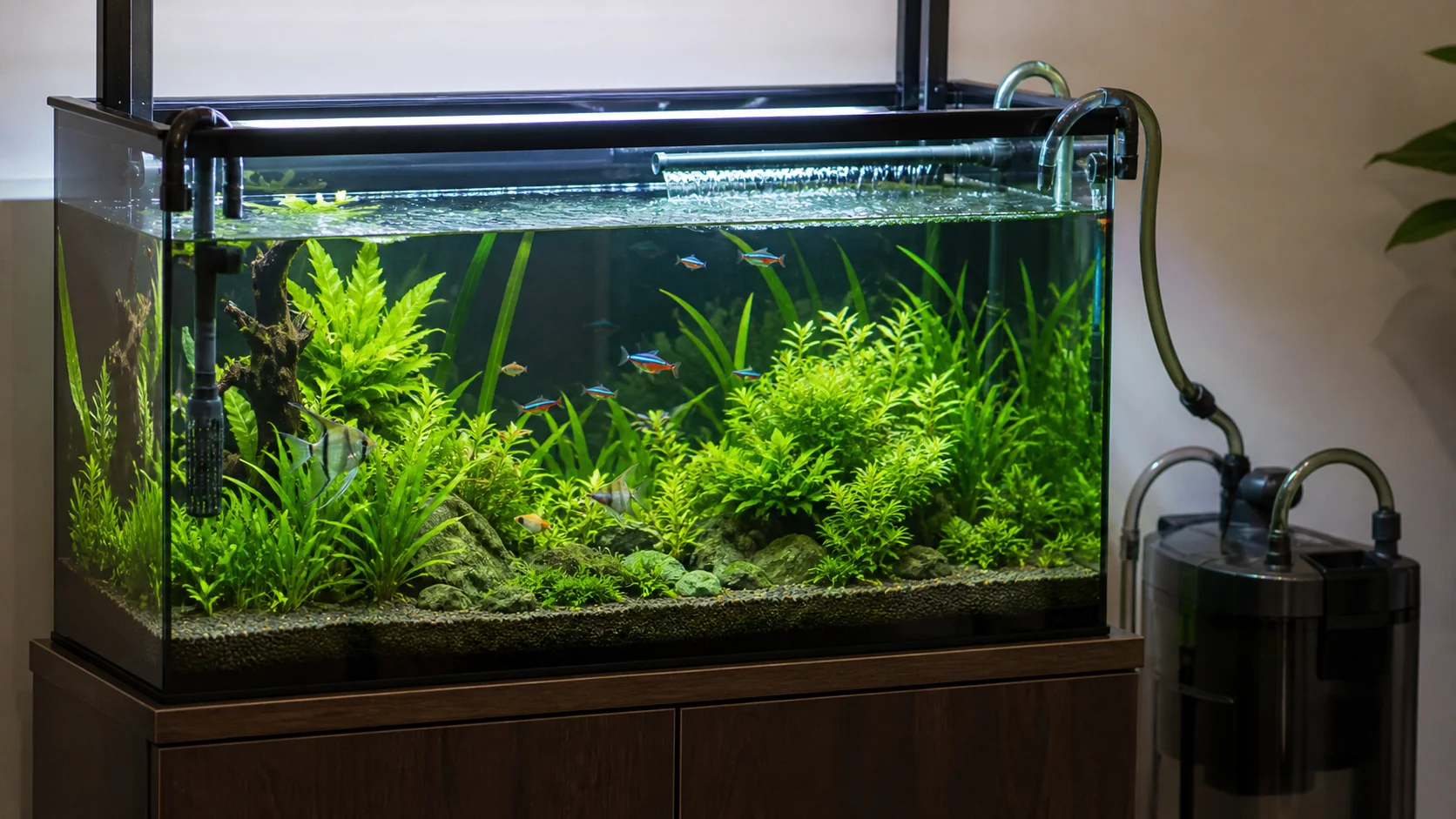
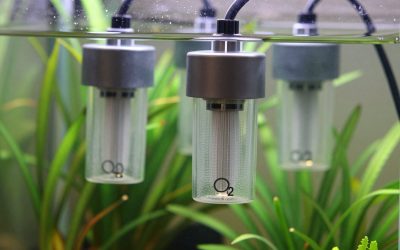
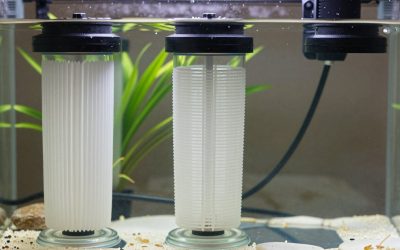
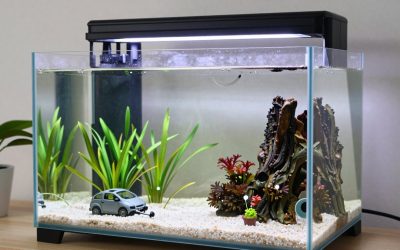
Editorial illustration; not evidence for species identification.
Separate four ideas that are often bundled together
Pump flow is water moved per unit time under stated test conditions. Filter throughput is water that actually passes through the installed media. Tank turnover divides a flow estimate by water volume. Circulation describes movement within the aquarium, including direction, velocity, surface agitation, and dead zones.
A system can show high nominal turnover while leaving debris behind rocks. It can also have adequate biological media yet create a jet that exhausts a slow-swimming fish. Filtration capacity depends on media, oxygen, microbial community, waste production, and maintenance—not flow alone.
The site’s filter selection guide compares functions and formats. The canister, HOB, and sponge comparison helps match those formats to practical layouts.
Start with actual water volume
The tank’s label usually describes external or nominal volume. Substrate, rock, wood, internal chambers, and an unfilled rim displace water, while a sump can add operating volume. Estimate actual water by recording measured fill volume during setup or using internal dimensions and subtracting displacement cautiously. State uncertainty rather than presenting a false exact figure.
Turnover can then be used as a descriptive calculation:
estimated turnover per hour = delivered flow per hour ÷ operating water volume
If 600 liters per hour is genuinely delivered through a 150-liter system, the descriptive result is four turnovers per hour. It does not prove that four is correct, that every corner moves, or that the fish are comfortable.
Rated flow falls after installation
Read the exact pump curve or filter manual. Manufacturers may state zero-head maximum flow, flow at particular head heights, or recommended tank ranges. Vertical lift, hose length and diameter, elbows, valves, spray bars, UV units, reactors, prefilter sponges, and packed media add resistance. As media collects debris, throughput commonly falls further.
Purdue Extension’s pump-system fundamentals explains head and system interactions in a general engineering context. It is not an aquarium sizing prescription, but it shows why one nameplate figure cannot describe every installation.
Never throttle a pump in a way its manufacturer prohibits. Some external pumps can be controlled on the discharge side; some designs require a controller; air-driven sponges behave differently. Restricting an inlet can cause cavitation or damage. Use only the manual’s approved adjustment method.
Measure delivered flow carefully
Where the design allows safe collection, time how long the return fills a known container during normal operation. Calculate volume divided by time and convert units. Repeat several times. This method may not suit a large return, divided outlets, or any setup where disconnecting plumbing risks flood, siphon, shock, or livestock harm.
Do not bypass safety interlocks, run pumps dry, or handle wet electrical connections. For a sump or complex installation, use manufacturer data or ask an experienced aquatic professional. Measuring one outlet also may omit bypass flow or multiple branches; document exactly what was measured.
Recheck after media cleaning and again before the next scheduled service. The difference shows the system’s normal decline and can help set maintenance timing. A flow meter rated for the plumbing may provide continuous data, but installation affects head and must follow its instructions.
Map circulation inside the display
Observe light plant movement and small food particles; they reveal direction better than a single flow number. Look behind hardscape, along the substrate, at the surface, and around heaters. Persistent debris pockets suggest low transport, though feeding location and animal digging also matter.
Aim for broad movement rather than a narrow high-speed jet. A spray bar, return angle, flow diffuser, or second gentle circulation source may distribute water more evenly. Protect intakes so small fish, shrimp, fry, long fins, and floating plants are not trapped. Guards reduce flow as they clog, so inspect them frequently.
Surface movement supports gas exchange, but violent splashing is not automatically superior. Floating plants and bubble-nesting or air-breathing fish need deliberate calm zones alongside open access. The RSPCA’s fish welfare guidance supports designing the environment around animal needs rather than equipment output.
Let livestock behavior set the ceiling
Species from swift habitats may benefit from high oxygen and directional flow, but captive care still needs resting zones. Slow-swimming, long-finned, juvenile, or ill fish may be pushed from food or forced to swim continuously by output that looks moderate to a person. Wild habitat descriptions are context, not permission to create a relentless captive jet.
Watch whether animals can hold position without constant effort, reach food, use the whole tank, and rest normally. Clamped fins, hiding only behind equipment, being pinned to an intake, or abandoning a normal zone warrants immediate adjustment and water-quality checks. Persistent distress or illness belongs with a qualified aquatic veterinarian; do not diagnose it as “too little turnover” from behavior alone.
Ornamental Aquatic Trade Association fish-keeper information provides an industry welfare baseline. Supplier claims should still be reconciled with species-specific evidence and actual observations.
Flow is not a substitute for media or maintenance
Mechanical media must intercept particles without clogging so rapidly that flow collapses. Biological media needs oxygenated water and protection from drying or harsh cleaning. Chemical media has specific purposes and exhaustion behavior. A faster pump cannot correct undersized media chambers or chronic overfeeding.
Service the filter when its performance and manufacturer schedule indicate, without sterilizing the biological community. The site’s guide to cleaning a filter without killing beneficial bacteria covers staged, aquarium-safe maintenance. Never wash established biological media in disinfectant, and avoid replacing all media at once unless the manufacturer and an urgent contamination response require it.
Monitor ammonia and nitrite, especially after installation, stocking changes, outages, medication, or major cleaning. Zero visible debris does not prove biological safety. Conversely, some settled mulm does not prove insufficient pump flow if water quality, livestock, and intended habitat remain healthy.
A sizing workflow that survives real use
First, define animals, waste load, intake vulnerability, and desired habitat. Second, calculate approximate operating water volume. Third, compare filter media capacity and manufacturer curves at the expected plumbing resistance. Fourth, plan broad circulation and quiet refuges. Fifth, install and observe animals, surface movement, temperature distribution, and debris patterns. Finally, measure or estimate delivered flow after the media has been operating, not only when pristine.
Build redundancy where a failure would rapidly threaten welfare. Two appropriately arranged filters may provide circulation from different directions and preserve some biological function during service. Redundancy is not permission to double unsafe velocity; outputs still need distribution and animal-safe guards.
If oxygen, flow, and filtration goals cannot all be met with one device, separate the functions. An air pump can provide aeration, a circulation pump can address a dead zone, and a filter can prioritize media contact—each selected and guarded for the inhabitants.
When to escalate
Ask the filter or pump manufacturer when curves, allowed throttling, head limits, or plumbing diameter are unclear. Use an aquatic professional for sumps, high-flow systems, unusual species, or measurements that would require unsafe disassembly. Any wet electrical problem goes to a licensed electrician.
The right aquarium filter flow rate is therefore a verified operating range, not a magic turnover target. It moves water through adequate media, maintains oxygen and temperature distribution, carries waste toward capture, and still lets every animal feed and rest. Measure the installed system, observe it as media loads, and adjust distribution before buying a larger number.
Sources
- Purdue Extension: Pumping Water for Irrigation
- RSPCA: Keeping fish as pets
- OATA: Fish-keeper useful information
- U.S. Geological Survey: Water science
Related Reviews & Guides

6 Best Marine Aquariums With Sump 2026
Best 32 Gallon Aquarium Kit: Best Proven Well-Researched Guide