Last Updated: September 25, 2026
AI Prime 16 HD vs Kessil A80 nano reef light pits a wide-coverage full-spectrum puck against a tiny, intense point source, so the right pick depends on your tank footprint and corals, not on the watts printed on the box. This comparison lines them up by PAR at depth, spectrum, and coverage to match the light to your nano.
As an Amazon Associate we earn from qualifying purchases.
As an Amazon Associate we earn from qualifying purchases at no extra cost to you. Prices and availability are accurate as of the date shown and are subject to change.

AquaIllumination AI Prime 16 HD LED App Controllable Saltwater Aquarium Reef Light - Black
Selected for "AI Prime 16 HD vs Kessil A80 Nano Reef Light Comparison": this listing is lighting (AquaIllumination AI Prime 16 HD LED App Controllable Saltwater Aquariu), matching the equipment this article covers.
View on Amazon
Kessil A160WE Controllable LED Aquarium Light, Tuna Blue
Selected for "AI Prime 16 HD vs Kessil A80 Nano Reef Light Comparison": this listing is lighting (Kessil A160WE Controllable LED Aquarium Light, Tuna Blue), matching the equipment this article covers.
View on AmazonBy David Nguyen
Quick answer: Our top pick in 2026 is the AI Prime 16 HD — our #1 rated choice. See the full ranked comparison, alternatives and buying advice below.
PAR at depth decides this light matchup
The AI Prime 16 HD vs Kessil A80 nano reef light choice comes down to how much usable light reaches your corals, not watts on a box. Set the light numbers before you choose.
The decision number: PAR at depth and coverage
PAR at the coral, measured in micromoles at your sand-bed depth, is the number that matters, along with the coverage footprint in inches and centimeters. Watts and lumens do not tell you what corals receive; a light that reads well at the surface can fall short 18 inches (46 cm) down.
The AI Prime 16 HD spreads a wider, full-spectrum output suited to covering a small tank, while the Kessil A80 is a tiny, dense point source that pushes intense light over a narrower footprint. Match coverage to your tank’s length and width first.
The criteria beyond raw output
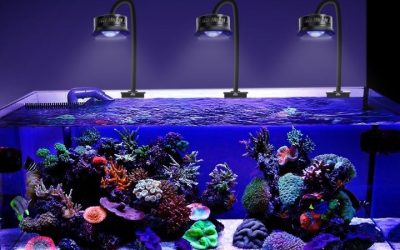
Weigh control and mounting. The AI Prime 16 HD offers app-based spectrum and scheduling and a rigid mount or hanging kit; the Kessil A80 uses simple onboard or external controllers and often a gooseneck. Consider shimmer too, since the Kessil’s point source gives dense, prized shimmer.
Tank size, placement, and fit
Coverage and mount height decide fit: one puck covers roughly a small nano footprint, and deeper tanks need more intensity. Measure your tank length, width, and depth, and the mount height you can achieve, before ordering, because a light that under-covers the footprint leaves dim corners no schedule can fix.
The two lights by need group
The AI Prime 16 HD vs Kessil A80 nano reef light decision is clearest matched to the kind of nano you run, so here is how each fits different needs. Confirm current PAR and coverage charts at purchase.
AI Prime 16 HD for a small mixed reef needing coverage
The AI Prime 16 HD covers a small mixed-reef footprint with full spectrum and enough PAR for many soft and LPS corals at nano depths. It fits keepers who want even coverage. Drawback: over a deep or larger tank, one puck spreads thin, so demanding SPS may need more or higher-output units.
AI Prime 16 HD for app control and spectrum
Its app-based scheduling and spectrum tuning suit keepers who like to program ramps and dial color. It fits hands-on hobbyists. Drawback: app-dependent control can be fiddly, and relying on an app and cloud features adds complexity a simple light avoids.
AI Prime 16 HD where it is not the pick
On a tiny pico or as a dense accent over a single coral, the wider puck is less ideal than a tight point source. Its spread is a strength on a footprint, not on a single focal colony.
Kessil A80 for a pico or tiny tank
The compact A80, around 15 watts, suits a pico or very small nano with intense, dense light over a narrow footprint. It fits tiny tanks and accents. Drawback: its coverage is limited, so over anything but a small footprint you get bright center and dim edges.
Kessil A80 for dense shimmer on a small footprint
The A80’s point source gives the prized dense shimmer many reefers love on a small display. It fits aesthetics-focused keepers. Drawback: onboard control is basic, so precise scheduling usually means adding an external controller at extra cost.
Kessil A80 where it is not the pick
Over a wider or deeper nano that needs even coverage, a single A80 leaves corners dark. It is a focal, small-footprint light, not a coverage light for a full small-reef footprint.
Choose AI Prime when, choose Kessil when
The AI Prime 16 HD vs Kessil A80 nano reef light verdict comes down to coverage versus point intensity, plus when neither fits.
When each light wins
Choose the AI Prime 16 HD for even coverage over a small mixed-reef footprint and app-based control. Choose the Kessil A80 for a pico or tiny tank, dense shimmer, and a compact point source, accepting its narrower coverage and simpler onboard control.
When neither is right
If your tank is a larger or deeper reef, one of either light under-covers it; you would want a bigger fixture or multiple units. Both are small-tank lights, so a growing reef may outgrow either quickly.
A cheaper or simpler alternative
For soft corals in a very small tank, a simpler full-spectrum nano light can be enough for less money. Match the light to your corals’ actual PAR needs rather than buying more intensity than low-light corals will use.
Operation, failures, and 12-month cost
The AI Prime 16 HD vs Kessil A80 nano reef light pair both run daily for years, so plan for LED wear and running cost on either.
Where reef LEDs wear
LED output slowly declines in PAR over years rather than failing outright, so corals get less light than day one. Drivers can fail, and humidity can corrode contacts and gooseneck fittings. A gradual coral response is your cue to check output with a meter.
Consumables, control, and coral acclimation
Neither uses consumable media, so running cost is mostly a modest wattage 24/7 and the occasional mount or controller. Ramp a new light up over 2 to 4 weeks rather than running full intensity day one, so corals acclimate; blasting new corals bleaches them, and no light setting is an instant fix.
Warranty, safety, and buying season
Check the warranty on the fixture and driver, and keep leads on a drip loop with a GFCI nearby. Reef lights are discounted hardest over Black Friday and Cyber Monday in late November and around Prime Day in late June; a sale is a good time to buy, but corals still need weeks to acclimate to new light. Prices and specs shift, so verify current PAR data at purchase.
Nano light questions, answered
These come up most about the AI Prime 16 HD vs Kessil A80 nano reef light choice.
Which covers more of my tank?
The AI Prime 16 HD spreads a wider footprint, so it covers a small mixed-reef better from one unit. The Kessil A80 is a tight point source, intense in the center but narrower, so it suits a pico or accent rather than an even spread.
Can either grow SPS corals?
On a shallow nano, both can support many corals, but demanding SPS at depth need high PAR that a single small unit may not deliver evenly. Check PAR at your sand depth, and consider more or higher-output units for an SPS-heavy nano.
Do I need a separate controller?
The AI Prime 16 HD has built-in app scheduling, so no. The Kessil A80 has basic onboard control, so precise ramps usually mean adding an external controller, which is an extra cost to factor into the comparison.
How high should I mount them?
Mount height trades coverage for intensity: higher spreads light wider but drops PAR at the sand. Start higher, measure PAR at depth, and lower gradually, ramping over 2 to 4 weeks so corals acclimate rather than getting blasted on day one. Mount height is a real variable in the AI Prime 16 HD vs Kessil A80 nano reef light choice.
Choosing between these two nano lights
The AI Prime 16 HD vs Kessil A80 nano reef light choice is coverage versus point intensity: the AI Prime 16 HD is the default for even coverage over a small mixed-reef footprint with app control, while the Kessil A80 is the pick for a pico, an accent, or keepers who prize dense shimmer. Measure your tank footprint and mount height, and check PAR at your sand depth before ordering, because coverage that misses the corners no schedule can fix. Verify current PAR and coverage data at purchase since specs and prices change.
| Option | Key number | Suitable tank | Recurring cost | Who it is for |
|---|---|---|---|---|
| AI Prime 16 HD | Wider coverage, full spectrum | Small mixed-reef footprint | Modest power; rare driver/mount | Even coverage, app control |
| AI Prime 16 HD (app) | Programmable spectrum and ramp | Nano mixed reef | Modest power | Hands-on schedulers |
| Kessil A80 | ~15 W intense point source | Pico or tiny nano | Modest power; optional controller | Accents, dense shimmer |
| Kessil A80 (controlled) | Dense shimmer, narrow coverage | Small-footprint display | Power; external controller | Aesthetics-focused keepers |
Ready to decide? Our #1 pick for 2026 is the AI Prime 16 HD.
Live price & availability on Amazon.
Related Reviews & Guides
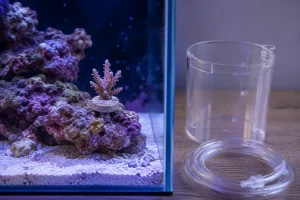
How to Acclimate Live Corals to Your Reef Tank
Best 75 Gallon Aquarium Kit for a Living Room: Top Compared