Last Updated: September 25, 2026
Activated carbon in aquarium filter baskets is one of the most misunderstood materials in the hobby, sold as a permanent fixture when it is really a short-term chemical tool. This guide covers what it adsorbs, what it does not touch, how quickly it saturates, and the situations where leaving it in causes genuine problems.
As an Amazon Associate we earn from qualifying purchases.
As an Amazon Associate we earn from qualifying purchases at no extra cost to you. Prices and availability are accurate as of the date shown and are subject to change.

Marineland Black Diamond Carbon Filter Media for Aquariums, 22 oz
Selected for "Activated Carbon in Aquarium Filter: When It Actually Helps": this listing is filtration (Marineland Black Diamond Carbon Filter Media for Aquariums, 22 oz), matching the equipment this article covers.
View on Amazon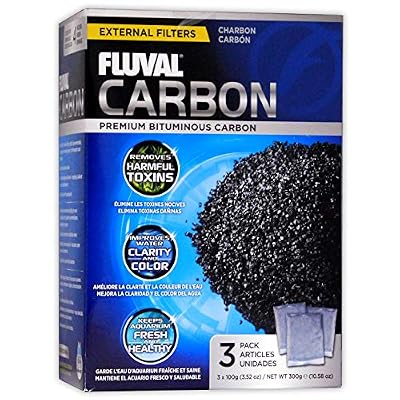
Fluval Carbon,100-gram Nylon Bags , Pack of 3
Selected for "Activated Carbon in Aquarium Filter: When It Actually Helps": this listing is aquarium equipment (Fluval Carbon,100-gram Nylon Bags , Pack of 3), matching the equipment this article covers.
View on Amazon
Fluval Spec/Evo/Flex Activated Carbon, 3-Pack, Black
Selected for "Activated Carbon in Aquarium Filter: When It Actually Helps": this listing is aquarium equipment (Fluval Spec/Evo/Flex Activated Carbon, 3-Pack, Black), matching the equipment this article covers.
View on Amazon
Marineland Black Diamond Carbon Filter Media For Aquariums, 40 oz
Selected for "Activated Carbon in Aquarium Filter: When It Actually Helps": this listing is filtration (Marineland Black Diamond Carbon Filter Media For Aquariums, 40 oz), matching the equipment this article covers.
View on AmazonBy David Nguyen
Quick answer: Our top pick in 2026 is the Tannins from new driftwood — our #1 rated choice. See the full ranked comparison, alternatives and buying advice below.
How It Works and the Numbers That Matter
Understanding activated carbon in aquarium filter systems means separating two very different jobs. Mechanical and biological media work continuously for years, whereas carbon is a consumable that saturates on a timescale of weeks and then sits in the basket doing nothing at all.
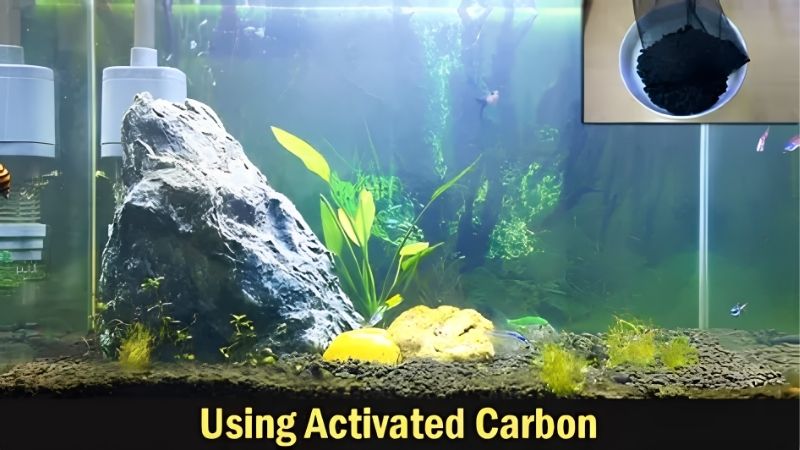
The decisive numbers behind carbon use
The first figure for activated carbon in aquarium filter use is working life. It is largely exhausted after roughly 3–4 weeks, and in a heavily stocked or newly planted tank it saturates sooner still. There is no visual signal for this, which is why replacement runs on a calendar rather than appearance.
Position is the second. Carbon belongs after the mechanical stage so it is not blinded by silt, and it should never displace biological media in a small chamber. In a hang-on-back basket of under 0.5 L, adding carbon usually means removing surface area that the bacterial colony was already using.
The third number is a hard rule rather than a range: carbon must be out of the filter for the entire duration of any medication course. It adsorbs many treatments efficiently, which leaves the tank dosed on paper and untreated in practice, and that wastes both time and money for no benefit.
The mechanism: adsorption, not filtration
Activated carbon works by adsorption, where dissolved molecules bind to an enormous internal pore network rather than being strained out of the water. The activation process creates that porosity, and the available binding sites are finite, which is exactly why saturation is inevitable.
What binds well is a specific list: dissolved organic compounds that yellow the water, tannins leached from driftwood, chlorine, many medications, and a range of odour-causing molecules. These are all relatively large organic molecules, and their removal is why clarity improves visibly.
What does not bind is equally specific. Ammonia, nitrite and nitrate are small ionic species that carbon does not meaningfully remove, so it contributes nothing to the nitrogen cycle. Products marketed for ammonia control rely on a separate resin blended in, not on the carbon itself.
Normal use against situations that require action
Routine use is optional. A well-maintained tank with regular water changes of 20–30 percent does not need carbon running permanently, and many long-established planted tanks run without it entirely while comfortably holding ammonia and nitrite at 0 ppm and nitrate below 20–40 ppm.
Specific situations justify it clearly: clearing tannins after adding driftwood, removing residual medication once a course finishes, dealing with an odour after an overfeeding incident, or polishing the water before photographs. Each of these is a defined job with a defined end point.
| Situation | What carbon does | Typical duration | What to do |
|---|---|---|---|
| Tannins from new driftwood | Adsorbs the colouring compounds | 2–4 weeks | Run it, then remove and discard |
| After a medication course | Strips residual treatment | Several days | Add fresh carbon once dosing ends |
| During a medication course | Removes the medication itself | Immediate | Take all carbon out beforehand |
| Ammonia or nitrite present | Nothing measurable | Not applicable | Water change and test, not carbon |
| Left in indefinitely | Nothing after saturation | Beyond 3–4 weeks | Replace with biological media |
What This Means for a Real Tank
The theory is constant, but the case for activated carbon in aquarium filter baskets changes sharply with chamber size and with what lives in the tank. A large canister can carry carbon at no real cost, whereas a small hang-on-back pays for it directly with lost biological capacity.
Tank size, placement and physical fit
Chamber volume decides whether carbon is free or expensive in practical terms. Hang-on-back units need 4–6 inches (10–15 cm) of clearance behind the tank and hold very little media, while canisters offer several litres and can dedicate one tray without touching the biological stage.
Weight sets the wider limits: a full tank runs near 10 lb per gallon (about 1 kg per L), so a 55 gallon (208 L) setup passes 600 lb (272 kg) and needs a purpose-built stand. Measure the internal cabinet height and the gap behind the tank with a tape measure before ordering any filter.
How the picture changes across 10, 20 and 55 gallon tanks
In a 10 gallon (38 L) tank holding perhaps 8 gallons (30 L) of water, the filter basket is small enough that a carbon pouch may occupy most of it. Here the honest advice is to skip routine carbon and use it only for a defined job, then return that space to sponge or rigid biological media.
A 55 gallon (208 L) tank with a canister has room to spare, so a carbon tray costs nothing biologically. The trade-off shifts to running cost and to remembering the replacement interval, since carbon left in place for months is simply occupying volume that could hold something useful.
Planted, shrimp and marine tanks each behave differently
In planted tanks the common worry is that carbon strips liquid fertiliser. It does adsorb some organic chelated compounds, though the effect is smaller than is often claimed, and dosing after a water change with the carbon removed sidesteps the question entirely without any need for argument.
Shrimp tanks have a different priority. Carbon is inert and safe, but the real hazard is copper, which appears in many medications and some fertilisers and harms invertebrates at very low concentrations. Running fresh carbon after any treatment is a sensible precaution in those particular tanks.
Marine and reef systems use carbon routinely to control yellowing, usually in a reactor with controlled flow. The accepted caution is to change it gradually rather than replacing a large volume at once, because a sudden jump in light transmission is a change corals experience abruptly.
Myths That Lead People Astray
Three claims about activated carbon in aquarium filter media circulate more or less constantly, and each of them pushes owners towards either unnecessary spending or a genuine mistake. Replacing them with the underlying mechanism makes the decision straightforward in almost every case.
The myth that carbon removes ammonia
Carbon does not meaningfully remove ammonia, nitrite or nitrate, and treating it as a safety net delays the response a tank actually needs. If ammonia reads above 0.25 ppm, the answer is a water change, reduced feeding and daily testing, not a fresh pouch dropped into the filter basket.
The confusion comes from blended products that combine carbon with an ammonia-binding resin, which is a different material with a different job. Read the composition on the back rather than the front of the packet, because the two behave nothing alike in a tank that is struggling.
The myth that exhausted carbon releases everything back
This belief keeps people replacing carbon anxiously and discarding filter contents unnecessarily. Saturated carbon holds what it has bound under normal aquarium conditions, and the practical consequence of leaving it in is simply that it stops working rather than that it dumps a payload.
The genuine reason to remove it is different and more mundane: it occupies chamber volume that biological media could use, and it can pack with silt and restrict flow. Both matter, and both are perfectly good reasons to take it out without invoking a release that does not actually occur.
The myth that carbon belongs in every filter permanently
This idea is largely a product of cartridge design, where carbon is bonded into a disposable frame and marketed as a monthly replacement. That format sells consumables and throws away colonised surface each time, which is a common cause of a mini-cycle in an otherwise mature tank.
A filter running loose media has no such requirement at all. Fill the chambers with coarse sponge and rigid biological media, then add carbon only when there is a specific job for it, and remove it when the job is done rather than treating it as a permanent stage in the flow path.
Long-Term Use, Costs and Maintenance
Treated as a tool rather than a fixture, activated carbon in aquarium filter systems is cheap and occasionally very useful. Treated as a subscription, it becomes one of the larger recurring costs in freshwater keeping while quietly reducing the tank’s biological capacity at the same time.
What to do periodically, and how often
If carbon is running, replace it every 3–4 weeks and discard the old material rather than rinsing it, since rinsing does not restore binding sites. Keep it downstream of the mechanical stage so silt does not blind it, and record the date it went in so the interval is not guesswork.
Around it, the usual routine continues: rinse mechanical media in siphoned tank water every 2–4 weeks, never under the tap, and change 20–30 percent of the water weekly with replacement water within 1–2 °F (about 1 °C) of the tank so the bacterial colony is never hit by a thermal swing as well.
What degrades, and how it shows
Carbon itself does not fail so much as fill, and the only reliable indicator is elapsed time. Around it, hardware wear reduces flow through the basket: impeller shafts groove and rattle, hoses grow a biofilm that narrows the bore, and lid gaskets harden and let air into the system.
A pouch left in for months eventually packs with fine sediment and becomes a flow restriction rather than a chemical stage. That shows as an outflow narrower than its clean baseline and in some cases as nitrate climbing steadily between water changes at an unchanged feeding rate.
The twelve month cost of running it
At roughly monthly replacement, carbon is a genuine recurring expense across a year, alongside floss, dechlorinator and an in-date liquid test kit. Loose granular carbon in a reusable bag costs considerably less than bonded cartridges, and prices move constantly, so check when buying.
Seasonal patterns shape the demand for it. Late December brings a wave of gifted tanks and driftwood-heavy aquascapes, and the tannin staining that follows in January is the single most common reason a first-time keeper reaches for carbon, often before the tank has finished cycling.
Frequently Asked Questions
These questions tend to arrive once the material is properly understood as a consumable with a defined job, because most disagreement about activated carbon in aquarium filter baskets comes from treating a temporary chemical stage as though it were permanent biological equipment.
Do I need carbon in my filter at all?
Not routinely, no. A tank with regular water changes and adequate biological media runs perfectly well without any carbon at all. Keep some on hand for specific jobs such as clearing tannins or stripping out residual medication, and use the chamber space for biological media the rest of the time.
How do I know when carbon is exhausted?
There is no visual test available, so use elapsed time instead. Assume roughly 3–4 weeks of useful life in a typical freshwater tank, and rather less in heavily stocked systems. Write the installation date somewhere visible, because the material looks identical on day one and day ninety.
Can carbon be rinsed and reused?
No. Rinsing removes surface dust but does not free the internal binding sites, so the material is not regenerated in any practical sense. Aquarium carbon should be replaced rather than cleaned, which is one more reason that buying it loose rather than bonded into cartridges makes sense.
Does carbon harm beneficial bacteria?
Not directly, since bacteria colonise its surface as they colonise anything else in the flow path. The indirect harm comes from replacing it, because discarding a pouch every month removes whatever colony has grown on it, which matters most in small filters with little other media.
Should carbon be removed before a water change?
No, ordinary water changes are unaffected. The important removal is before any medication is added, and it should come out for the entire course, with fresh carbon added afterwards to strip out residual treatment once the dosing has finished and the tank is being returned to normal.
See More:
Conclusion
Used correctly, activated carbon in aquarium filter baskets is a short-term chemical tool with three clear applications: clearing tannins, polishing dissolved organics, and stripping medication once a course has ended. It saturates in roughly 3–4 weeks and does nothing thereafter.
It never removes ammonia, nitrite or nitrate, and it must be out of the filter throughout any treatment. Where chamber space is tight, biological media earns that volume far more reliably, so add carbon deliberately for a defined job and take it out again when the job is finished.
Ready to decide? Our #1 pick for 2026 is the Tannins from new driftwood.
Live price & availability on Amazon.
Related Reviews & Guides



Best Aquarium Rack for a Small Apartment: Smart Top Picks
Best Licensed Aquarium Ornaments SpongeBob: Proven Top Picks