Last Updated: October 4, 2026
- Decide These 3 Things First
- Match Filter Size to the Tank and Bioload
- Prioritize Media Capacity and Useful Media Materials
- Examine Construction, Seals, and Hose Design
- Evaluate Performance, Noise, and Flow Control
- Set a Sensible Price Tier
- Compare Warranty and Replacement-Part Support
- Plan Delivery, Assembly, and Maintenance Access
- Spec Checklist
- Red Flags
- FAQ
- Top Pick: AQUANEAT 16 pcs Replacement Canister Filter Pads Compatible with AMOSIJOY/PONDFORSE 172/225/265GPH Aquarium Filter Media Generic Floss
- Best Value: Fluval 207 Perfomance Canister Filter for Aquariums up to 45 Gallons
- Premium Choice: PONDFORSE Canister Filter, External Aquarium Filter Ultra-Quiet with Media
Canister filters are often bought by headline rating alone: “up to 45 gallons,” “ultra-quiet,” or a large gallons-per-hour number. That is how buyers end up with a filter that is undersized once media is installed, difficult to service, or too powerful for a low-flow aquarium. Another common mistake is treating the filter as a complete solution. A canister filter can provide excellent mechanical, biological, and chemical filtration, but it still needs appropriately sized intake protection, regular maintenance, and a flow pattern that reaches the whole tank.
In 2026, the best canister filter is not necessarily the biggest or most expensive model. It is the one with enough real-world flow for the aquarium, practical media capacity, dependable seals, and a maintenance routine you will actually keep up with.
As an Amazon Associate we earn from qualifying purchases at no extra cost to you.



Decide These 3 Things First
- Know the aquarium’s actual water volume and livestock. Measure tank length, width, and water height rather than relying only on the advertised gallon size. A planted 40-gallon community aquarium has very different filtration needs from a heavily stocked 40-gallon cichlid tank or goldfish setup.
- Choose a realistic turnover target. For many freshwater community tanks, aim for roughly 4 to 6 times the aquarium’s water volume per hour after media, hoses, and lift height reduce flow. A 45-gallon tank usually benefits from approximately 180 to 270 gallons per hour of usable circulation. Messier fish, reef systems, and high-oxygen setups may need more total movement, often supplemented by a circulation pump rather than relying on filter output alone.
- Check the cabinet before buying. Measure the interior height, width, and depth, plus the distance from the cabinet floor to the aquarium rim. Leave at least 2 to 3 inches around the filter for hose bends and hand access. A filter that technically fits but cannot be lifted out for cleaning is a frustrating purchase.
Match Filter Size to the Tank and Bioload
Manufacturer aquarium ratings are a starting point, not a final answer. Flow ratings are generally measured under favorable conditions before the filter fills with sponges, ceramic media, carbon, and debris. Once installed beneath a stand, a canister’s practical output will be lower.
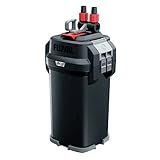
For tanks under 30 gallons, a compact canister rated around 100 to 160 GPH can work well if the livestock does not require especially gentle flow. For 30- to 55-gallon freshwater tanks, look in the 180 to 300 GPH class. The Fluval 207, rated for aquariums up to 45 gallons, is the type of mid-size format that suits a standard community tank when stocked reasonably.
For 55- to 90-gallon aquariums, filters in the 300 to 450 GPH range are common. Larger systems, especially 125 gallons and above, may call for 500 GPH or more, multiple filters, or a filter plus powerheads. The Fluval FX6 is designed for very large aquariums and is marketed for tanks up to 400 gallons, but its physical size and strong output make it a poor fit for a lightly stocked 55-gallon setup.
Also account for fish behavior. Betta fish, dwarf seahorses, and some slow-swimming species need diffused output. Goldfish, large cichlids, and plecos create substantial solid waste and benefit from larger media baskets and easy-to-clean prefiltration.
Prioritize Media Capacity and Useful Media Materials
A canister filter’s advantage is media volume. Look beyond the number of trays and inspect what fits inside them. Three baskets holding 0.5 liter each are not equivalent to three baskets holding 1.5 liters each. For a 40- to 55-gallon aquarium, roughly 2 to 4 liters of total media space is a useful baseline; larger 75- to 125-gallon filters often offer 5 to 10 liters or more.
Plan media in layers:
- Mechanical media: coarse foam first, followed by medium or fine foam and polishing floss. Coarse foam catches larger debris and protects finer material from clogging too quickly.
- Biological media: porous ceramic rings, sintered glass, or similar durable media provides surface area for beneficial bacteria. This should occupy the largest share of the basket space in most established tanks.
- Chemical media: activated carbon, resin, phosphate-removing media, or specialty media should be used when there is a clear purpose. It is not automatically necessary in every freshwater aquarium.
Check whether replacement pads are proprietary. Generic cut-to-fit floss can be economical; for example, replacement pad packs may cost around $15 for 16 pieces. However, proprietary shaped foam, cartridges, and specialty baskets can raise long-term ownership costs. A filter that accepts standard bulk foam sheets and loose biological media gives you more flexibility.
Examine Construction, Seals, and Hose Design
A canister filter should feel stable when full of water. Expect many mid-size units to weigh 8 to 15 pounds empty and 15 to 25 pounds when filled with media and water. Large models can exceed 20 pounds empty and 40 pounds in service. A broad base, sturdy handle, and thick lid latches matter because the unit will be moved repeatedly for maintenance.
Look for a watertight head with a replaceable gasket or O-ring. The gasket should be accessible, not permanently buried in a complicated housing. Lubricating it lightly with aquarium-safe silicone grease during maintenance can help prevent dry seals and air leaks. Avoid filters with thin, loose-fitting latches or lids that flex noticeably when closed.
Hoses deserve just as much attention as the canister. Typical tubing diameters range from about 1/2 inch to 1 inch, depending on filter size. Wider tubing supports higher flow but needs more room behind the aquarium. Quick-disconnect valves are valuable: they let you shut off water, detach the canister, and carry it to a sink without draining the hoses. Make sure valves lock positively and are not difficult to reach inside your cabinet.
Evaluate Performance, Noise, and Flow Control
Wattage affects operating cost and heat, though it is not a direct measure of filtration quality. Compact canisters often use about 8 to 15 watts; mid-size models commonly use 15 to 25 watts; large high-flow filters may use 30 to 50 watts or more. At 20 watts running continuously, electricity use is about 14.4 kWh per month. Check local utility rates to estimate the actual cost.
Quiet operation depends more on setup than marketing language. A properly primed canister should produce a low motor hum, while persistent rattling, gurgling, or splashing usually signals trapped air, a dirty impeller, a loose intake connection, or water level that is too low. Place the filter on a firm cabinet floor, not directly against a resonant side panel. A thin dense foam pad beneath it can reduce vibration, provided it does not interfere with ventilation or stability.
Choose adjustable output if the tank houses delicate plants or slow-moving fish. An adjustable valve is useful, but avoid reducing flow excessively for long periods; it can make the filter work harder and reduce circulation. A spray bar, directional nozzle, or lily pipe can often soften current more effectively.
Set a Sensible Price Tier
Budget canister filters: roughly $60 to $110. These can be appealing for a 20- to 55-gallon aquarium, particularly when they include hoses, baskets, and starter media. A model such as the PONDFORSE canister filter around $72 is within this category. Expect to inspect seals carefully, confirm replacement-part availability, and potentially upgrade included media.
Mid-range filters: roughly $120 to $230. This is often the best value range for most 30- to 75-gallon freshwater aquariums. You are more likely to get better priming systems, stronger valves, clearer instructions, readily available replacement parts, and more refined noise control. A Fluval 207 at about $150 is an example of this price level.
Premium and large-capacity filters: roughly $250 to $500 or more. These are justified for large aquariums, high-bioload fish, buyers who value serviceability, or anyone who needs substantial media capacity. The approximately $407 Fluval FX6 sits in this category. Do not pay premium pricing solely for a high maximum aquarium rating; verify basket volume, cabinet fit, wattage, and maintenance access.
Compare Warranty and Replacement-Part Support
A warranty of 1 to 3 years is common, while some better-supported brands offer longer coverage on selected components. Read what is excluded. Wear items such as impellers, O-rings, hoses, and media baskets may have different coverage from the motor head.
More important than the headline warranty is whether you can buy parts individually. Before purchasing, check for replacement impellers, impeller shafts, gasket rings, intake strainers, hose adapters, valve assemblies, and media baskets. A $12 to $25 replacement impeller is normal maintenance over the life of a filter; needing to replace a whole $150 unit because a small valve broke is not.
Plan Delivery, Assembly, and Maintenance Access
Inspect package dimensions and weight before ordering. Small canisters may ship in cartons around 12 by 10 by 14 inches and weigh 10 to 15 pounds. Large filters can arrive in boxes closer to 20 by 16 by 22 inches and weigh 25 to 40 pounds before water and media are added. If the aquarium stand is upstairs or in a tight apartment, that difference matters.
Assembly usually takes 30 to 60 minutes for a first-time owner. Rinse all media in dechlorinated or clean water as directed, trim hoses only after confirming the route, and keep hose runs as short and straight as practical. The filter should sit below the aquarium waterline, usually 12 to 48 inches lower depending on the manufacturer’s specified lift limit.
For maintenance, rinse mechanical media every 2 to 6 weeks based on debris load. Clean the impeller and chamber every 1 to 3 months. Rinse biological media gently in removed aquarium water, not untreated tap water, and replace it only when it is physically breaking down. Build in enough free space to carry the canister to a sink or bathtub without dragging it through a cramped cabinet.
Spec Checklist
| Spec | Budget | Mid | Premium |
|---|---|---|---|
| Typical price | $60-$110 | $120-$230 | $250-$500+ |
| Best tank range | 20-55 gallons | 30-75 gallons | 75-400 gallons |
| Advertised flow range | 150-300 GPH | 200-450 GPH | 500-925+ GPH |
| Typical wattage | 10-20 watts | 15-25 watts | 25-50 watts |
| Media capacity | 1.5-3 liters | 3-6 liters | 6-15+ liters |
| Useful features | Basic baskets, shutoff valves | Primer, stronger valves, adjustable flow | Large baskets, drain port, advanced valve system |
| Warranty target | 1 year | 2-3 years | 3 years or better, plus strong parts support |
Red Flags
- A very high GPH claim with no stated media capacity, lift height, or hose diameter.
- “Includes media” without identifying whether it is foam, ceramic biological media, carbon, or disposable cartridges.
- No separately sold O-rings, impellers, valves, or hose fittings.
- Hard-to-reach latches that cannot be opened with the filter inside the cabinet.
- A tank rating that barely matches your aquarium volume, especially for goldfish, cichlids, turtles, or heavily fed fish.
- Rigid hose routing that requires sharp bends or puts stress on the intake and outlet fittings.
- Instructions that do not explain priming, safe restart procedures, or maximum installation height.
FAQ
How big should a canister filter be for my aquarium?
Choose based on bioload and real circulation rather than the minimum tank rating. For a typical 40-gallon community aquarium, a canister advertised around 200 to 300 GPH is usually a practical range. For messy fish, choose a larger model with more mechanical media capacity or run two filters.
Are canister filters better than hang-on-back filters?
They are not automatically better, but they generally offer more media volume, quieter enclosed operation, and less equipment visible in the aquarium. Hang-on-back filters are easier to access and may be sufficient for smaller or lightly stocked tanks. A canister is especially useful when you want layered media and a cleaner tank rim.
How often should I clean a canister filter?
Check flow weekly. Rinse clogged mechanical pads every 2 to 6 weeks, depending on fish load and plant debris. A full canister service is often needed every 1 to 3 months. Do not replace all biological media at once, since that can disrupt beneficial bacterial colonies.
Can I turn off a canister filter at night?
No. Canister filters are intended to run continuously. Turning one off for hours reduces oxygenated water moving through the media and can harm beneficial bacteria. If flow is too strong at night, redirect the outlet, use a spray bar, or select a filter with adjustable output rather than switching it off.
Ready to decide? Our #1 pick for 2026 is the Typical price.
Live price & availability on Amazon.
Related Reviews & Guides
Best 100 Gallon Fish Tank With Stand 2026
6 Best Fish Foods: Top Picks Reviewed and Compared (2026)