Last Updated: September 25, 2026
Root tabs vs liquid fertilizer is not really a contest between two products. It is really a question about where your plants take up nutrients, because a tank of swords and crypts feeds through the substrate while a tank of anubias, java fern and floating plants can only use what is dissolved in the water around them.
As an Amazon Associate we earn from qualifying purchases.
As an Amazon Associate we earn from qualifying purchases at no extra cost to you. Prices and availability are accurate as of the date shown and are subject to change.
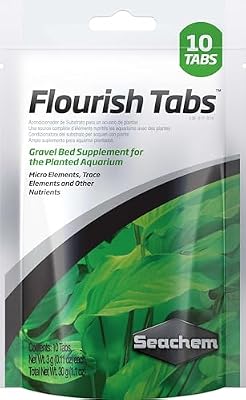
Seachem Flourish Tabs 10 tab Pack
Selected for "Root Tabs vs Liquid Fertilizer: Compared by the Numbers": this listing is aquarium equipment (Seachem Flourish Tabs 10 tab Pack), matching the equipment this article covers.
View on Amazon
NilocG ThriveCaps Aquarium Root Fertilizer for Planted Tanks, 60 Caps
Selected for "Root Tabs vs Liquid Fertilizer: Compared by the Numbers": this listing is tanks (NilocG ThriveCaps Aquarium Root Fertilizer for Planted Tanks, 60 Caps), matching the equipment this article covers.
View on Amazon
Root Tabs Freshwater Aquarium Plant Fertilizer, Slow-Release 100 Tabs 1g/Tab, Safe for Fish and Shrimp, for Planted Aquarium Substrate (100)
Selected for "Root Tabs vs Liquid Fertilizer: Compared by the Numbers": this listing is substrate and hardscape (Root Tabs Freshwater Aquarium Plant Fertilizer, Slow-Release 100 Tabs ), matching the equipment this article covers.
View on Amazon
FZONE Root Tabs, Aquarium Plant Fertilizer, Safe for Fish & Shrimp, 60g/Box
Selected for "Root Tabs vs Liquid Fertilizer: Compared by the Numbers": this listing is aquarium equipment (FZONE Root Tabs, Aquarium Plant Fertilizer, Safe for Fish & Shrimp, 60), matching the equipment this article covers.
View on AmazonBy David Nguyen
Quick answer: Our top pick in 2026 is the Root tabs — our #1 rated choice. See the full ranked comparison, alternatives and buying advice below.
Feeding Route, Grain Size and Dose Interval
Anyone comparing root tabs vs liquid fertilizer should settle three numbers first: the proportion of root feeders in the layout, the grain size of the substrate, and how many weeks pass between doses. Those three decide the outcome long before any brand differences become relevant at all.
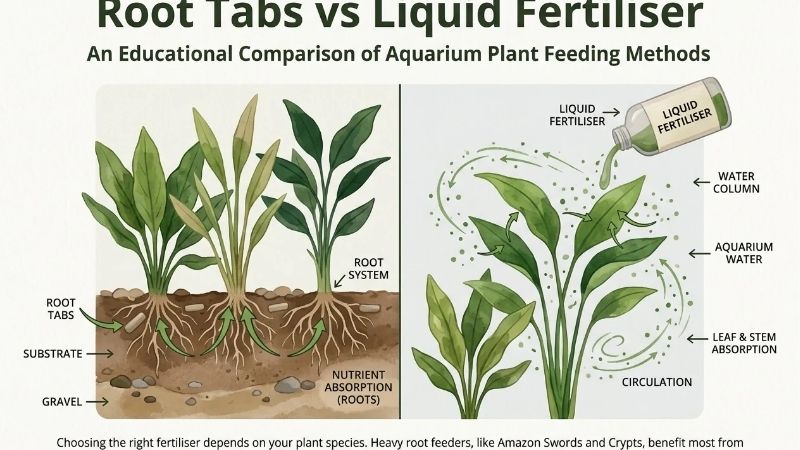
The Deciding Numbers: Feeding Route, Grain Size and Dose Interval
Feeding route is the primary number and it is close to binary. Swords, crypts, vallisneria and dwarf lilies pull the majority of their nutrients through roots, while anubias, java fern, bucephalandra, mosses and every floating plant have no functional root uptake in the substrate at all.
Grain size decides whether tabs work. A bed of 1-3 mm (0.04-0.12 in) material holds a dissolving tab in place, while coarse gravel above 4 mm (0.16 in) lets nutrients wash straight up into the water column, which turns a substrate product into an expensive liquid one. Check grain size before buying tabs.
The third number is dose interval. Tabs release across roughly three to four months, liquids across three to seven days, and that difference is the whole practical distinction: one is a quarterly task you can forget, the other is a habit you maintain every week of the year. Choose the rhythm you will keep.
Substrate Chemistry and Water Column Levels
Liquid dosing sets measurable targets in the water: nitrate around 10-25 ppm, phosphate 0.5-2 ppm, potassium 10-20 ppm and iron 0.1-0.5 ppm. You can test all four and correct within days, which makes liquid the controllable option when growth goes visibly wrong. Feedback arrives within days rather than months.
Tabs work where you cannot test. Substrate nutrient levels are not practically measurable at home, so dosing is scheduled rather than corrected, and the feedback loop runs through the plants themselves over several weeks instead of through a test kit within a single afternoon. You are dosing on trust rather than data.
Tank Size, Placement and Fit
Both products are dosed against real water volume, not the rating on the box. A 20-gallon (76 L) tank holds roughly 17-18 gallons (64-68 L) after substrate and hardscape, and a bed 3 in (7.6 cm) deep at the back holds enough material to place tabs properly. Shallower beds rule tabs out whatever the plant list says.
Bed depth is the fit constraint for tabs specifically, since they need burying 1-2 in (2.5-5 cm) down and under the crown. Measure the real numbers before you order: substrate depth against tab length, and light fixture length against the full length of the tank. Both checks take a minute with a tape measure.
Where Each Option Belongs
The comparison below groups both products by the tanks they suit rather than ranking them, because in most planted tanks the honest answer to root tabs vs liquid fertilizer is that a mature layout ends up using both on different parts of the same plant list. Root tabs vs liquid fertilizer is a split, not a winner.
| Option | Key number | Tank it suits | Recurring cost | Who it fits |
|---|---|---|---|---|
| Root tabs | Replace every 3-4 months | Inert gravel or sand, root feeders | 18-24 tabs a year for 20 gal | Low-tech keepers who dislike weekly tasks |
| Liquid fertiliser | Dose every 3-7 days | Epiphytes, floaters, stems, CO2 tanks | One to two bottles a year | Keepers who test and adjust regularly |
| Both together | Tabs quarterly, liquid weekly | Mixed layouts over 20 gal (76 L) | Combined, roughly additive | Established community planted tanks |
Root Tabs for Heavy Root Feeders in Inert Beds
Amazon swords, crypts and dwarf lilies in plain gravel or sand are the clearest case for tabs. One tab under each crown every three to four months supplies nitrogen, phosphorus, potassium and iron directly where the roots are, without raising nutrient levels in the open water at all.
Who it does not suit: anyone with an epiphyte-dominated layout gets nothing from tabs, and anyone with a shallow bed under 2 in (5 cm) will see tabs leach upward within days, which feeds algae rather than plants and wastes most of the product. Depth and grain size decide whether tabs work at all.
Root Tabs for Keepers Who Want a Quarterly Task
The strongest practical argument for tabs is adherence. A schedule you perform four times a year gets followed, while a weekly dosing habit lapses during holidays and busy months, and plants notice a missed fortnight of liquid far more than they notice anything else. Consistency beats theoretical precision.
The limitation is responsiveness. When a deficiency appears, tabs cannot correct it quickly, because the nutrients release on their own timetable and adding more simply concentrates them in one spot rather than raising availability across the substrate over the following few days.
Root Tabs in Aquasoil: Usually Unnecessary
Fresh aquasoil already holds a substantial nutrient charge for roughly 18-24 months, so adding tabs during that period mostly wastes money. The exception is a heavily planted soil tank past the two-year mark, where root feeders begin showing shortage signs on older leaves. Watch old leaves before adding anything.
There is a risk worth naming: tabs pushed into fully charged soil in a small tank can raise ammonium locally. In a 10-gallon (38 L) tank that is enough to feed a bloom of algae, which is why soil tanks generally start with liquid dosing instead. Wait until growth signals a genuine shortage first.
Liquid Fertiliser for Epiphytes, Floaters and Stem Plants
Anubias, java fern, bucephalandra, moss and every floating plant take up nutrients through their leaves and exposed roots, so liquid is the only route that reaches them. In a tank built around hardscape and epiphytes, tabs are simply the wrong tool for the job. No placement technique changes that.
Stem plants sit between the two. They root reasonably well but take a large share through the water column, and because they are trimmed and replanted constantly, tabs positioned under them lose their alignment every time the layout is pruned and rearranged. Liquid follows the stems wherever they go.
Liquid Fertiliser for Tanks That Get Tested and Adjusted
If you own a liquid nitrate, phosphate and iron test kit, liquid dosing turns into a controllable system. You can read 5 ppm nitrate on a Sunday, raise the dose, and read the correction the following week, which is not possible with any substrate-delivered product. Testing turns dosing into a controlled loop.
The cost is discipline and consumables. Reagents expire, dosing has to continue every week of the year, and skipping two or three weeks during a holiday shows up as visible deficiency in fast-growing stems well before it appears in slower rooted plants. Plan around holidays if you dose liquid alone.
Liquid Fertiliser in CO2-Injected High-Light Tanks
Injected tanks running above 50 micromoles of PAR consume nutrients several times faster than low-tech tanks, and demand changes week to week as plant mass grows. Only liquid dosing can be scaled that quickly, which is why high-light setups are almost always liquid-driven. Scale doses with plant mass.
The limitation is that high-light tanks punish inconsistency hard. Missing doses in a tank consuming 20 ppm of nitrate a week produces deficiency and algae within days, so this route suits people who already maintain a fixed weekly routine rather than anyone hoping to reduce the work involved.
Direct Comparison and When Neither Is the Answer
Setting root tabs vs liquid fertilizer side by side clarifies most decisions, but there is a third outcome worth taking seriously: some tanks need neither, and dosing them is a way of spending money on a problem that light or carbon is actually causing. Rule those two out before buying either product.
Choose Tabs When, Choose Liquid When
Choose tabs when the substrate is inert, the bed is at least 2 in (5 cm) deep, and rooted plants dominate the layout. That combination gives the highest return per unit of effort, and it survives the weeks when maintenance slips for entirely ordinary reasons. Effort per result is the deciding factor.
Choose liquid when epiphytes, floaters or stem plants dominate, when you inject CO2, or when you own test kits and intend to use them. Liquid also wins in any tank you rescape often, since tabs and their positions are lost every time the substrate is disturbed. Frequent rescapers should skip tabs.
When Neither Product Fixes the Problem
If PAR at the substrate is under 15 micromoles, no fertiliser produces growth, because light is the limiting factor and nutrients simply accumulate. The same applies when a demanding carpeting species is kept without CO2 at 2-3 ppm ambient carbon, which no dosing regime overcomes.
Newly flooded soil tanks are the other case. They release ammonia at 1-3 ppm for two to four weeks and already hold a nutrient charge, so dosing during that window adds to an algae problem instead of solving a deficiency that does not exist yet. Let the tank settle for a month first.
The Cheaper Route That Usually Works
For most low-tech community tanks the economical answer is tabs under the root feeders plus a comprehensive liquid at half the label rate weekly. That covers both routes, costs less than dosing either aggressively, and produces steadier growth than committing entirely to one product.
Making your own capped soil bed is the deeper saving, since it feeds root plants for years without tabs at all. The trade is a rebuild, several weeks of cloudy water and ammonia, and a layout you cannot rearrange casually once the cap has settled. It suits planners, not experimenters.
Twelve-Month Cost, Failure Points and Storage
Judged across a year rather than at checkout, root tabs vs liquid fertilizer separates on running cost and on how each one fails. Both are consumables, both degrade in storage, and both have specific failure modes that show up in the tank before they show up on a receipt. Both are consumables in the end.
What Each One Costs Across a Year
A 20-gallon (76 L) tank with six root feeders needs roughly 18-24 tabs annually, while the same tank on liquid alone typically consumes one to two bottles of a comprehensive product. Prices shift regularly, so check them at the moment of purchase rather than budgeting from old figures.
Late November discounting covers plant supplies alongside larger equipment, and buying a year of consumables then is sensible planning. It changes nothing biologically, though: a newly set up planted tank still needs three to eight weeks of cycling before any fish are added to it.
Failure Points: Leaching, Clouding and Expiry
Tabs fail by leaching. A tab placed too shallow, or pushed into coarse gravel above 4 mm (0.16 in), releases into the water column instead of the root zone, and the visible result is usually a film of algae across the glass within a week of dosing. Push the tab deeper and it stops.
Liquids fail by degrading. Chelated iron breaks down faster in warm, bright storage, so a bottle kept on a sunny shelf can lose potency well before its printed date, which shows up as pale new growth in tanks that are supposedly being dosed correctly every week. Replace opened bottles annually.
Storage, Shrimp Safety and Seasonal Demand
Store both products sealed, cool and dark, and check every label for copper before dosing a tank with shrimp or snails, since copper appears in some plant supplements and is lethal to invertebrates at concentrations well below what fish tolerate without any visible distress. Check invertebrate-safe labels twice.
Demand also shifts with the calendar. Warmer rooms and longer daylight from March onward raise consumption noticeably, so a dose that suited the tank in midwinter may fall short in spring, while that same summer schedule leaves surplus nutrients sitting unused in the water column by December.
Frequently Asked Questions
These come up most often from keepers running a first planted tank who have bought one product, seen mixed results, and are deciding whether the other one would have been the better purchase. Root tabs vs liquid fertilizer questions usually reduce to depth, timing and cost, so each answer sticks to checkable numbers.
Can I use both at the same time?
Yes, and most established planted tanks do. Tabs handle the root feeders on a quarterly cycle while a weekly liquid at half the label rate covers epiphytes, floaters and stems. Watch nitrate for the first month to confirm the combination is not overshooting 40 ppm. Adjust one product at a time.
How deep do root tabs need to go?
Bury them 1-2 in (2.5-5 cm) down and directly under the crown of a heavy feeder. Shallower placement leaks nutrients into the water column, and in beds under 2 in (5 cm) deep, tabs are usually the wrong choice regardless of how carefully they are positioned. Build depth first, then dose.
Does root tabs vs liquid fertilizer matter in a sand substrate?
It matters more, not less. Sand at 0.45-0.55 mm holds tabs securely and carries no nutrients of its own, so root feeders in sand depend entirely on tabs, while anything not rooted in the bed depends entirely on what you dose into the water column. Sand makes the split unusually clear.
Will fertiliser harm my fish?
Dosed at label rates for the real water volume, standard plant fertilisers are not a hazard to fish. The risks worth respecting are overdosing in small tanks, copper content harming shrimp and snails, and confusing plant products with ammonia-based supplements intended for cycling a tank.
See More:
Conclusion
Root tabs vs liquid fertilizer comes down to where your plants take up nutrients and how often you want a task on the calendar. Tabs suit inert beds with rooted plants on a quarterly rhythm, while liquid suits epiphytes, stems and any tank you intend to test and adjust regularly.
The default for a mixed low-tech community tank is tabs under the heavy feeders plus a weekly liquid at half the label rate. If you want the cheaper single option, tabs in inert gravel cost less across a year and survive missed weeks far better. Add a weekly liquid later if epiphytes appear.
Ready to decide? Our #1 pick for 2026 is the Root tabs.
Live price & availability on Amazon.
Related Reviews & Guides

8 Best Aquarium CO2 Diffusers for Lush Plant Growth

Best Bearded Dragon Tanks in 2026: Compared and Ranked