Last Updated: September 25, 2026
Live rock vs dry rock trades three things against each other: cycling time, cost per pound, and what arrives in the tank alongside the rock. Both need the same 1-1.5 lb per gallon (0.45-0.7 kg per 3.8 L) to do the same job, so the choice comes down to timeline, budget and risk rather than to function at all.
As an Amazon Associate we earn from qualifying purchases.
As an Amazon Associate we earn from qualifying purchases at no extra cost to you. Prices and availability are accurate as of the date shown and are subject to change.

Eorbow 8 lbs Aquarium Holey Rocks, White Coral Ornament for Aquascaping, Natural Sea Dry Base Stones, Limestone Decor Hardscape Stone for Fish Tank Bonsai Terrariums Reptile Habitat
Selected for "Live Rock vs Dry Rock: Cost, Cycling Time and Pest Risk": this listing is tanks (Eorbow 8 lbs Aquarium Holey Rocks, White Coral Ornament for Aquascapin), matching the equipment this article covers.
View on Amazon
YZHZOM Dry Base Rock for Aquarium White Coral Ornament Sea Base Rocks for Aquarium Aquascaping (7lb,Mix Size & Shape)
Selected for "Live Rock vs Dry Rock: Cost, Cycling Time and Pest Risk": this listing is substrate and hardscape (YZHZOM Dry Base Rock for Aquarium White Coral Ornament Sea Base Rocks ), matching the equipment this article covers.
View on Amazon
Real Reef Premium Live Rock for Saltwater Aquariums (40 LB) Mixed Sizes
Selected for "Live Rock vs Dry Rock: Cost, Cycling Time and Pest Risk": this listing is substrate and hardscape (Real Reef Premium Live Rock for Saltwater Aquariums (40 LB) Mixed Size), matching the equipment this article covers.
View on Amazon
ARC Reef All New! Reef Stacker Dry Rock, All in 1 Aquascaping Kit for Saltwater Aquariums, 10 lbs.
Selected for "Live Rock vs Dry Rock: Cost, Cycling Time and Pest Risk": this listing is substrate and hardscape (ARC Reef All New! Reef Stacker Dry Rock, All in 1 Aquascaping Kit for ), matching the equipment this article covers.
View on AmazonBy David Nguyen
Quick answer: Our top pick in 2026 is the Live rock, full structure — our #1 rated choice. See the full ranked comparison, alternatives and buying advice below.
Same Rock, Different Starting Point
The live rock vs dry rock decision is often framed as quality, which is misleading. Both are the same porous calcium carbonate skeleton; the difference is whether it arrives populated with organisms or sterile, and everything else follows from that.
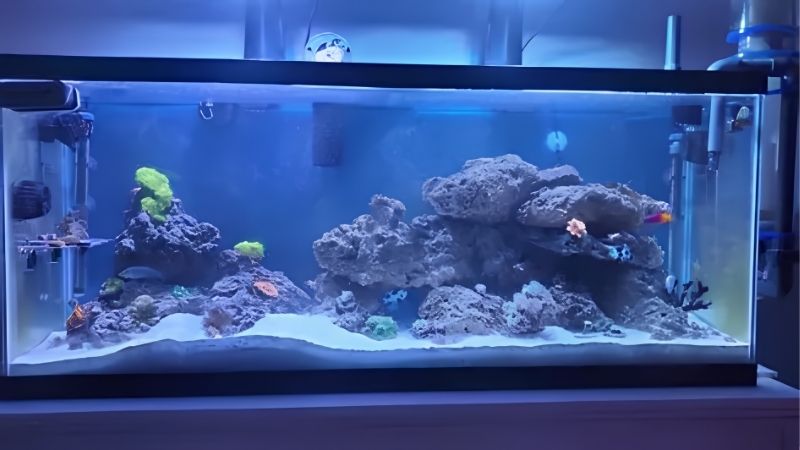
The Deciding Numbers: Cycling Time, Weight and Cost
Cycling time is the headline figure. Live rock carrying an established colony can complete a cycle in three to four weeks, while dry rock typically takes five to eight, because the colony has to establish from whatever seed source you provide.
Quantity is identical either way at 1-1.5 lb per gallon (0.45-0.7 kg per 3.8 L). Cost per pound favours dry rock substantially, and the gap widens on larger tanks where the total rock requirement runs to 50 lb (23 kg) or more.
Two More Criteria With Numbers Attached
Pest risk is the criterion that decides most cases. Live rock can carry unwanted organisms including nuisance algae, aiptasia anemones and predatory worms, and once introduced these are far harder to remove than they were to avoid.
Aquascaping control favours dry rock clearly. Dry rock can be drilled, cut and glued into a structure before water goes in, while live rock must be worked with quickly and wet, which limits how carefully the layout can be built.
Tank Size, Placement and Fit
Measure the tank footprint against your intended structure before ordering rock, since a 48 x 13 in (122 x 33 cm) tank takes a very different shape of aquascape from a 24 x 24 in (61 x 61 cm) cube at the same weight.
Build on the bottom glass or on an eggcrate base rather than on sand, whichever rock you choose. Sand shifts under weight over months, and a structure that settles unevenly can crack glass or trap fish behind a collapse.
Where Each Type Actually Wins
Neither type wins outright, and many tanks end up using both. The sections below split the live rock vs dry rock decision by situation, since the right answer changes with budget, timeline and how much risk you can absorb.
Live Rock: For the Fastest Route Through Cycling
Main number: three to four weeks rather than five to eight, provided the rock is kept wet and warm in transit. That saving is real and it is the strongest argument for live rock in a build where the timeline matters.
It suits keepers restarting an existing system or replacing rock in a running tank. It does not suit anyone unwilling to quarantine or inspect it, since the same organisms that speed the cycle can include ones you will spend years removing.
Live Rock: For Biodiversity and a Mature Appearance
Main point: coralline algae, sponges, small crustaceans and worms arrive with it, giving a tank that looks established in month two rather than month twelve. That microfauna also feeds fish and processes detritus continuously.
It suits anyone who values a mature look and a working detritivore population from the start. It does not suit tanks where the aquascape must be precise, since live rock is worked wet and quickly rather than dry-fitted and glued.
Live Rock: For Seeding a Larger Dry Rock Structure
Main number: 10-20% of total rock weight is usually enough to seed the rest. A few pounds of live rock placed among a dry structure transfers the colony and much of the microfauna without importing a full tank’s worth of risk.
It suits almost everyone as a hybrid approach, and it is the option most experienced keepers actually use. It does not suit anyone wanting a genuinely sterile start, since even a small piece can carry an unwanted organism.
Dry Rock: For a Pest-Free Start
Main point: nothing arrives with it. A tank built entirely on dry rock cannot import aiptasia, bubble algae, predatory worms or flatworms with the rock, which removes the single largest source of long-term nuisance problems in reef keeping.
It suits first reefs and anyone who has fought a pest before and would rather not again. It does not suit an impatient timeline, since the cycle runs five to eight weeks and the tank looks bare for the first several months.
Dry Rock: For Aquascaping Control and Cost
Main numbers: substantially lower cost per pound, and unlimited working time. Dry rock can be drilled for rods, cut to fit and epoxied into an arch or overhang before the tank holds any water, which is not practical with live rock.
It suits ambitious aquascapes and larger tanks where rock quantity drives the budget. It does not suit anyone who wants the tank populated quickly, and some dry rock requires curing to remove residues before it goes in.
Dry Rock: For a Slow, Deliberate First Build
Main point: a longer cycle is time spent learning the system rather than time wasted. Five to eight weeks of testing, adjusting salinity and watching how the tank behaves is exactly the practice a first marine keeper needs.
It suits beginners who accept the timeline. It does not suit anyone whose motivation depends on visible progress, since a dry rock tank in week four looks identical to the same tank in week one apart from the readings.
| Option | Cycling time | Relative cost | Pest risk | Best for |
|---|---|---|---|---|
| Live rock, full structure | 3-4 weeks | Highest | High | Fast start, mature look |
| Live rock as seed, 10-20% | 4-6 weeks | Moderate | Moderate | Most builds, balanced approach |
| Dry rock, full structure | 5-8 weeks | Lowest | Very low | First reefs, precise aquascapes |
| Dry rock plus bottled bacteria | 4-7 weeks | Low | Very low | Pest-free with a modest head start |
| Rock from a running tank | 3-4 weeks | Varies | Depends on that tank | Only with a known, inspected source |
Choosing Between Them, and When Both Are Wrong
The decision is rarely exclusive, and there are cases where the rock is not the variable that matters. This section sets out when each is clearly correct and where the live rock vs dry rock question is a distraction.
Choose Live Rock When
You are restarting or expanding an existing system, you want microfauna from day one, or the timeline genuinely matters. Buy from a source you can inspect, and quarantine the rock in a separate container for several weeks where practical.
Even then, use it as a seed rather than as the whole structure wherever you can. Ten to twenty per cent of total rock weight transfers the colony effectively while limiting how much unknown material enters the display tank.
Choose Dry Rock When
It is a first reef, the aquascape needs precision, or the rock budget is the constraint. Accept five to eight weeks of cycling and use the time to learn salinity control, testing and the tank’s temperature behaviour.
Cure it first if the supplier recommends it, and consider adding a small piece of known-clean live rock or a bottled bacteria product as a seed. Neither shortens the confirmation test, which stays the same in every case.
When the Rock Is Not the Problem
A stalled cycle is almost never a rock problem. Check temperature at 78-80 °F (26-27 °C), salinity at 1.024-1.026 SG, whether an ammonia source is present, and whether the test reagents are in date before blaming the rock.
Persistent algae after cycling is a source water and light problem rather than a rock choice. Verify RO/DI output at 0 ppm TDS with a meter and cut the photoperiod before concluding that the rock was leaching phosphate.
Living With Either Choice Over 12 Months
Rock is a one-time purchase with long-term consequences, so the live rock vs dry rock choice keeps resurfacing months later. This section covers what changes across the first year, what it actually costs, and what to watch for.
What Happens Over the First Year
Dry rock colonises steadily and starts developing coralline algae from around month three to six, given calcium at 400-450 ppm and alkalinity at 8-9 dKH. By month twelve the visual difference from live rock has largely closed.
Live rock loses some of what it arrived with. Sponges and delicate organisms that survived shipping often die back in the first weeks, releasing nutrients, which is why a live rock tank sometimes shows an ammonia spike after appearing settled.
Pests, Removal and Real Cost
The honest cost of live rock includes what it may introduce. Aiptasia and bubble algae in particular can take months to control, and the effort involved usually exceeds the several weeks of cycling time the rock saved at the start.
Inspect any live rock in a bucket under good light before it goes in, and remove visible anemones and unknown organisms then. That inspection is the highest-value step in the whole process and it costs nothing but an hour.
Cost, Storage and Timing
Dry rock stores indefinitely, so buying in advance is practical and it ships more cheaply because weight rather than water is the only cost. Live rock cannot be stored and has to be used within hours of arriving.
On timing, rock and marine equipment see their deepest discounts in late June and again in late November. A sale changes nothing biological, since the tank still needs three to eight weeks of cycling either way, and prices move constantly.
Live Rock vs Dry Rock: Questions
These arrive at the planning stage, before either type is ordered. Every answer on live rock vs dry rock stays with cycling time, cost and pest risk, since those three between them cover almost every case that comes up.
How much rock do I need?
One to one and a half pounds per gallon (0.45-0.7 kg per 3.8 L) of either type, which is 40-60 lb (18-27 kg) for a 40 gallon (151 L) tank. Above that floor, structure and flow around the rock matter more than the exact weight does.
Can I mix the two?
Yes, and it is the approach most experienced keepers use. Ten to twenty per cent live rock seeds a dry structure effectively, giving much of the cycling benefit while limiting how much unknown material enters the display.
Does dry rock leach phosphate?
Some does, particularly rock reclaimed from an old system rather than quarried. Curing it in saltwater with regular water changes before use removes most of that, and testing the cure water tells you when it has stopped.
Is bottled bacteria worth using with dry rock?
It can shorten the first stage by acting as a seed, and it does not replace the process itself. Confirm completion with the same ammonia test either way: 2 ppm clearing to zero along with nitrite within 24 hours, repeated twice.
See More:
Conclusion
On live rock vs dry rock, the practical answer for most builds is a hybrid: a dry rock structure aquascaped in advance, seeded with 10-20% live rock from an inspected source. That gives four to six weeks of cycling with limited pest risk.
Choose full live rock only when the timeline genuinely matters and the source is known, and full dry rock for a first reef or a precise aquascape, accepting five to eight weeks. Either way, use 1-1.5 lb per gallon and build on the glass.
Ready to decide? Our #1 pick for 2026 is the Live rock, full structure.
Live price & availability on Amazon.
Related Reviews & Guides
Best Budget Protein Skimmer: Top Expert Picks for Beginners
8 Best Budget Aquarium Sump Pumps for Refugium