Last Updated: October 4, 2026
- Top Pick: AQUANEAT LED Aquarium Light Full Spectrum for 18 Inch to 24 Inch Fish Tank Light Fresh Water
- Best Value: hygger Clip On 24/7 Lighting Aquarium LED Light,Sunrise-Daylight-Moonlight and DIY Mode, Adjustable Timer/Brightness Fish Tank Light with 7 Colors for Planted Tank (14W for 12~20in Tank)
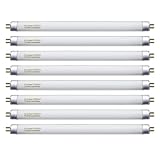
- Premium Choice: Circle F8T5 CW Fluorescent Tube Bulb 12 Inch T5 Under Cabinet 8W 4100K 6 Pk
Choosing between an LED aquarium light and a T5 fluorescent light is less about finding a universal “best” option and more about matching the fixture to your tank, room, fish, plants, and willingness to maintain it. The real decision a buyer faces is this: do you want a compact, cooler-running light with programmable features and low energy use, or a familiar fluorescent setup with replaceable tubes and a broad, even spread of light?
For most new freshwater aquarium setups in 2026, LED is the practical default. It is easier to fit over a small tank, uses less electricity, and often includes brightness controls or timers. T5 fluorescent lighting still has a place, particularly for hobbyists who already own compatible fixtures, prefer its uniform illumination, or want the simplicity of changing a tube rather than replacing an entire integrated fixture.
As an Amazon Associate we earn from qualifying purchases at no extra cost to you.

Quick Verdict
Choose an LED aquarium light if you are starting from scratch, have a 10- to 30-gallon tank, want adjustable brightness, keep the aquarium in a warm room, or value low ongoing costs. Basic LED fixtures commonly cost about $15 to $60, while more advanced planted-tank models can run $70 to $200 or more.
Choose a T5 fluorescent light if you already have a T5 aquarium hood or fixture in good condition, want a soft and even light spread, or prefer readily replaceable bulbs. A T5 tube may cost roughly $5 to $20 depending on length and color temperature, but the fixture, ballast, and periodic bulb replacements raise long-term ownership costs.
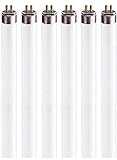
One important shopping note: a T5 tube is not automatically an aquarium light. For example, Circle F8T5 CW 12-inch 8W tubes and Konideke F8T5/CW 12-inch 8W cool-white bulbs are made for compatible G5 mini bi-pin fixtures and are often sold for under-cabinet use. Check the fixture’s tube length, pin type, ballast compatibility, splash protection, and wattage before considering any replacement tube above a fish tank.
Side by Side
| Buying factor | LED aquarium light | T5 fluorescent light |
|---|---|---|
| Comfort in the room | Usually runs cooler and adds less heat around the aquarium. | Produces more fixture heat, especially in enclosed hoods. |
| Durability | LED diodes can last years, though integrated units may not have user-replaceable LEDs. | Fixture can last a long time, but tubes typically need scheduled replacement. |
| Typical price range | About $15–$60 for basic models; $70–$200+ for feature-rich planted-tank units. | About $20–$100+ for a fixture, plus roughly $5–$20 per replacement tube. |
| Maintenance | Wipe dust and mineral deposits from the lens; few routine parts to replace. | Replace tubes periodically and maintain the fixture, end caps, and ballast. |
| Space needed | Slim bars and clip-on lamps suit narrow shelves and compact tank lids. | Usually needs a hood or fixture sized precisely to the tube length. |
| Look | Can offer crisp white light, selectable colors, moonlight, and sunrise effects. | Creates a classic, even fluorescent glow; color depends on the tube selected. |
| Resale and replacement | Popular and easy to resell if from a recognized aquarium-light brand; integrated failures may mean replacing the unit. | Older fixtures can be harder to resell, but compatible tubes remain easy to swap when available. |
| Energy use | Generally lower for comparable visual brightness. | Generally higher, particularly when used eight to 10 hours daily. |
| Best for | New tank owners, apartments, planted freshwater tanks, and convenience-focused homes. | Existing T5 setups, traditional hoods, and owners who prefer replaceable bulbs. |
Where LED Aquarium Light Wins
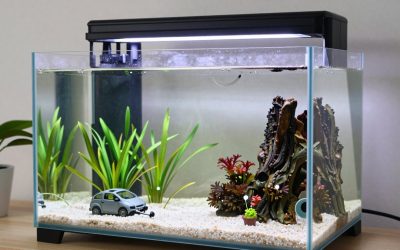
LED lighting wins on flexibility. Many current fixtures let you lower brightness for timid fish, increase it for undemanding live plants, or shift the color balance to make green plants and colorful fish stand out. That adjustment matters because a light that looks attractive in a store can be too intense for a bare tank or too weak for plants positioned near the substrate.
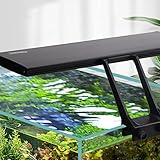
It also wins on physical size. A simple light bar for an 18- to 24-inch aquarium can be only a few inches wide and rest on extendable brackets. The AQUANEAT Full Spectrum LED Aquarium Light for 18- to 24-inch freshwater tanks, priced around $15, is the kind of straightforward budget fixture that makes sense for a basic community tank. It is a more direct fit for this use than repurposing an under-cabinet fluorescent tube.
For a small planted tank, programmable LEDs can make day-to-day care easier. The hygger Clip On 24/7 Lighting Aquarium LED Light, listed around $25 for the 14W version sized for 12- to 20-inch tanks, illustrates why clip-on LEDs are appealing in apartments: they take up little surface area and can provide sunrise, daylight, moonlight, timer, brightness, and color settings without adding another bulky hood.
Energy use is another meaningful advantage. A 14W LED operated for eight hours a day uses about 41 kilowatt-hours annually. At an electricity rate of $0.16 per kilowatt-hour, that is approximately $5 per year. A 24W fluorescent fixture used on the same schedule uses about 70 kilowatt-hours, or roughly $10 annually. The difference is not enormous for one aquarium, but it becomes worthwhile over several years and helps keep heat lower near the water.
Finally, LEDs are generally easier for renters and first-time owners. There is no tube length to match, no ballast to consider, and no need to keep spare lamps on hand. Choose a fixture with a timer or use a basic outlet timer, set a consistent photoperiod of about six to eight hours for a new planted tank, and adjust gradually if algae appears.
Where T5 Fluorescent Light Wins
T5 fluorescent lighting remains appealing for its broad, uniform illumination. A tube distributes light along much of its length, which can make a rectangular aquarium look evenly lit from end to end. Some owners prefer this softer, less point-source appearance over LEDs, especially in traditional aquarium hoods.
Replaceability is another advantage. If a fluorescent tube dims, changes color, or stops working, you can replace that single component instead of discarding an integrated light fixture. This can be useful for homeowners who prefer repairable household items and already have a dependable T5 fixture.
T5 also offers straightforward color-temperature choices. Cool-white tubes around 4100K can look neutral to slightly warm, while daylight-oriented aquarium tubes are often selected for a brighter, cleaner appearance. However, tube labeling alone does not determine whether a lamp is suitable for fish or plants. Aquarium-safe installation, stable electrical components, a splash guard, and correct output for the tank all matter.
The biggest limitation is that T5 systems are less convenient for most new setups. Fixtures can be bulkier, tubes are fragile, and fluorescent output declines over time even before a lamp visibly fails. If your existing hood takes an 8W, 12-inch F8T5 tube, a six-pack such as the Circle set at about $15 or the Konideke eight-pack at about $15 may be economical for maintaining that specific compatible fixture. But those prices do not make a T5 system automatically cheaper once fixture cost, replacements, and electricity are included.
Cost Over 5 Years
For a realistic comparison, consider a modest aquarium light used eight hours per day at $0.16 per kilowatt-hour. Actual local electricity prices, lighting schedules, and fixture wattages will change the total.
- Basic LED setup: $15 to $45 for the fixture, plus about $30 to $45 in electricity over five years for a 12W to 16W light. Estimated five-year total: $45 to $90.
- Feature-rich LED setup: $40 to $120 for a timer-equipped or planted-tank fixture, plus about $35 to $65 in electricity for a 14W to 24W unit. Estimated five-year total: $75 to $185.
- T5 setup: $25 to $100 for a fixture, roughly $20 to $80 for replacement tubes depending on the number of lamps and replacement schedule, plus about $45 to $90 in electricity for a 20W to 30W setup. Estimated five-year total: $90 to $270.
These figures assume the fixtures remain functional. An integrated LED light that fails outside its warranty may need full replacement, while a quality T5 fixture may continue operating with new tubes. Still, for the average small freshwater aquarium, LED usually has the lower predictable cost.
Which One for Your Home
Small apartment
Choose LED. A slim light bar or clip-on unit keeps the tank visually light and avoids adding a large hood to a studio, bedroom, or compact living room. Look for a model sized to the tank’s actual rim-to-rim length; a fixture designed for 12- to 20-inch tanks should not be stretched over a 24-inch aquarium. A timer is especially helpful when your daily schedule changes.
Family with kids or pets
Choose LED with a secure mounting system and a protected power cord. Low heat is helpful around curious hands and pets, although every aquarium light should be installed with a drip loop and kept away from splashing water. Avoid loosely balanced clip-on lights if a cat can jump onto the aquarium lid. A covered LED bar on sturdy brackets is often the safer-looking choice.
Rental
Choose LED unless the aquarium already came with a working T5 hood. LEDs are easier to move, require fewer spare parts, and are more likely to work with your next tank if you size up or down slightly. Keep the original packaging if possible; a clean, working aquarium light is easier to sell or pass along when you move.
Long-term home
Either option can work, but LED is usually the better new purchase. Pick a higher-quality LED fixture if you want a planted display, dimming, or automated daily transitions. Choose T5 only if you enjoy the traditional setup, already own a well-maintained compatible fixture, and are comfortable replacing tubes as routine maintenance.
FAQ
Is LED better than T5 for a planted aquarium?
For most beginner and intermediate planted aquariums, LED is the easier choice because brightness can often be adjusted and timers are commonly built in. T5 can also grow plants effectively, but it is important to match the fixture output, tube selection, photoperiod, fertilizer routine, and plant needs rather than assuming any fluorescent tube will work.
Can I put an under-cabinet T5 bulb in an aquarium fixture?
Only if the bulb exactly matches the fixture’s required length, wattage, pin configuration, and ballast requirements, and the fixture itself is appropriate for use above an aquarium. An F8T5 12-inch, 8W G5 mini bi-pin tube may physically fit certain fixtures, but fit alone does not confirm safe or desirable aquarium performance.
How long should aquarium lights stay on each day?
Start around six to eight hours daily for a new aquarium, especially one with live plants. Increase slowly only if plants need more light and algae remains controlled. Leaving lights on for 12 hours or more rarely improves a home aquarium and often encourages algae growth.
Do LED aquarium lights need bulb replacement?
Most do not use replaceable bulbs. The LEDs are built into the fixture and may operate for years, but the fixture can eventually fail because of its driver, switch, timer, or moisture exposure. Clean the lens gently, keep ventilation openings clear, and use the light only in the mounting position specified by its manufacturer.
Ready to decide? Our #1 pick for 2026 is the Comfort in the room.
Live price & availability on Amazon.
Related Reviews & Guides
Best Temporary Fish Holding Tank For Tank Transfers: Trusted
Best Portable Koi Pond For Backyard: Essential Reliable