Last Updated: October 4, 2026
- Top Pick: AQUANEAT LED Aquarium Light Full Spectrum for 48 Inch to 54 Inch Fish Tank Light Fresh Water
- Best Value: GloFish 10-Inch LED Light Sticks for Fish Aquariums Up to 75 Gallons, 2 Count, with White, Blue and Magenta LED Lights
- Premium Choice: hygger 42W 24/7 Lighting Aquarium LED Light, Sunrise-Daylight-Moonlight Mode and DIY Mode, Timer Adjustable Brightness Fish Tank Light with Extendable Bracket 7 Colors for Planted Tank
The Short Answer
For most 75-gallon aquariums, the best LED light length is 48 to 54 inches (122 to 137 cm). A standard rectangular 75-gallon tank is approximately 48 inches long, 18 inches wide, and 21 inches high (122 × 46 × 53 cm). The light should either match the tank’s usable length or include adjustable brackets that extend beyond the fixture.
When comparing led aquarium light dimensions for 75 gallons, length is usually more important than the gallon rating. A 75-gallon tank can have different proportions, and a light designed for a long 48-inch aquarium may not fit a 75-gallon bowfront, corner, or unusually deep setup. Measure the aquarium’s top rim, not just the glass, before ordering.
As an Amazon Associate we earn from qualifying purchases at no extra cost to you.


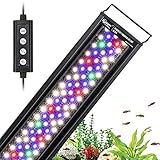

For a freshwater community tank with low- to moderate-light plants, look for a fixture approximately 42 to 48 inches long, or a shorter fixture with strong end-to-end coverage. For a planted aquarium, choose a model labeled for 48- to 54-inch tanks and check its wattage, brightness controls, mounting range, and light spread. Typical consumer prices for suitable fixtures in 2026 range from about $40 to $71, while specialty planted-tank models may cost more.
Standard Sizes
The table below shows common measurements for a 75-gallon aquarium and the light sizes frequently used above it. Tank dimensions can vary by manufacturer, so use these as planning measurements rather than guaranteed specifications.
| Item or setup | Typical dimensions in inches | Approximate dimensions in centimeters | Best use |
|---|---|---|---|
| Standard 75-gallon tank | 48 L × 18 W × 21 H | 122 L × 46 W × 53 H | Reference aquarium size |
| Compact LED fixture | 36 to 42 L × 3 to 5 W × 0.5 to 2 H | 91 to 107 L × 8 to 13 W × 1 to 5 H | Lower-light tanks or centered coverage |
| Standard 48-inch fixture | 47 to 48 L × 3 to 5 W × 0.5 to 2 H | 119 to 122 L × 8 to 13 W × 1 to 5 H | Most standard 75-gallon aquariums |
| Adjustable 48- to 54-inch fixture | 47 to 54 L × 3 to 5 W × 0.5 to 2 H | 119 to 137 L × 8 to 13 W × 1 to 5 H | Rimmed tanks with variable mounting points |
| Two 10-inch light sticks | 10 L × approximately 1 to 2 W each | 25 L × approximately 3 to 5 W each | Accent lighting or segmented coverage |
A 48-inch model is generally the cleanest visual match for a standard tank. A 48- to 54-inch adjustable model can be more practical when the aquarium has a wide plastic rim, hinged glass tops, or mounting brackets positioned inside the ends of the frame. Avoid assuming that a 54-inch light will fit every 48-inch tank: its shortest bracket setting and total overhang matter.
Examples in this category include full-spectrum lights rated for 48- to 54-inch tanks, such as the AQUANEAT model priced around $40, and the SEAOURA WRGB model priced around $70. A 42W hygger 24/7 fixture, priced around $70, is another example of a longer adjustable light intended for planted or freshwater setups. These prices illustrate the market range; specifications and availability can change.
Wattage is not a direct measurement of brightness. A 42W light may be appropriate for a planted aquarium, but plant requirements, mounting height, water depth, lens design, and dimming controls also affect performance. A lower-wattage light can work well for fish-only displays, while demanding carpeting plants may require a stronger or more carefully positioned fixture.
How to Measure Your Space
- Measure the tank’s outside length. Measure from the outside edge of the left rim to the outside edge of the right rim. A typical 75-gallon tank measures close to 48 inches, but confirm your aquarium instead of relying on the nominal gallon capacity.
- Measure the usable mounting span. If the light rests on brackets, measure between the surfaces where those brackets will sit. A thick rim, center brace, or canopy can reduce the available span.
- Measure the front-to-back width. The usual width is about 18 inches. This helps you decide whether one bar can illuminate the entire tank or whether the light should be centered over the plants and hardscape.
- Check the top clearance. Measure the distance from the top rim to the underside of a canopy, shelf, or cabinet. Include the fixture height, mounting feet, and any space required for ventilation.
- Account for lids and braces. Confirm whether the light sits above glass covers or fits around a center brace. A fixture may be the correct length but still interfere with feeding doors or removable lids.
- Measure cord and outlet distance. Leave enough slack for a safe drip loop. Timers, dimmers, and power adapters also need a stable location away from splashing water.
- Compare the adjustment range. For a 48-inch aquarium, a light labeled 48 to 54 inches should have brackets that retract to at least the measured rim span. Do not use its maximum length as the only measurement.
By Room or Use Case
Living Room Display
A 48-inch bar usually provides the most balanced appearance above a standard 75-gallon tank. Choose a slim fixture about 3 to 5 inches wide if it will sit on an open rim or glass top. Adjustable white brightness and a gradual evening mode are useful in a living room because they reduce visual glare and let you set a consistent schedule. A neutral daylight setting often shows fish colors naturally without making the room feel overly blue.
Planted Freshwater Aquarium
Planted tanks benefit from even coverage across the full 48-inch length. Consider a 48- to 54-inch fixture with adjustable brackets, multiple color channels, a timer, and brightness control. Models such as the hygger 42W 24/7 light or SEAOURA WRGB light are examples of feature-rich options in roughly the $67 to $71 range. Keep the light centered over the plant mass, and verify that the fixture’s controls allow a gradual ramp-up and ramp-down if fish are easily startled.
Fish-Only or Low-Light Aquarium
A less powerful 42- to 48-inch fixture is often sufficient when the goal is visibility rather than intensive plant growth. Full-spectrum LED bars commonly cost about $40 to $50 in this category. Choose a dimmable model if the tank contains shy fish, reflective decor, or a dark background. Excessive brightness can emphasize algae and create glare on the front glass.
Accent or GloFish Setup
Short light sticks can add color without covering the entire aquarium. A pair of 10-inch GloFish LED sticks, priced around $50, can be positioned separately to create white, blue, and magenta zones. They are better for accent effects than for uniform illumination across a 48-inch tank. Place them securely and keep wiring arranged so that it cannot fall into the water.
Canopy or Built-In Cabinet
Measure the inside of the canopy before purchasing. A fixture that fits an open-rim aquarium may be too wide or too tall for an enclosed hood. Leave clearance around the light for heat dissipation, and confirm that the power adapter fits outside the humid enclosure. If the canopy blocks the ends, a 42- to 48-inch fixture may be more practical than a fully extended 54-inch model.
Common Sizing Mistakes
- Buying by gallon rating alone: “For up to 75 gallons” does not guarantee a 48-inch fit. Always compare the actual fixture length with the tank rim.
- Confusing light length with coverage length: A 36-inch bar may be rated for a larger aquarium, but its ends may receive noticeably less light than the center.
- Ignoring the tank rim: Measure where the feet rest, including rim thickness and center braces.
- Choosing maximum extension only: A 48- to 54-inch light must also retract far enough for your aquarium.
- Using wattage as the only performance guide: Compare dimming, color channels, lens design, mounting height, and intended plant level.
- Forgetting the lid: Check whether the light can sit above glass tops without blocking access or interfering with feeding doors.
- Overlooking splash protection: LEDs should be mounted securely and kept away from direct splashes, while power connections need a drip loop.
FAQ
What size LED light is best for a 75-gallon aquarium?
A 48-inch LED light is the usual choice for a standard 75-gallon tank. An adjustable 48- to 54-inch fixture is useful when the rim or mounting points require extra reach. Select a shorter light only when the display is intentionally centered or used mainly for accent lighting.
Will a 54-inch aquarium light fit a 75-gallon tank?
It may fit if its adjustable brackets retract to the tank’s mounting span. Check the manufacturer’s minimum and maximum length, not just the advertised maximum. Also verify that the fixture does not obstruct a canopy, glass lid, or center brace.
How many watts should a 75-gallon aquarium light have?
There is no universal wattage requirement. Fish-only tanks may use a modest full-length LED, while planted tanks often benefit from a brighter, dimmable fixture. The example 42W planted-tank light represents one available option, but wattage should be compared with light output, aquarium depth, plant type, and mounting height.
Can two 10-inch LED sticks light a 75-gallon tank?
Two 10-inch sticks can provide decorative or localized lighting, but they usually will not illuminate a 48-inch aquarium as evenly as a full-length bar. Use them for color accents, fish-only displays, or supplemental lighting rather than assuming they replace a 48-inch fixture.
Ready to decide? Our #1 pick for 2026 is the Standard 75-gallon tank.
Live price & availability on Amazon.
Related Reviews & Guides
Best Aquarium for Hard Water Fish: Top Compared Size Guide
Best Rimless Aquarium for Saltwater: Reef Ready Top Picks