Last Updated: October 4, 2026
Quick answer: Our top pick in 2026 is the Frequent partial water changes — our #1 rated choice. See the full ranked comparison, alternatives and buying advice below.
The Short Answer
Yes, a protein skimmer is worth it for a reef aquarium if you keep a moderately stocked or heavily fed saltwater system and are willing to tune, clean, and empty it regularly. If your tank is lightly stocked, under about 30 gallons, or maintained with frequent water changes and careful feeding, a skimmer is helpful but not essential.
The basic decision is not whether skimmers work. They do. The question is whether the extra equipment, noise, maintenance, and cost will solve a problem your aquarium actually has. A good skimmer removes dissolved organic compounds before they break down into ammonia, nitrite, and nitrate. It also helps improve gas exchange and can make a crowded reef easier to manage.
As an Amazon Associate we earn from qualifying purchases at no extra cost to you.


For 2026, a realistic budget is roughly $100 to $350 for a small-to-mid-size in-sump skimmer, plus the cost of a sump or filter chamber if your aquarium does not already have one. That is a meaningful investment, so tank size and livestock load matter more than marketing claims.
What You Actually Get
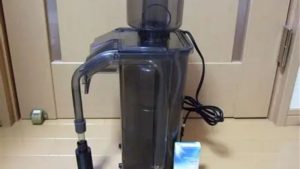
A protein skimmer mixes aquarium water with very fine air bubbles inside a reaction chamber. Organic waste sticks to the bubbles, which rise into a collection cup as dark foam. You remove that foam and the concentrated waste with the cup instead of allowing all of it to remain in the display tank.
Most reef skimmers include a pump, air intake, reaction chamber, collection cup, water-level adjustment, and drain fitting or outlet. In-sump models are usually the most stable because the sump provides a consistent water level. Hang-on-back skimmers can work for tanks without sumps, but they may be more visible, less quiet, and more sensitive to water-level changes.
Expect the physical footprint to be approximately 6 to 10 inches wide by 8 to 14 inches deep for many small and medium models. Height commonly falls between 16 and 24 inches, including enough clearance to remove the collection cup. Check the space above your sump before buying; a skimmer that fits inside the chamber but cannot be lifted out is not a practical fit.
Power use is usually modest. Small DC or needle-wheel pumps often draw about 8 to 20 watts, while larger models may use 20 to 40 watts or more. Electricity cost is rarely the deciding factor. At 15 watts running continuously, the consumption is about 131 kilowatt-hours per year, which costs approximately $20 to $40 annually at common residential electricity rates.
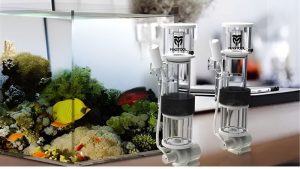
The MagTool DC Protein Skimmer with Controllable Pinwheel Pump N100 Plus, listed for under $200, sits in the small-to-mid-size price category. The N130 Plus, listed at $229, is the larger step-up option. Those prices make sense when you need more capacity, but capacity should not be the only buying criterion. A skimmer that is too large for the aquarium can be difficult to tune and may produce inconsistent foam.
Pros
- Removes dissolved waste continuously. A skimmer works between water changes, helping reduce the organic load created by fish waste, uneaten food, and dying material.
- Improves gas exchange. The air-water interaction can help oxygenate the system and release excess carbon dioxide, which is useful in densely stocked tanks or rooms with limited air circulation.
- Creates more room for stocking mistakes. A skimmer cannot replace responsible husbandry, but it may give a reef more stability when feeding increases or the fish population grows.
- Can reduce the burden on mechanical filtration. Filter socks, floss, and sponges still have a role, but removing waste before it decomposes can mean less material trapped in those filters.
- Helps keep water clearer. Skimming is not a substitute for activated carbon, but it can reduce some compounds that contribute to yellowing water and unpleasant odors.
- Works well with larger systems. On aquariums around 40 gallons and up, especially those with several fish, the ongoing waste removal is easier to justify.
Cons
- It needs regular attention. Expect to empty and rinse the collection cup every few days to once a week, depending on how much it produces. The neck and air intake also need periodic cleaning.
- Break-in can be frustrating. A new skimmer may overflow or produce weak foam for several days, and oils from hands, plastics, or foods can temporarily change its behavior.
- It can remove useful compounds. Aggressive skimming may remove some dissolved organics and trace material that corals and microorganisms use. This is one reason to avoid blindly running a skimmer at maximum output.
- It takes up sump space. A skimmer chamber, return section, refugium, heater, dosing equipment, and probes all compete for room. Measure the footprint and operating water depth before ordering.
- Noise is possible. Air intake hiss, pump vibration, and the sound of water returning to the sump can be noticeable. A properly seated pump and a silencer help, but no skimmer is guaranteed to be silent.
- It may remove too much in a small, lightly stocked tank. If the skimmer pulls out nearly clear water or the aquarium has persistently low nutrients, reduce the air or operating level, run it intermittently, or skip it.
- It cannot fix every water-quality problem. It does not replace water changes, biological filtration, stable salinity, adequate flow, or testing. It also does not directly remove nitrate and phosphate as reliably as targeted nutrient management.
Who Should Buy It
Buy a protein skimmer if you have a reef aquarium with a sump, several fish, frequent feeding, or a history of rising nutrients. It is especially sensible for mixed reefs and fish-heavy systems where the display is roughly 40 gallons or larger. A skimmer is also useful if you travel occasionally and want a little more continuous export between maintenance sessions, although it should never be treated as a substitute for an aquarium sitter.
Choose the model based on the aquarium’s actual bioload rather than the biggest advertised tank rating. A lightly stocked 50-gallon reef may need less skimming than a crowded 30-gallon fish system. The N100 Plus for under $200 may be the more sensible choice for a smaller or moderately stocked setup. The N130 Plus at $229 is easier to justify when you have more fish, heavier feeding, or plans to increase the bioload. Allow room for the skimmer, its cup, and your hands; a few extra inches of clearance can make maintenance much easier.
Who Should Skip It
Skip a skimmer if your aquarium is a small nano reef with one or two fish, your nutrient readings are already stable, or you enjoy maintaining nutrient export through consistent water changes and manual filter cleaning. A skimmer may also be a poor fit for a tank without a sump if you do not want equipment hanging on the back of the aquarium.
Do not buy one simply because every reef build appears to include one. A skimmer that over-exports nutrients, overflows onto the floor, or sits unused because it is difficult to clean is not an upgrade. In a simple 10- to 20-gallon system, a reliable heater, circulation pump, quality light, testing supplies, and an automatic top-off system may provide more practical value.
Cheaper Alternatives
| Option | Cost | Trade-off |
|---|---|---|
| Frequent partial water changes | $5–$20 per month in salt and water, depending on tank size | Low equipment cost, but requires consistent labor and does not provide continuous export. |
| Filter floss or disposable filter pads | $5–$15 per month | Captures visible particles, but does not remove dissolved waste and must be replaced before it decomposes. |
| Activated carbon in a media bag | $8–$20 per month | Can improve water clarity and odor, but it is not a complete substitute for foam fractionation. |
| Refugium with macroalgae | $30–$150 to set up | Provides nutrient export and habitat, but needs light, space, pruning, and time to establish. |
| Hang-on-back skimmer | $80–$200 | Can avoid a sump, but often has a larger visual footprint and may be noisier or more sensitive to water-level changes. |
FAQ
Do reef tanks need a protein skimmer?
No. A reef tank can succeed without one if its bioload is modest and the owner performs dependable water changes, removes debris, and controls feeding. A skimmer becomes more valuable as fish numbers, feeding frequency, and aquarium volume increase.
How often should a protein skimmer run?
Many reef keepers run a properly tuned skimmer 24 hours a day. If nutrients fall too low or the skimmer removes very little besides clear water, you can reduce its air intake or run it on a schedule. Make changes gradually and monitor nitrate, phosphate, coral behavior, and the amount collected in the cup.
Is a protein skimmer worth it for a 30-gallon reef?
It depends on the livestock. A lightly stocked 30-gallon reef can usually be managed with water changes and mechanical filtration. A 30-gallon tank packed with fish or fed heavily may benefit from a small, controllable skimmer, provided it fits the available sump or rear filtration chamber.
What is the biggest mistake when buying a skimmer?
Choosing a model by advertised maximum tank size alone is the most common mistake. Check the recommended operating depth, footprint, height, wattage, pump access, and collection-cup clearance. Then choose enough capacity for the current bioload without dramatically oversizing the unit. A correctly sized skimmer that is easy to clean is usually worth more than a larger model with impressive specifications but poor day-to-day usability.
Ready to decide? Our #1 pick for 2026 is the Frequent partial water changes.
Live price & availability on Amazon.
Related Reviews & Guides
Best Reef LED Light for LPS Corals: Top Expert Buying Guide
Best AquaIllumination Hydra LED for Coral Growth Reviews