Last Updated: September 18, 2026
Quick answer: Our top pick in 2026 is the Hang-on-back filter — our #1 rated choice. See the full ranked comparison, alternatives and buying advice below.
The Short Answer
Yes—if you have a medium-to-large aquarium and will spend a few extra minutes each month on maintenance, a canister filter is often worth it. It provides strong mechanical, biological, and chemical filtration while keeping equipment out of sight. For a small tank, a simple hang-on-back filter usually delivers enough performance with less cost and hassle.
That distinction matters because a canister filter is not automatically “better” for every aquarium. It is a more capable system, but capability comes with hoses, valves, media baskets, seals, and a cleaning routine. In 2026, entry-level canister filters commonly cost about $70 to $100, while established midrange models are often $140 to $220. The right choice depends on your tank size, stocking level, noise tolerance, and willingness to maintain it.
As an Amazon Associate we earn from qualifying purchases at no extra cost to you. Product prices and availability are accurate as of the date shown and are subject to change.

What You Actually Get
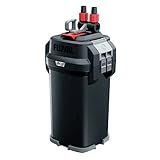
A canister filter is a sealed external pump-and-filter system. Water leaves the aquarium through an intake tube, travels into the canister, passes through one or more media stages, and returns through an outlet or spray bar. The filter usually sits beneath the aquarium in a cabinet or on a sturdy shelf.
Most models use three types of filtration:
- Mechanical filtration: Foam pads or floss trap particles such as uneaten food, plant debris, and waste.
- Biological filtration: Porous ceramic or plastic media provide surface area for beneficial bacteria that process toxic ammonia and nitrite.
- Chemical filtration: Optional media such as activated carbon, phosphate removers, or specialty resins target specific water issues.
Unlike many compact internal filters, a canister can hold several media types at once. A typical unit for a 30- to 50-gallon aquarium may measure roughly 8 to 12 inches wide, 8 to 12 inches deep, and 14 to 20 inches tall before accounting for hose clearance. An empty or lightly loaded canister may weigh 5 to 10 pounds; once filled with water and media, it can be considerably heavier.
Pay attention to the difference between a manufacturer’s maximum tank rating and its useful real-world capacity. A filter advertised for up to 45 gallons may work well on a moderately stocked 30-gallon tank but feel underpowered on a heavily stocked 45-gallon tank. Flow also drops as media becomes dirty, and the actual flow rate is usually lower once water travels through hoses and filtration media.
Power consumption is generally modest. Many aquarium canister filters use about 10 to 25 watts, depending on pump size. That is not a major electricity expense, but the filter runs continuously, so reliability and easy access matter more than saving a few watts.
Pros
- Excellent media capacity: Multiple baskets let you combine coarse foam, fine polishing pads, biological media, and optional chemical media.
- Cleaner-looking aquarium: The motor and most filtration hardware stay below the tank, leaving only intake and return tubes visible.
- Quiet operation: With a properly primed system and no trapped air, an external canister is often quieter than a rattling or vibrating hang-on-back filter.
- Strong circulation: A spray bar can distribute water across the surface and reduce stagnant areas in larger tanks.
- Flexible setup: You can adjust media order, use different outlet styles, and tailor filtration for fish, plants, turtles, or messy eaters.
- Useful for planted aquariums: The equipment can be hidden in a cabinet, helping preserve a clean aquascape.
- Long service life when maintained: Replacing worn O-rings, impellers, and tubing is often possible instead of replacing the entire filter.
Cons
- More expensive upfront: Budget canisters start around $70 to $90, while well-known midrange models often cost $140 to $200 or more.
- More complicated installation: You must route two hoses, position intake and return fittings, and make sure every connection is secure.
- Messier maintenance: Cleaning requires shutting down the filter, closing or disconnecting hoses, carrying a wet canister, and rinsing media in removed aquarium water.
- Leaks are possible: A damaged gasket, loose valve, cracked connector, or incorrectly seated lid can allow water onto the cabinet or floor.
- Priming can be frustrating: Some designs start easily, while others need manual pumping or repeated adjustments to remove air.
- Flow may be too strong: Small fish, shrimp, and slow-moving species may need a spray bar, pre-filter sponge, or flow control.
- Hidden does not mean maintenance-free: A canister can go longer between cleanings than some small filters, but neglected media eventually restricts flow and reduces performance.
Two examples show the price spread. The PONDFORSE Canister Filter, an external ultra-quiet model sold with media, is listed at $71.99. The Fluval 207 Performance Canister Filter, rated for aquariums up to 45 gallons, is listed at $149.89. The cheaper option may appeal to a value-focused buyer, while the higher-priced model may be preferable if you place more weight on established design, parts availability, and long-term support. Price alone does not prove which filter will be quieter or more reliable in your particular setup.
Who Should Buy It
A canister filter makes the most sense for aquariums of about 20 gallons and larger, especially when the tank is heavily stocked or located in a living room, bedroom, or office where visible equipment and noise are distracting. It is also a strong choice for aquascapers who want to keep pumps and media chambers out of the display.
Buy one if you want to customize filtration. A canister is useful when you need extra biological media, fine particle polishing, or a specific chemical medium. It can also be practical for turtle tanks and other systems that produce more waste, although you must choose a model with suitable flow and clean it frequently.
Before buying, confirm that your aquarium stand has enough room. Allow space above the canister to remove the lid and enough clearance behind the tank for tubing. Measure the cabinet rather than assuming a compact-looking filter will fit. A full canister may be difficult to move, so an accessible shutoff valve is a worthwhile feature.
Who Should Skip It
Skip a canister if you want the simplest possible setup, have a tank under about 20 gallons, or dislike wet maintenance. A small hang-on-back filter can provide adequate mechanical and biological filtration for many smaller aquariums at a lower price.
It may also be the wrong choice if your aquarium stand has no enclosed storage, your tank sits on furniture that cannot tolerate moisture, or you frequently move the aquarium. New fishkeepers should not feel pressured to buy the most advanced filter. Correct sizing, regular water changes, and consistent maintenance matter more than the filter category.
Cheaper Alternatives
| Option | Cost | Trade-off |
|---|---|---|
| Hang-on-back filter | $20–$70 | Lower cost and simpler cleaning, but the motor and media are visible and may be noisier. |
| Sponge filter with air pump | $10–$35 | Very inexpensive and gentle for shrimp or fry, but it offers less polishing and requires an external air pump. |
| Internal power filter | $15–$60 | Easy to install and suitable for many small tanks, but it occupies display space and has limited media capacity. |
| DIY sump or overflow system | $100–$300+ | Excellent capacity and customization, but it requires more space, equipment, and setup knowledge. |
For many people, a hang-on-back filter is the best value. A sponge filter is usually the safest budget pick for a breeding tank or low-flow setup. A canister earns its higher price when hidden equipment, large media capacity, and stronger circulation solve a problem that those alternatives cannot.
FAQ
Are canister filters better than hang-on-back filters?
They are more flexible, not universally better. Canisters usually hold more media and keep equipment out of the aquarium, while hang-on-back filters are cheaper, easier to install, and faster to clean. Choose the canister when its extra capacity and cleaner appearance justify the added cost and maintenance.
How often should a canister filter be cleaned?
Inspect flow and the intake sponge weekly, then clean the canister roughly every four to eight weeks as a starting point. A heavily stocked tank may need more frequent cleaning, while a lightly stocked planted tank may go longer. Rinse biological media in removed aquarium water rather than untreated tap water.
Can a canister filter be too powerful?
Yes. Excessive current can stress bettas, shrimp, fry, and slow-moving fish. Use a spray bar, aim the return toward the glass, add a pre-filter sponge, or reduce flow if the model allows it. Match the filter to the aquarium’s occupants, not just its gallon rating.
What size canister filter should I buy?
Use the manufacturer’s rating as a starting point, then size up cautiously for a heavily stocked aquarium. For example, a filter rated up to 45 gallons may be a sensible match for a normally stocked 30- to 40-gallon tank. Always check cabinet dimensions, hose length, wattage, replacement media cost, and the availability of seals and impellers before purchasing.
Ready to decide? Our #1 pick for 2026 is the Hang-on-back filter.
Live price & availability on Amazon.
Related Reviews & Guides


Betta Fish Disease Treatment: Best Products Guide
6 Best TV Stand Fish Tanks 2026