Last Updated: September 25, 2026
Before you set up a big tank, the real question of how much weight can an aquarium stand hold comes down to three verified numbers: the tank full loaded weight, the stand rated capacity, and whether the base footprints actually match. Gallons alone will mislead you.
As an Amazon Associate we earn from qualifying purchases.
By David Nguyen
Quick answer: Our top pick in 2026 is the 55-gal water only — our #1 rated choice. See the full ranked comparison, alternatives and buying advice below.
How to Calculate the Load
Sizing a stand starts with load, not looks. A filled aquarium is far heavier than its water alone, and a rating only means something when the tank base sits fully on the supported frame. Work from published weights first, estimates second.

| Input | Result | Note | Exception |
|---|---|---|---|
| 55-gal water only | 458 lb (55 x 8.33) | Not the finished weight | Add tank, substrate, decor, gear |
| Aqueon 55, full | 625 lb published | Use maker figure, not water only | Varies with substrate/decor |
| Aqueon 75, full | 785 lb published | 160 lb over the 55-class tank | Confirm exact model |
| Brooklyn 55 stand | 825 lb rated | 32% above the 625 lb tank | Footprint 48.5×13.5 in must match |
| AF 75/90 stand | 900 lb rated | 14.6% above the 785 lb tank | Footprint 49.37×19.37 in must match |
Start With Manufacturer Full Weight
Manufacturers publish a full-weight reference for many standard tanks, and it beats any rule of thumb. Aqueon lists a standard 55-gallon at 625 lb full and a 75-gallon at 785 lb full [Aqueon, 2023/2025], figures that already fold in glass, water and a typical setup.
That number is the load your stand carries every day, not a peak. Aqueon also notes full weight varies with substrate and decor, so treat the published figure as a planning baseline and add margin if you run a deep sand bed or heavy rock.
If Needed, Estimate Water at 8.33 lb/gal
When no full-weight sheet exists, estimate the water at 8.33 lb per US gallon [USGS], the freshwater density near room temperature. A 55-gallon holds about 458 lb of water (55 x 8.33) and a 75-gallon about 625 lb (75 x 8.33).
This is water only, not the finished tank. Glass, substrate, rock, filters and a lid push the real load well past the estimate, which is why the water figure always sits below every published full weight. Never plan a stand from the water number alone.
Add Tank, Substrate, Decor and Equipment
Total load is water plus everything that never leaves the tank. The gap between roughly 458 lb of water and the 625 lb published full weight on a 55 — about 167 lb — is exactly the glass, hardware and substrate a water-only estimate ignores.
Aquascaping choices move this a lot: a deep sand bed and dense hardscape add tens of pounds, and a sump or canister adds its own filled weight. Sum the heaviest realistic build, then compare that to the stand rating rather than the bare-tank number.
Match the Entire Bottom Footprint
Capacity is only half the check; the tank base must rest fully on the supported footprint. A 55-gallon at 48.25×12.75 in needs continuous support along that base, and overhang at the ends concentrates stress the rating never assumed.
This is where a bigger number can still fail. The Brooklyn 55 stand supports a 48.5×13.5 in class footprint, so a wider or longer tank than that is out of range regardless of the pounds printed on the box. Measure the base, not the gallon label.
Apply the Method to Real Stand Ratings
Real listings show why the method matters. The gap between a tank full weight and a stand rating tells you the margin, but only after you confirm the footprint fits. Two common freshwater sizes make the arithmetic concrete.
55-Gallon Example: 625 lb vs 825 lb Rating
Pair an Aqueon 55 at 625 lb full with the Imagitarium Brooklyn stand rated 825 lb [Petco, 2026]. The rating sits 32% above the tank full-weight reference (base 625), leaving a real cushion for substrate and rock beyond the baseline.
Read it the other way for perspective: the 625 lb tank is about 24% below the 825 lb ceiling. That spread is comfortable for a standard freshwater build, though a heavily stocked or rock-laden setup eats into it, so keep the footprint aligned too.
75-Gallon Example: 785 lb vs 900 lb Rating
Step up to an Aqueon 75 at 785 lb full on an Aquatic Fundamentals 75/90 stand rated 900 lb [Petco, 2026]. The rating is about 14.6% above the tank full weight (base 785), a tighter margin than the 55-gallon pairing above.
The 785 lb tank is roughly 12.8% below the 900 lb rating, so there is less headroom for a deep sand bed or a filled sump. On a marine or heavily aquascaped 75, plan the load carefully and confirm the 49.37×19.37 in footprint covers the base.
Why a Bigger Rating Does Not Fix a Bad Footprint
A higher number never rescues a mismatch. If the tank base overhangs the supported frame, load concentrates on unsupported glass, and a stand rated for far more weight still fails the tank it cannot support evenly. Rating and contact geometry are separate constraints.
The same gallon label does not mean the same footprint, so two wide or long variants can need different stands. This is the recurring trap in the hobby: buyers size by the box, not the base. Match exact model dimensions before trusting any capacity figure.
Why Floor Capacity Is a Separate Question
The stand transfers the aquarium load through its frame to the floor, but the rating says nothing about what the floor beneath can bear. A concentrated 700-plus-pound point load on an upper story is a structural question the stand spec cannot answer.
House-floor structural capacity cannot be inferred from an aquarium-stand rating, so a large tank near a load-bearing wall or on a slab is the safer placement. For anything heavy on a suspended floor, a contractor read on the joists beats any guess.
Frequently Asked Questions
A few questions come up on every stand-sizing thread, usually about shortcuts buyers wish were true. Each answer below starts with the direct verdict, then the one condition that actually changes it for your tank.
Is 10 lb per gallon accurate?
As a rough ceiling it is close, but it is not exact. Freshwater is 8.33 lb per gallon, and the extra allowance covers glass, substrate and gear. Multiplying gallons by 10 overshoots a bare tank and can undershoot a rock-heavy reef.
Use it only as a sanity check. When a manufacturer full-weight figure exists — like 625 lb for a 55 — that verified number beats any per-gallon rule, because gallons times ten is never the exact loaded weight.
Can I use a stand rated exactly at tank weight?
It is safer to keep a margin. A stand rated right at the tank full weight has no cushion for substrate, rock, a sump or the daily flex of a filled tank, so a rating comfortably above the loaded figure is the practical target.
The 55-gallon example shows why: 625 lb full under an 825 lb rating leaves about a 24% cushion. Aim for headroom like that rather than a rating that only just meets the number, especially for marine builds that carry heavy rock.
Does metal automatically hold more than wood?
No. Capacity comes from bracing, joints and top support, not the material name. Representative metal and wood stands can share the same 550 lb rating, so material alone does not establish higher capacity.
Compare the printed load rating and the top support of the exact models instead. A well-braced wood cabinet can match or beat a light metal frame, so read each stand own spec rather than assuming the metal one wins.
Can I put a larger tank on a smaller stand?
Only if the stand rating and footprint both cover the tank. If the base overhangs the supported frame or the loaded weight tops the rating, the pairing is out of range no matter how sturdy the stand looks.
A 75 at 785 lb needs the wider 49.37×19.37 in support and its 900 lb-class rating, not a 55-gallon stand. When either the pounds or the footprint falls short, choose the correctly rated stand rather than risking an overhang.
Final Thoughts
In the end, how much weight can an aquarium stand hold is answered by data, not gallons: start from the published full weight, fall back to 8.33 lb per gallon only as an estimate, and confirm the base sits fully on the rated footprint. Match those three and the stand carries the tank safely for years.
As an Amazon Associate we earn from qualifying purchases at no extra cost to you. Prices and availability are accurate as of the date shown and are subject to change.

MZNZ 5-10 Gallon Fish Tank Stand with Storage Shelves, 3-Tier Aquarium Stand with Rust-Proof Metal Frame, Heavy Duty Waterproof Reptile Turtle Tank Stand for Home Office Up to 150LBS, 21.5" L x 11.5" W x 30" H, Rustic Brown
Selected for "How Much Weight Can an Aquarium Stand Hold: Top Expert Guide": this listing is stands and furniture (MZNZ 5-10 Gallon Fish Tank Stand with Storage Shelves, 3-Tier Aquarium), matching the equipment this article covers.
View on Amazon
Snughome 10-30 Gallon Fish Tank Stand, Aquarium Stand 2-Tier Storage Shelves, Heavy Duty Terrarium Stand for Home Office Fish Tank Shelf, 30" L x 11.8" W x 30.7" H, Rustic Brown
Selected for "How Much Weight Can an Aquarium Stand Hold: Top Expert Guide": this listing is stands and furniture (Snughome 10-30 Gallon Fish Tank Stand, Aquarium Stand 2-Tier Storage S), matching the equipment this article covers.
View on Amazon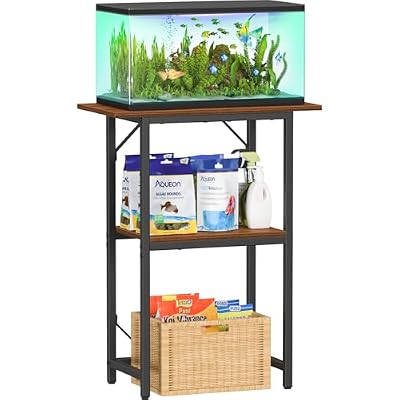
Snughome 10-20 Gallon Fish Tank Stand, Aquarium Stand 2-Tier Storage Shelves, Heavy Duty Terrarium Stand for Home Office Fish Tank Shelf, 24" L x 11.81" W x 30.71" H, Rustic Brown
Selected for "How Much Weight Can an Aquarium Stand Hold: Top Expert Guide": this listing is stands and furniture (Snughome 10-20 Gallon Fish Tank Stand, Aquarium Stand 2-Tier Storage S), matching the equipment this article covers.
View on Amazon
Heybly 20-29 Gal Fish Tank Stand with Drawer, Power Outlet,330lbs HAS001BK
Selected for "How Much Weight Can an Aquarium Stand Hold: Top Expert Guide": this listing is stands and furniture (Heybly 20-29 Gal Fish Tank Stand with Drawer, Power Outlet,330lbs HAS0), matching the equipment this article covers.
View on AmazonReady to decide? Our #1 pick for 2026 is the 55-gal water only.
Live price & availability on Amazon.
Related Reviews & Guides



Best Aquarium Gifts for Fish Keepers: A Practical Guide

Best Pond Filter System for Winter: Cold-Weather Smart Picks