Last Updated: October 21, 2026
The best rodi system for saltwater tanks starts with your tap chemistry, then follows into DI depth and throughput. Adding a sixth stage runs about $72, roughly 29.6 percent over a five-stage build, so the real question is whether your source water and DI consumption justify the extra resin.
As an Amazon Associate we earn from qualifying purchases.
By David Nguyen
How to Choose an RODI System for Saltwater Tanks
Saltwater and reef tanks demand zero-TDS water, so the choice runs from source chemistry to DI architecture to throughput. Identify your disinfectant and how fast you burn DI resin, decide how much DI depth you need, and only then weigh output, since more stages is not automatically better filtration.
Source Water Sets Stage Count
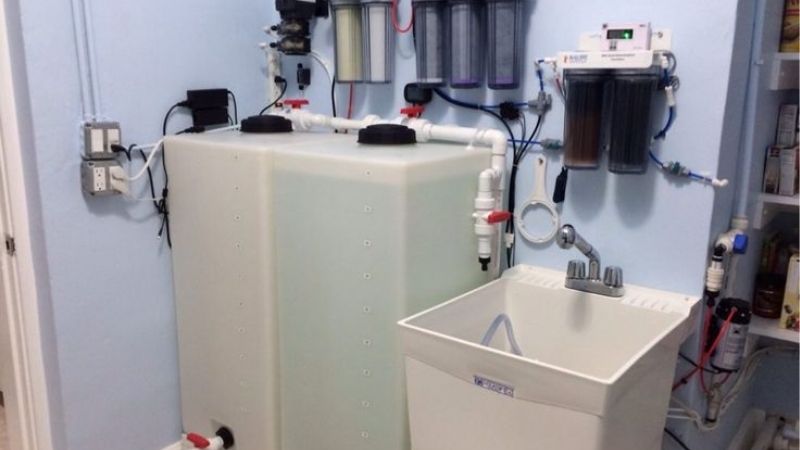
On saltwater the deciding input is your tap chemistry, not a stage-count bragging point. Chloramine and heavy contaminant loads call for more pretreatment and DI capacity, while cleaner supplies need less, so read stage count as a response to your water rather than as a quality score you climb for its own sake.
Because reef water must reach zero TDS, correct pretreatment protects the DI resin that does the final polishing. A build matched to your source keeps that resin from exhausting prematurely, which is where the real recurring cost lives, so match architecture to the water you actually have on your line.
DI Depth Versus Throughput
There is a genuine fork at the same price point: at around $325, you can choose a six-stage build with deeper DI at 75 GPD or a five-stage build with 150 GPD throughput. One favors resin longevity on demanding water; the other favors faster fills when your source is cleaner and time matters.
Stepping from five to six stages costs about $72, near 29.6 percent, while six to seven adds roughly $45, about 14.3 percent, so each layer of DI has a real price. Decide whether your DI consumption or your batch speed is the binding constraint before paying for depth you may not exhaust.
Match Pretreatment to Chloramine
Chloramine is the quiet reef killer of DI resin, so pretreatment must handle it. Dual-carbon builds neutralize chloramine before it reaches the membrane and DI, while lighter stages let it slip through and strip resin fast, which is why the wrong build shows up as surprisingly frequent resin changes.
Testing your water first, since chloramine is common and tasteless, tells you whether you need the dual-carbon route. On saltwater the cost of getting this wrong is both money and risk, since exhausted DI lets TDS into a reef, so matching carbon to your disinfectant is the highest-value decision here.
Throughput and Recurring Media Cost
Reef tanks make a lot of water over time, so throughput and media cost together define the real burden. Faster GPD shortens fills but does not change the DI depth your water demands, and the recurring line, meaning sediment, carbon, DI resin and a TDS meter, is what you pay year after year.
Size output to your change volume and let source water set DI depth independently, since the two axes are separate. Reusing reject water for other uses trims the waste side, but the resin schedule, driven by your tap and your monitoring, is the number that actually governs long-term saltwater running cost.
Top Picks
For saltwater the right build depends on your source water and DI consumption rather than one winner, so the order below is conditional and leads with the water each suits. Match a row to your own tap and throughput needs instead of assuming more stages automatically means a better overall system.
| Product | Best For | Key Spec | Watch Out For |
|---|---|---|---|
| BRS 5 Stage Premium Plus 150 | Cleaner water, faster fills | 150 GPD, 1.5:1, dual carbon | Needs 65 PSI; ~under $350 |
| BRS 6 Stage Premium Plus 75 | Deeper DI on demanding water | 75 GPD, extra DI stage | 3:1 waste; ~under $350 |
| BRS 5 Stage Premium Plus 100 | Chloramine on softer pressure | 100 GPD, dual carbon, 50 PSI | 3:1 waste; ~under $300 |
| BRS 7 Stage Premium Plus 75 | Maximum DI polishing | 75 GPD, deepest DI here | Highest media cost; ~under $400 |
BRS 5 Stage Premium Plus 150
When your source water is relatively clean and you value faster fills, the BRS 5 Stage Premium Plus 150 pairs 150 GPD and a 1.5:1 ratio with dual-carbon pretreatment for around $325 as of 09/28/2026. It is the throughput side of the same-price fork, trading extra DI depth for quicker reef water.
The condition is pressure: it needs 65 PSI minimum, so soft plumbing undercuts both its speed and its ratio and may force a booster. It is the right call only when your water does not demand deep DI and your line clears that threshold, so confirm both before choosing throughput over resin depth.
BRS 6 Stage Premium Plus 75
On demanding water with chloramine or high TDS, the BRS 6 Stage Premium Plus 75 spends the same roughly $325 as of 09/28/2026 on deeper DI instead of speed, adding a stage over the five-stage build for about $72, near 29.6 percent. That extra resin stretches DI life where your source burns it fast.
The trade-offs are output and waste: at 75 GPD fills take longer, and the 3:1 ratio sends more water to drain than a 1.5:1 build. It earns its place when DI consumption, not batch speed, is your binding constraint, so choose it when your tap genuinely exhausts resin faster than a lighter build can handle.
BRS 5 Stage Premium Plus 100
For chloraminated tap on softer plumbing, the BRS 5 Stage Premium Plus 100 keeps dual-carbon pretreatment while dropping the minimum to 50 PSI, around $300 as of 09/28/2026. On a line that cannot sustain 65 PSI, it often reaches closer to its rating than a starved 150 would on the same water.
The trade-offs are the 3:1 ratio, which sends about thirty gallons to drain per ten produced, and a middling 100 GPD output. It is the pressure-limited reef keeper’s practical choice, protecting DI on chloramine while staying passive on soft plumbing, so pick it when pressure rather than DI depth is your real limit.
BRS 7 Stage Premium Plus 75
For the deepest polishing on the worst source water, the BRS 7 Stage Premium Plus 75 adds a further DI layer over the six-stage build for about $45, near 14.3 percent, listed around $350 as of 09/28/2026. Where your tap is genuinely punishing, that extra resin buys the longest DI life in this lineup.
The cost is the highest recurring media spend here, since more DI stages mean more refills over time. Do not choose it as a default; a seventh stage removes contaminants only if your water actually carries them, so reserve it for demonstrably demanding supplies rather than treating stage count as a quality ladder.
Frequently Asked Questions
Saltwater keepers usually ask how many stages they need, whether more DI removes more contaminants, and how to choose between depth and speed at the same price. The answers below attach prices and thresholds to each, so you can match architecture to your water instead of climbing stage count for its own sake.
How Many Stages Does Saltwater Need?
As many as your source water demands, and no more. Chloraminated or high-TDS supplies justify deeper DI and dual-carbon pretreatment, while cleaner water needs less, so the honest answer is set by your tap rather than by a universal reef minimum. Test your disinfectant before deciding how deep to go.
Stepping from five to six stages costs about $72, near 29.6 percent, so each layer of DI has a real price. Buy depth only where your DI consumption proves you need it, since paying for stages your water never taxes just raises the recurring media bill without protecting your reef any further.
Does a Seventh Stage Remove More Contaminants?
Only if those contaminants are actually present. A seventh DI stage adds polishing capacity, but it does not remove a fixed percentage more from water that a six-stage build already brings to zero TDS, so on clean-ish supplies the extra resin mainly sits in reserve rather than doing new work.
Where your source is genuinely punishing, though, that reserve extends DI life meaningfully between changes. So judge the seventh stage by your measured DI consumption, not by the assumption that more stages equals cleaner water, since the membrane and earlier DI already handle most of the load on typical taps.
Deeper DI or Faster Output at the Same Price?
At around $325 the fork is real: a six-stage build gives deeper DI at 75 GPD, while a five-stage build gives 150 GPD throughput. Choose depth when your water burns resin fast, and choose speed when your source is cleaner and shortening fill time matters more than stretching DI life.
Your binding constraint decides it, so identify whether resin consumption or batch time is your actual bottleneck before paying. If chloramine or high TDS is exhausting DI quickly, depth wins; if fills feel slow on clean water, throughput wins, and there is no single right answer across every reef.
Will a Canister or Skimmer Replace RO/DI?
No; they solve different problems. RO/DI makes the zero-TDS starting water you mix salt into, while a protein skimmer and in-tank filtration handle waste inside an established reef, so one cannot substitute for the other no matter how capable your display tank filtration already is.
You still need clean source water even with excellent tank equipment, since tap contaminants would otherwise enter with every change. Treat RO/DI as the input side of reef husbandry and your skimmer and media as the maintenance side, and budget for both rather than hoping one covers the other.
Final Thoughts
A saltwater rodi system is chosen from your tap outward: let source chemistry set DI depth, then weigh the same-price fork of a six-stage 75 GPD build versus a five-stage 150 GPD build. Match dual carbon to chloramine, size output to your changes, and treat stage count as a response to your water, not a quality score.
Red Sea Reefdose 4 Vs 2 Head Dosing Pump: Top Compared Guide
Best Quiet Auto Top Off System: Low-Noise Smart Reef Picks