Last Updated: November 23, 2026
As an Amazon Associate, I earn from qualifying purchases.
A 1 horsepower submersible is the workhorse size for a residential well: strong enough to lift water from a couple of hundred feet and feed a pressure tank, yet still sized for a standard 4-inch casing. The detail that separates the pumps in this guide from the wider 1 HP field is the built-in check valve. That valve sits at the discharge and stops the water column in the drop pipe from running back down through the pump every time the motor stops. Without it, the pump restarts against a draining line, the pressure tank cycles oddly, and the motor and impellers take avoidable wear. With it, the line stays primed and pressure holds between cycles.
Three 1 HP pumps meet the brief here, and they split cleanly by voltage and by output style. Two are high-flow Hallmark Industries models, one on 230V and one on 110V, and the third is a lower-flow, deep-rated Red Lion built for potable-water certification and longer lifts. None of them needs a separate check valve purchase to satisfy the keyword, because each listing states a built-in check valve.
Quick Picks
- Hallmark Industries MA0414X-7A — Best for 230V homes wanting high flow: 1 HP, 33 GPM, 207 ft head, 2-wire, built-in check valve.
- Hallmark Industries MA0414X-7 — Best for 110V supply: the same 33 GPM and 207 ft ratings on a standard-voltage motor.
- Red Lion RL12G10-2W2V — Best for deeper, certified drinking-water installs: 1 HP, 12 GPM class, 434 ft shut-off, NSF/ANSI 372 certified, built-in check valve.
The Pumps in Detail
Hallmark Industries MA0414X-7A Deep Well Submersible Pump
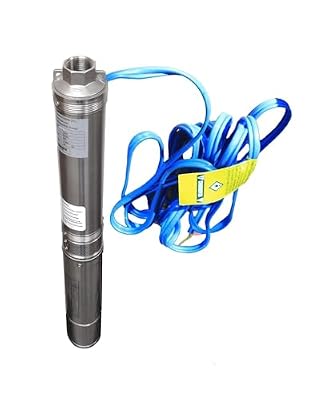
The MA0414X-7A is the 230V version of Hallmark’s 1 HP deep well submersible, and its headline is flow. The listing rates it at 33 GPM maximum with a 207-foot maximum head, from a seven-stage pump end in a stainless steel shell that fits a 4-inch or larger casing. For a house, that flow figure matters less as a promise of 33 gallons every minute and more as headroom: a pump that is not straining at the top of its curve refills a pressure tank briskly and keeps showers and laundry from competing.
It is a 2-wire pump, meaning the starting components are built in and no separate control box is needed at the wellhead, which simplifies both the first install and any later swap. The listing states built-in thermal overload protection and a built-in check valve, so the drop pipe stays charged when the pump stops. The discharge is 1-1/4 inch NPT, the motor draws 5.1 amps at 230V, and the unit ships with a short 10-foot lead, so plan on a proper splice kit and drop cable for the actual set depth.
Specifications from the listing
- Power: 1 HP, 230V, 60 Hz, 5.1 amps
- Maximum flow: 33 GPM
- Maximum head: 207 ft
- Stages: 7
- Discharge: 1-1/4 inch NPT
- Wiring: 2-wire plus ground, built-in capacitor start, no control box required
- Check valve: built in, per the listing
- Shell: stainless steel, for 4-inch or larger wells
Pros
- High 33 GPM rating for a 1 HP submersible
- 2-wire design removes the separate control box
- Built-in check valve and thermal protection stated in the listing
- 230V draw keeps amperage low on long cable runs
Cons
- 207 ft maximum head limits it to moderate-depth wells
- Short factory lead means a splice is always part of the job
- 230V supply is required, so a 110V-only service cannot run it
View the Hallmark MA0414X-7A on Amazon
Hallmark Industries MA0414X-7 Deep Well Submersible Pump
The MA0414X-7 is the 110V sibling of the pump above, built for homes whose well circuit is standard voltage. Its hydraulic ratings mirror the 230V model: 1 HP, up to 33 GPM, and a 207-foot maximum head, in the same stainless steel, 4-inch format with a 1-1/4 inch NPT discharge. That makes it the natural pick when the panel, generator, or existing wiring at the wellhead is 110V and rewiring for 230V is not on the table.
Like the 7A, it uses a 2-wire motor with a built-in control arrangement, so there is no external box to mount or replace, and it carries built-in thermal protection. The trade-off for running this much pump on 110V is current: the motor draws roughly double the amps of the 230V version, so cable gauge and run length matter more. Voltage drop over a long, undersized drop cable is the classic reason a 110V pump underperforms or trips protection, so size the wire to the set depth before ordering.
Specifications from the listing
- Power: 1 HP, 110V, 60 Hz
- Maximum flow: 33 GPM
- Maximum head: 207 ft
- Discharge: 1-1/4 inch NPT
- Wiring: 2-wire plus ground, no separate control box required
- Check valve: built in, per the listing
- Shell: stainless steel, for 4-inch or larger wells
Pros
- Runs on a standard 110V supply
- Same strong flow and head ratings as the 230V model
- No control box to buy or wire
- Stainless shell suits long submersion
Cons
- Higher amp draw makes voltage drop a real planning issue
- Same 207 ft head ceiling as the 230V version
- Splice and drop cable are still on the buyer to supply
View the Hallmark MA0414X-7 on Amazon
Red Lion RL12G10-2W2V Submersible Well Pump
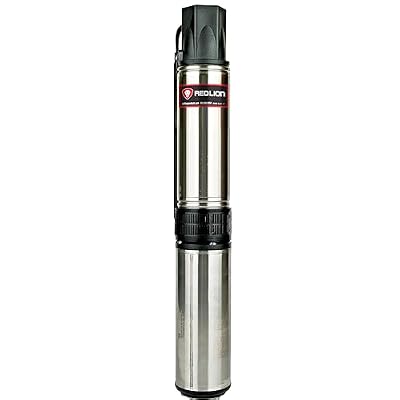
The Red Lion takes the opposite approach to the Hallmarks. Instead of chasing maximum flow, it is a 12 GPM-class pump, delivering a rated 12 GPM at 30 PSI from 160 feet, with a 434-foot shut-off head. That profile suits deeper wells and ordinary household demand — taps, showers, and appliances rarely call for anything near 33 GPM — where lift and pressure matter more than raw volume.
It is also the credentialed pick. The listing states NSF/ANSI 372 certification for safe drinking water, plus CSA and UL listing, which matters when the well feeds a kitchen tap. The body is 3.9 inches across, fitting 4-inch or larger wells, with a steel shell and a thermoplastic discharge of 1-1/4 inch FNPT. The 2-wire design builds the switch mechanism into the pump, so no control box is required, and Red Lion’s specification includes a built-in check valve and suction screen. At 230V it draws 10.4 running amps per the listing.
Specifications from the listing
- Power: 1 HP, 230V, 10.4 running amps
- Rated flow: 12 GPM at 30 PSI from 160 ft
- Shut-off head: 434 ft
- Discharge: 1-1/4 inch FNPT
- Wiring: 2-wire plus ground, no control box required
- Check valve: built in, per the manufacturer specification
- Certifications: NSF/ANSI 372, CSA and UL listed
- Diameter: 3.9 inches, for 4-inch or larger wells
Pros
- Deep capability with a 434 ft shut-off head
- Certified for potable water contact
- Built-in check valve and suction screen
- Modest flow rating matches real household demand closely
Cons
- 12 GPM class will refill large tanks and irrigation zones slowly
- 230V only
- Heavier, more traditional install than the light Hallmark units
View the Red Lion RL12G10-2W2V on Amazon
How to Choose a 1 HP Submersible Well Pump
Match voltage first. A pump cannot adapt to the wrong supply. If the well circuit is 230V, both the Hallmark 7A and the Red Lion are candidates; if it is 110V, the Hallmark 7 is the fit here. Running a 230V pump on 110V, or the reverse, is not a gray area.
Work from total head, not well depth alone. Add the vertical lift from the pump setting to the pressure tank, the tank pressure converted to feet, and friction loss in the pipe. A pump whose maximum head barely exceeds that total will deliver a trickle at pressure. The Red Lion’s 434 ft shut-off suits deep sets; the Hallmarks’ 207 ft ceiling suits moderate ones.
Read flow at your depth, not the maximum. Maximum GPM is measured at little or no lift. What matters is the flow the curve gives at your lift and pressure — the Red Lion states this directly with its 12 GPM at 160 ft and 30 PSI figure, which is the honest way to compare.
Confirm the check valve, then still protect the line. Every pump here lists a built-in check valve, which holds the water column between cycles. Many installers add a second valve at the tank; follow the pump maker’s guidance, and never rely on a valve you have not confirmed is in the listing.
Check casing and discharge. All three pumps need a 4-inch or larger casing and use a 1-1/4 inch discharge. Measure before you order, and budget for drop cable, a splice kit, safety rope, and torque protection as part of the same job.
FAQs
Why does a built-in check valve matter on a well pump?
It stops the water in the drop pipe from draining back into the well when the pump stops. That keeps the system primed, holds pressure at the tank, and prevents the backspin and water hammer that shorten pump life.
Is 1 HP enough for a whole house?
For most homes, yes. Household demand is usually well under the flow these pumps deliver at working depth, and 1 HP provides enough head for a standard pressure tank setup on a moderate-depth well. Very deep wells or high simultaneous demand are the cases that push buyers to larger motors or deep-rated models like the Red Lion here.
Do I still need a control box with a 2-wire pump?
No. A 2-wire pump has its starting components built in, which is why all three pumps here are listed as not requiring a separate control box. A 3-wire pump is the design that needs one.
Can I install one of these myself?
Many homeowners do, but the job involves lowering a heavy pump on pipe or cable, making a waterproof splice, and wiring a 230V or 110V circuit. If any of that is unfamiliar, a licensed well contractor or electrician is the safer route, and local codes may require one.
Conclusion
For a 230V home that wants flow headroom, the Hallmark MA0414X-7A is the straightforward pick; its 110V twin, the MA0414X-7, covers the same ground where only standard voltage is available. For a deeper well feeding drinking water, the Red Lion RL12G10-2W2V trades headline flow for lift and certification. All three keep the built-in check valve the brief calls for — confirm your voltage, casing, and total head against the listings, and the right pump chooses itself.
Best One and a Half Horsepower Submersible Well Pumps with Built In Check Valves for Residential Wells

Best Freshwater Shrimp Food: 5 Picks for Healthy Colonies