Last Updated: October 4, 2026
Flow is spatial, so the biggest number on the box rarely tells you what your tank will feel. The best circulation pump for saltwater aquarium use is one with a verified adjustable range, genuine flow modes, and a size and mounting that fit your tank, not just a headline maximum GPH.
As an Amazon Associate we earn from qualifying purchases.
By David Nguyen
How to Choose a Saltwater Circulation Pump
Circulation is about moving water everywhere, not blasting one spot. The specs that matter are an adjustable range you can actually tune, a match between that range and your tank, how the pump spreads flow, and the control and upkeep it needs. These four beat a single GPH figure.
Adjustable Flow, Not Max GPH Alone
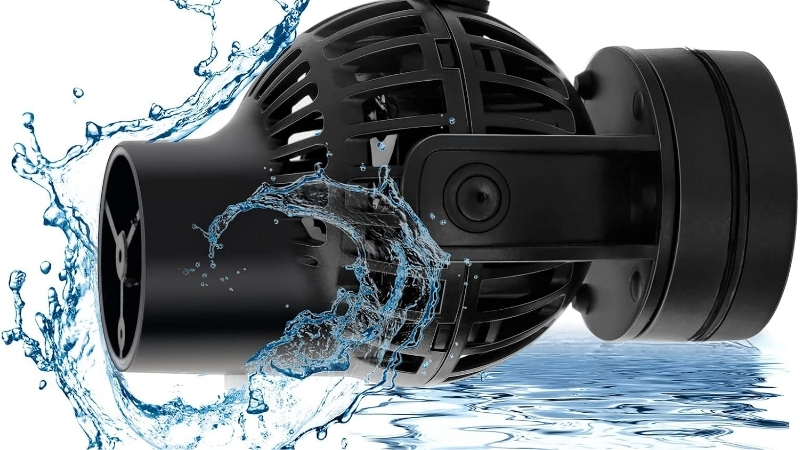
A pump you can dial across a wide band suits more tanks than one that only lists a ceiling. The SICCE XStream SDC publishes a 270–2,250 GPH range with its controller (SICCE, 2026), so you know both ends before buying, which matters far more than a lone maximum.
Nominal GPH differences also do not equal useful flow differences, so a 3,000 GPH pump is not simply better than a 2,250 one. Judge a pump by whether its adjustable range covers what your tank needs, then tune within it, rather than treating the top number as a quality score.
Match Range to Tank
Pumps are built for size bands, so match the pump to your volume. The AI Nero 5 targets 40 to 100-plus gallons with a 3,000 GPH maximum (AI, 2026), while smaller pumps suit nanos. Oversizing a pump on a small tank often means running it near its floor, where control is coarse.
Undersizing leaves dead spots that no amount of aiming fixes. Pick a pump whose range brackets your tank so your working setting sits comfortably in the middle, giving headroom to increase flow later without swapping hardware or living at the extreme ends of the dial.
Wide Flow vs Placement
How a pump spreads water decides dead spots as much as its output. A wide, gentle flow circulates a tank more evenly than a narrow jet, which is why placement and flow shape matter. Circulation quality is spatial: direction and pattern determine local velocity and where detritus settles.
Use the pump’s positioning to your advantage. The XStream SDC mounts with 360-degree positioning (SICCE, 2026), letting you aim across the surface and into shaded corners. Start by clearing the areas where detritus collects, then fine-tune the setting rather than simply turning everything up.
Controller, App and Maintenance
Control and upkeep separate a pump you enjoy from one you fight. The XStream SDC runs on a controller with the ContrALL app for modes and schedules (SICCE, 2026), while the EcoTech MP10mQD keeps its motor outside the tank, so there is no in-tank electrical cord in the display.
Weigh how much programmability you want against cleaning access. In-tank pumps need periodic impeller cleaning in salt water, and external-motor designs trade that for a glass-thickness limit. Choose the balance of app control and maintenance you will actually keep up with over months of running.
Best Saltwater Circulation Pumps
These four span a verified-range all-rounder, a broad-flow pump for larger tanks, an external-motor design and an efficient controlled option. They are separated by adjustable range, control and mounting, not by their biggest GPH number. Prices and generations vary, so confirm the exact current model first.
| Product | Best For | Key Spec | Watch Out For |
|---|---|---|---|
| SICCE XStream SDC | Best overall | 270–2,250 GPH; 12V, 360° | Needs its controller |
| AI Nero 5 | Best value, larger tanks | 3,000 GPH; 40–100+ gal | ≤0.63 in glass limit |
| EcoTech MP10mQD | No in-tank cord | 2,500 GPH; ≤0.375 in glass | Priciest; generation matters |
| TUNZE 6075 | Efficient controlled flow | ~700–2,000 GPH; 1–8W | Premium price |
SICCE XStream SDC
The SICCE XStream SDC earns the top slot because it is verified on the defining axis: a 270–2,250 GPH adjustable range with a controller and ContrALL app, a low-voltage 12V/12W design, and 360-degree positioning (SICCE, 2026). At around $300 at BRS as of 09/2026, it is a complete controllable package.
That published low-to-high range plus scheduling makes it easy to tune for many tank sizes. It relies on its controller to unlock modes, which is part of the cost. For a saltwater tank that wants dependable, adjustable circulation with app control, it is the safest overall pick here.
AI Nero 5
The AI Nero 5 is the value choice for larger tanks, with a 3,000 GPH maximum, a 40 to 100-plus gallon range, and up to 30W draw (AI, 2026). At about $250 at BRS as of 09/2026, roughly 13% below the XStream, it delivers strong flow for bigger reefs at a lower price.
Its higher maximum suits mid-to-large displays that need serious movement. Note the 0.63-inch maximum glass thickness, since it couples externally, and remember that a bigger GPH ceiling is only useful if the range still suits your tank. For larger systems on a budget, it is a compelling pick.
EcoTech MP10mQD
The EcoTech MP10mQD keeps the motor outside the tank, so there is no in-tank electrical cord in the display. The current mQD rates 2,500 GPH with an 8–19W draw and a 2.5 to 50-plus gallon range (EcoTech, 2026). It runs about $400 at BRS as of 09/2026, the priciest here.
The clean in-tank look is its draw, offset by a 0.375-inch glass limit and premium cost. Watch the generation: the current mQD does 2,500 GPH, while older MP10QD listings can show 1,500, so confirm you are buying the current model rather than an older one at a similar price.
TUNZE 6075
The TUNZE 6075 is the efficient, controlled-flow option, drawing just 1–8W for roughly 700–2,000 GPH and rated for reef tanks up to 132 gallons (TUNZE, 2026). At around $325 from TUNZE USA as of 09/2026, its low power draw stands out for a pump moving that much water.
That efficiency suits keepers who run pumps around the clock and care about energy use. It sits at a premium price, and like any in-tank pump it needs periodic impeller cleaning. For controlled, low-wattage circulation across a wide range of tank sizes, it is a strong, efficient choice.
Frequently Asked Questions
Reefers ask the same things about circulation: how much flow a saltwater tank needs, whether a bigger maximum wins, how to avoid dead spots, and how often pumps need cleaning. Short answers first, then the practical caveats.
How much flow does a saltwater tank need?
It depends on the livestock, so treat turnover figures as a starting point. Soft corals and fish-only tanks want gentler flow than SPS reefs, and the aim is enough movement to keep detritus suspended and reach every corner without blasting the animals. A tunable pump lets you find it.
Because flow is spatial, the same GPH feels different depending on placement and tank shape. Start moderate, watch how detritus settles and how corals respond, and adjust the setting or aim rather than assuming a bigger pump is automatically the answer.
Is a higher maximum GPH always better?
No. A larger maximum only helps if the adjustable range still suits your tank, and nominal GPH differences do not translate directly to useful flow. A 3,000 GPH pump is not simply better than a 2,250 one; what matters is whether you can tune it to the movement your tank needs.
On smaller tanks, an oversized pump may run near its floor where control is coarse. Prioritize a range that brackets your tank and good flow shaping over a big top number, and judge the result by how the water actually moves, not by the spec sheet.
How do I avoid dead spots?
Dead spots come from flow pattern, not just output. Aim pumps to sweep across the surface and into shaded corners, and use wide flow rather than a narrow jet where you can. A pump with flexible positioning, like the XStream’s 360-degree mount, makes this much easier to dial in.
Watch where detritus collects and redirect flow toward those areas first. On larger or complex aquascapes, a second pump on the opposite side can break up stagnant zones better than simply increasing one pump’s output and creating a single strong current.
How often do circulation pumps need cleaning?
In-tank pumps need periodic impeller and housing cleaning because salt creep and biofilm build up over weeks. A regular rinse in freshwater or a vinegar soak keeps flow strong and quiet, and neglecting it is the usual reason a pump slows or gets noisy over time.
External-motor designs like the MP10mQD keep the electronics dry but still have a wet-side impeller to service. Set a maintenance interval that matches your tank’s buildup, and clean sooner if you notice flow dropping, since a fouled impeller strains the motor as well as weakening circulation.
Final Thoughts
The best circulation pump for saltwater aquarium use is the one with a verified adjustable range, real modes, and a fit for your tank and glass, judged on how it moves water rather than its biggest GPH figure. The XStream SDC leads on a published range and app control, the Nero 5 suits larger tanks on a budget, and the MP10mQD and TUNZE 6075 cover clean looks and efficiency. Match the range to your tank first.
As an Amazon Associate we earn from qualifying purchases at no extra cost to you. Prices and availability are accurate as of the date shown and are subject to change.
Simplicity 320DC vs 540DC Protein Skimmer Compared Guide
Best Kessil LED Light for Reef Tank: How to Pick by Size