Last Updated: September 27, 2026
For a newcomer, the best calcium reactor for beginners is the one you can actually set up, tune and maintain, not the one with the biggest spec sheet. Confirm your demand justifies a reactor first, because a reactor is never maintenance-free and adds real CO2 handling to learn.
As an Amazon Associate we earn from qualifying purchases.
By David Nguyen
Quick answer: For most people in 2026, the best calcium reactor for beginners is the AquaReady cTech T-1 — our #1 rated choice. See the full ranked comparison, alternatives and buying advice below.
How to Choose a Beginner Calcium Reactor
For a beginner, the hardest part of a reactor is the tuning and the parts list, not the price, so choose for manageability once demand justifies one. These criteria favor clear documentation, honest parts counting and included control provisions, since a reactor a newcomer can run beats one with a slim spec edge.
Confirm You Actually Need One
Before shopping, make sure a reactor is the right tool, because many beginner reefs have modest demand that two-part dosing meets cheaply and safely. A reactor is not necessary for every reef, and it is certainly not required for all SPS, so measure your daily alkalinity draw before assuming you need one.
If your demand is low or the tank is new, holding off is a legitimate beginner decision that avoids CO2 handling you are not ready for. Let a measured, rising consumption trend, rather than eagerness for advanced gear, be the signal that a reactor will genuinely save you effort rather than simply add complexity.
Favor Clear Documentation
For a first reactor, good instructions are worth more than a spec advantage. A body with a clear setup and tuning workflow lets a beginner leak-test, purge air, establish flow and dial output without guesswork, which matters far more than a slightly larger chamber when you are still learning to read effluent.
Because tuning targets are model and media specific, documentation also keeps you from copying another tank’s settings. Follow the maker’s own guide, change one variable at a time, and confirm several days of stability before adjusting again, so the learning curve stays gentle rather than a source of swings.
Count the External Hardware
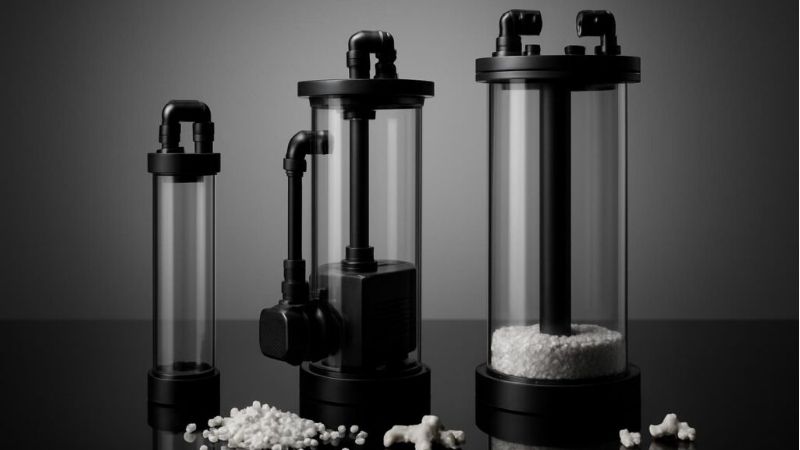
A reactor body is only part of the cost, so count everything it needs before buying. A working setup usually adds a feed pump, a CO2 regulator with solenoid, a bubble counter, CO2 media and ideally a pH controller, so a low body price can hide a much larger bill once the full chain is assembled.
Some bodies reduce that list by bundling parts, such as the AquaReady T-1 shipping with a Sicce pump, but you still supply the CO2 side. Reading each listing against the full parts chain prevents a half-finished install and tells you which reactor is genuinely beginner-friendly on total cost, not just sticker price.
Make Slow Tuning Changes
Beginner mistakes usually come from impatience, so choose a reactor you can adjust in small, controlled steps and commit to changing one thing at a time. A body and pump that hold a stable output make this easier, letting you nudge effluent or CO2 gently rather than chasing a target with large, risky moves.
Plan on waiting several days after each change to judge the result, since the tank’s alkalinity trend, not an instant reading, shows whether tuning is right. A reactor that rewards patience suits a beginner far better than one that feels twitchy, so weigh stable, gradual control as a real selection criterion.
Top Picks
These four bodies are ranked for how manageable they are for a newcomer once demand justifies a reactor, not for raw capacity. Shortlist from the table, then confirm your measured draw and read the maker’s tuning guide, since the friendliest reactor is the one you can set up and keep stable without frustration.
| Product | Best For | Key Spec | Watch Out For |
|---|---|---|---|
| AquaReady cTech T-1 | Best Overall for beginners | 75-300 gal; 2.9 L; Sicce pump; ~$235 (Sep 2026) | Still needs CO2 gear and tuning |
| Reef Octopus CR-100 | Best for a smaller first system | 69-120 gal; 1.5 L chamber; 15 W pump | pH probe and CO2 gear not included |
| Tunze 3171 | Best for a larger beginner reef | Up to 317 gal; 1.85 L media; 25 W US; $579.99 | Priciest; rating depends on coral load |
| GEO CR612 GEN3 | Best for verified capacity | Up to 150 gal; 8 lb media; ~$425 direct | More reactor than a light reef needs |
AquaReady cTech T-1 — Best Overall for Beginners
The AquaReady cTech T-1 is the most beginner-manageable body here. Its 75 to 300 gallon range and 2.9-liter chamber fit most reefs that have grown into needing a reactor, an included Sicce pump trims the parts list, and at around $235 as of September 2026 it leaves budget for a solid regulator and controller.
It still requires the CO2 side and patient tuning, so treat the price as a starting point rather than the finished cost. Follow its own documentation for effluent and internal pH instead of copied figures, change one setting at a time, and wait for several days of stability before adjusting the reactor again.
Reef Octopus CR-100 — Best for a Smaller First System
The Reef Octopus CR-100 suits a smaller beginner reef whose demand is real but moderate, bracketing 69 to 120 gallons on a 1.5-liter chamber with a 15-watt pump. It is a right-sized current body from an established brand, keeping a newcomer from overspending on capacity a modest tank will never actually use.
Its pH probe and the CO2 gear are not included, so budget those before assuming it is complete, and its smaller chamber means more frequent refills. Confirm current pricing, and if you expect the reef to grow substantially, weigh this right-sized fit against a body with more headroom before deciding.
Tunze 3171 — Best for a Larger Beginner Reef
For a beginner starting on a larger, more demanding reef, the Tunze 3171 offers capacity up to 317 gallons with 1.85 liters of media and a 25-watt US pump. That headroom keeps output steady while you find your footing with tuning, so a big first tank need not run its reactor near the top of its range.
At $579.99 it is the most expensive body here, and its rating is conditional on coral population rather than a fixed output test, so it is overkill for a light reef. Keep the region-specific 25-watt US electrical figure in mind, and reserve this for a genuinely large beginner system that clearly justifies it.
GEO CR612 GEN3 — Best for Verified Capacity
The GEO CR612 GEN3 gives a beginner verified capacity, rated up to 150 gallons with 8 pounds of media for long refill intervals. At about $425 direct as of September 2026 it steadies output on a busier first reef, which can reduce how often a newcomer has to interrupt a working system to service it.
Its media is quoted in pounds, which cannot be compared straight to liter chambers without density, and it still needs the full external control chain. On a lightly stocked beginner reef it is more capacity and cost than the load needs, so size to measured demand rather than buying the largest body you can afford.
Frequently Asked Questions
Beginners ask practical questions about friendliness, features and when a reactor beats dosing. These answers stay on manageability and measured demand, since the biggest newcomer risk is adding CO2-driven automation before the reef needs it, and the second is expecting a reactor to run without any upkeep.
How Beginner-Friendly Are Calcium Reactors?
They are manageable with patience, but they are not plug-and-play, since a reactor involves CO2 handling, tuning and regular upkeep. The friendliest bodies pair clear documentation with stable, gradual control, which lets a newcomer set flow, purge air and dial output without the swings that come from rushed changes.
A reactor is also never maintenance-free; you refill media, clean the pump and monitor effluent over time. Treating it as a system to learn rather than a set-and-forget device is the mindset that makes it beginner-friendly, so choose a body known for good instructions and forgiving, incremental adjustment.
Which Features Make Tuning Easier?
Look for a controllable, stable pump, a clear bubble counter and provision for a pH controller with a decent probe, since these let you make small, repeatable adjustments. Included parts, like a bundled feed pump, also reduce the number of unfamiliar components a beginner has to source and integrate correctly.
Clear, model-specific documentation ties it all together, because tuning targets vary by reactor and media and cannot be copied between tanks. A body that spells out its own starting effluent and internal pH, and that adjusts gently, is far easier for a newcomer than one with a sparse manual and twitchy control.
What Metrics Should a Beginner Watch?
Watch the aquarium’s alkalinity trend first, since holding that steady is the reactor’s whole job. Alongside it, track effluent flow, internal pH and how fast you use media, because a slipping alkalinity reading or a shortening refill interval is the early sign that demand has moved past your current settings.
Judge success by the tank’s readings over several days, not an instant number, and adjust one variable at a time. Because targets are model and media specific, a calm, on-target alkalinity trend on your own system, rather than a borrowed bubble count, is the real proof that a beginner has tuned the reactor correctly.
When Should a Beginner Switch From Two-Part?
Switch when dosing volume or frequency becomes a genuine burden, usually as coral load and daily demand rise. If you are refilling two-part containers constantly or your measured draw has climbed well beyond easy manual dosing, a reactor automates both parameters and often saves time and supplement cost over the year.
On a small, stable or new reef that point may never arrive, and staying with two-part is a sound beginner choice. Let your measured consumption trend make the call rather than a desire for advanced gear, since a reactor added too early simply piles CO2 handling onto an already busy learning curve.
Final Thoughts
The best calcium reactor for beginners is the one you can set up, tune and maintain once demand justifies it, remembering it is never maintenance-free or required for every reef. Confirm the need, count every part, and favor clear documentation: the AquaReady cTech T-1 is the most manageable current pick.
Ready to decide? Our #1 pick for 2026 is the AquaReady cTech T-1.
Live price & availability on Amazon.
Related Reviews & Guides
Neptune Apex Jr vs Full Apex Which Controller: Best Compared
Best Reef Octopus VarioS Pump for Return Flow: Top Picks