Last Updated: October 4, 2026
Hard water tells you which fish you can keep, not what size tank to buy. The best aquarium for hard water fish is chosen by the species, because hard-water fish range from tiny livebearers to large Rift Lake cichlids, whose tank needs differ enormously, and ordinary glass is not a special hard-water tank.
As an Amazon Associate we earn from qualifying purchases.
By David Nguyen
Hard Water Does Not Set Tank Size by Itself
Water hardness defines suitable species, but the tank size comes from those species, not the water. What matters is defining hard water, then sizing for small livebearers, larger livebearers, or Rift Lake cichlids, each a different scale. These four show why there is no one hard-water tank size.
Define Hard Water
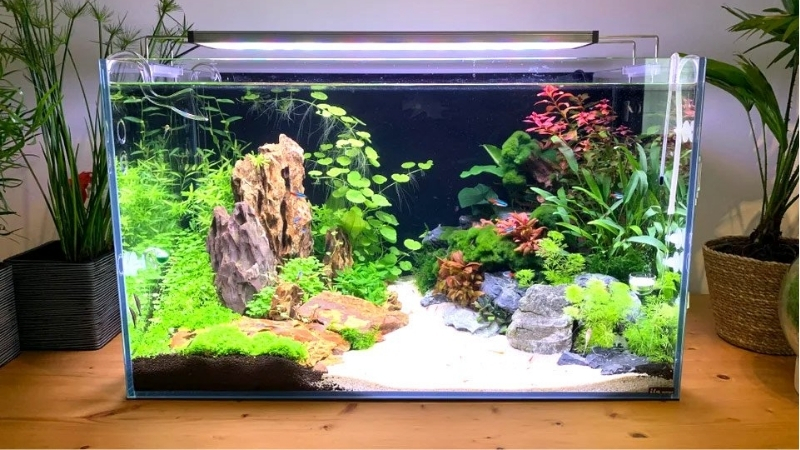
Hard water is a hardness range, not a fish type. Aqueon’s chart puts hard water at about 8.5 to 17 dH, or 150 to 300 ppm, and very hard above 17 dH or 300 ppm (Aqueon, 2026). Hardness mainly reflects dissolved calcium and magnesium, and matching fish to your source water reduces the need to alter chemistry.
Knowing your tap water’s hardness lets you pick fish adapted to it rather than fighting the chemistry. Many hard-water species come from mineral-rich waters and thrive in it, which is easier than constantly softening or buffering. Start by testing your water, then choose livestock that suits the reading.
Livebearers
Small livebearers are the accessible entry to hard-water keeping, tolerating a pH around 7.0 to 8.4, with common species suited to roughly 5 to 20 gallons depending on the fish (Aqueon, 2026). Guppies, platies and similar fish do well in hard, alkaline water without special equipment.
Their modest size means a small-to-medium tank suffices, but do not assume all livebearers fit a 10-gallon, since needs vary by species and stocking. Match the volume to the specific fish and group size, and hard water becomes an advantage rather than a problem for these popular, hardy fish.
Larger Livebearers
Bigger livebearers need noticeably more room. Swordtails and sailfin mollies call for about 20 to 30 gallons (Aqueon, 2026), as they grow larger and are more active than guppies or small platies, so a tank that suits a small livebearer community can be too cramped for them.
Step up the volume for these species rather than crowding them into a nano. The jump from small to larger livebearers is a good example of why hard water alone does not set tank size, since two hard-water fish from the same broad group can need very different tanks.
Rift Lake Cichlids
At the large end, Rift Lake cichlids need a much bigger tank, with general guidance of at least 55 gallons and water around pH 8 to 9 and 10 to 25 dKH alkalinity (Aqueon, 2026). They are the hard-water fish that demand the most space and the most robust setup.
Hard, alkaline water suits them, but that does not make them automatically appropriate; the 55-gallon-plus requirement and their territorial nature must be met first. This is the clearest case where matching water is only the start, and the species’ size and behavior drive a far larger tank than livebearers need.
Best Aquariums by Hard-Water Fish Type
These four tanks are separated by the species they suit, from larger livebearers to mixed African cichlids, not by a single overall winner, since hard-water fish vary so widely. Keep each nominal volume tied to its footprint. Confirm current pricing and stand load rating before buying, as sale figures are temporary.
| Product | Best For | Key Spec | Watch Out For |
|---|---|---|---|
| Aqueon 20 Long | Larger livebearers | 30.25×12.5 in; 20 gal | Too small for cichlids |
| Aqueon 40 Breeder | Livebearer community | 36.375×18.25 in; 40 gal | Below Rift Lake minimum |
| Aqueon 55 | Rift Lake minimum class | 48.25×12.75 in; ~615 in² | Narrower footprint |
| Aqueon 75 | Mixed African cichlids | 48.5×18.5 in; ~897 in² | Heavy; sale price temporary |
Aqueon 20 Long
The Aqueon 20 Long suits larger livebearers, at 30.25 by 12.5 by 12.75 inches and around $70 at Petco as of 09/2026 (Aqueon, 2026). Its 20-gallon volume fits swordtails or sailfin mollies that need more than a small livebearer nano, while staying compact and affordable for a hard-water community.
It gives active livebearers room to swim without the cost of a big tank. It is, however, too small for Rift Lake cichlids, so it is a livebearer tank, not a cichlid one. For a hard-water setup centered on guppies, platies and larger livebearers, it is a practical, budget-friendly size.
Aqueon 40 Breeder
The Aqueon 40 Breeder is a larger livebearer community tank, at 36.375 by 18.25 by 16.94 inches and around $150 at Petco as of 09/2026 (Aqueon, 2026). Its wide footprint suits a bigger, mixed hard-water community with more fish and swimming room than the 20 long provides.
The extra floor area and volume make it more flexible and stable for a busy livebearer tank. It still sits below the 55-gallon Rift Lake minimum, so it is not a cichlid tank. For keepers wanting a substantial hard-water community short of cichlids, the breeder’s footprint is a strong middle option.
Aqueon 55
The Aqueon 55 meets the Rift Lake minimum class, at 48.25 by 12.75 by 21 inches for about 615 square inches of base, around $200 at Petco as of 09/2026 (Aqueon, 2026). It satisfies the general 55-gallon guidance for common Rift Lake cichlids at a lower cost than the 75.
It is the entry point for hard-water cichlids, meeting the volume floor for a typical community. The trade-off is the narrower 12.75-inch front-to-back width, which gives less territory than the 75. For a first Rift Lake cichlid tank on a budget, it clears the minimum, with the footprint caveat noted.
Aqueon 75
The Aqueon 75 is the pick for a mixed African cichlid setup, at 48.5 by 18.5 by 21.125 inches for about 897 square inches of base, roughly 46% more floor than the 55 (Aqueon, 2026). A recent Petco snapshot showed about $160 on sale against a under-$350 regular price as of 09/2026.
That wider footprint gives territorial cichlids more room to separate, reducing conflict in a busy tank. It is heavy and needs a solid stand, and the sale price is temporary, so confirm the current figure. For a serious hard-water cichlid community, the 75’s extra territory makes it the strongest choice.
Frequently Asked Questions
Hard-water keepers ask the same things: what counts as hard water, whether all hard-water fish need a big tank, whether hard water makes cichlids automatically suitable, and whether a special tank hardens water. Short answers first, then the caveats.
What counts as hard water?
By Aqueon’s chart, hard water is about 8.5 to 17 dH or 150 to 300 ppm, and very hard is above 17 dH or 300 ppm (Aqueon, 2026). Hardness mainly reflects dissolved calcium and magnesium, so it is a measurable property of your water rather than a vague description.
Test your tap water to find its hardness, then choose fish adapted to that reading. Matching livestock to your source water is easier than constantly altering chemistry, and knowing the number is the first step to picking suitable hard-water species and the right tank for them.
Do all hard-water fish need a big tank?
No. Hard-water fish span a huge size range, from small livebearers suited to 5 to 20 gallons up to Rift Lake cichlids needing 55 gallons or more (Aqueon, 2026). The tank size comes from the species, so there is no single answer for hard-water fish as a group.
This is why you size by the fish, not the water. A guppy community and a cichlid tank are both hard-water setups with completely different requirements, so decide on the species first, then choose a tank that meets that species’ volume and footprint needs.
Can I keep African cichlids just because my water is hard?
Not automatically. Hard, alkaline water suits Rift Lake cichlids, but that alone does not make them appropriate; you also need at least a 55-gallon tank and to accommodate their territorial behavior. Matching the water is necessary but not sufficient for keeping them well.
Confirm you can meet the space and setup requirements before choosing cichlids over easier hard-water fish. If a large tank is not practical, livebearers make excellent use of hard water at a fraction of the size, so match ambition to the space you actually have.
Does a special tank make water harder?
No. Ordinary aquarium glass does not change water hardness; there is no special hard-water tank. Hardness comes from dissolved minerals in the water, so you adjust it through substrate, source water and buffering, not by buying a particular tank.
If your water is already hard, the easiest path is choosing fish that suit it rather than trying to change it. Where you do want to raise hardness, mineral-rich substrate or buffering does the job, but the tank itself is just a container and plays no part in the chemistry.
Final Thoughts
The best aquarium for hard water fish is chosen by the species, since hard-water fish run from small livebearers to large Rift Lake cichlids with very different needs. The 20 long and 40 breeder suit livebearers, the 55 meets the cichlid minimum, and the 75 gives cichlids real territory. Test your water, pick fish that suit it, then size the tank to those fish.
As an Amazon Associate we earn from qualifying purchases at no extra cost to you. Prices and availability are accurate as of the date shown and are subject to change.
8 Best Budget Aquarium Nets for Catching Fish
Best Fish Tanks for Small Spaces in 2026: Compared and Ranked