Last Updated: October 4, 2026
A fish room lives or dies on how many devices and sensors one platform can run without overloading a bar. The best aquarium controller for a fish room is the one whose controlled outlets, sensor inputs, and expansion match your tank count, since there is no single winner until you know exactly what you need to control.
As an Amazon Associate we earn from qualifying purchases.
By David Nguyen
Quick answer: For most people in 2026, the best aquarium controller for a fish room is the Neptune A3 Apex + extra EB832 — our #1 rated choice. See the full ranked comparison, alternatives and buying advice below.
How to Choose an Aquarium Controller
Sizing for a fish room means counting the real work: the AC devices you must switch, the sensors you must read, the expansion you will need, and the electrical load per bar. Because different port types are not interchangeable, add them up separately rather than chasing one headline port total.
Count Controlled AC Devices
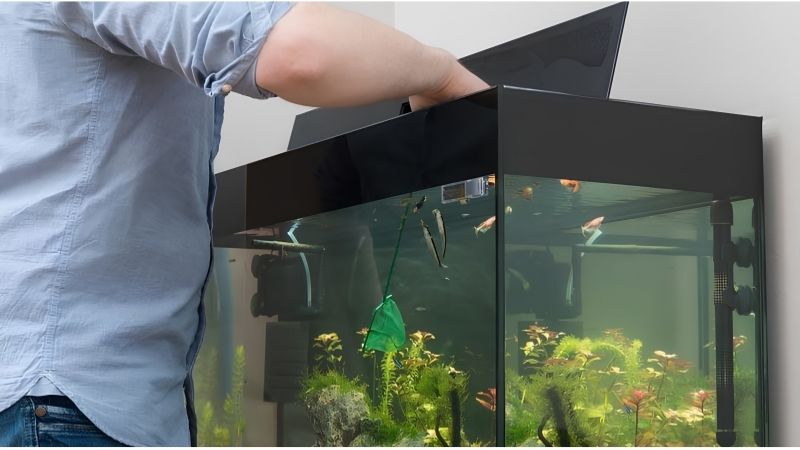
Start by listing every device that needs switching across all tanks: heaters, return pumps, lights, skimmers, and more. A Neptune A3 Apex with a second EB832 reaches 16 AC outlets, while a HYDROS X4/XP8 pack offers 8 hard-wired AC outlets, so match the outlet count to your true device list, not a guess.
Group devices by tank so nothing is left unswitched. A published HYDROS example ran 17 outputs across a 75-gallon planted tank plus nano tanks, which shows how quickly outlet demand grows in a multi-tank room, so count generously and leave headroom for the equipment a fish room inevitably adds later.
Match Sensor Inputs to Parameters
Next, count the parameters you must monitor and the ports each needs, remembering they are different resources. HYDROS Sense ports, pH or ORP probes, and salinity inputs are not interchangeable, so a platform with four Sense ports plus a pH input is not the same as one with more of a single type.
Map each tank’s needs to specific inputs. A reef tank may want pH, ORP, and salinity while a planted tank needs temperature and pH, so tally the exact probe types across the room. Adding unlike ports into one number hides shortfalls, so count Sense, probe, and dosing inputs on their own.
Plan for Expansion
A fish room grows, so buy a platform that expands cleanly. Neptune’s system adds outlet bars and modules, and HYDROS scales with more Sense devices and Wi-Fi units, so confirm how far each stretches before you fill it, since running out of inputs mid-build forces a costly platform change.
Weigh how expansion is added, not just whether it exists. Extra outlet bars, dosing heads, and sensor modules each carry their own cost and wiring, so plan the end-state room and price the modules you will need. A platform that expands in the direction you are growing saves money over piecemeal upgrades.
Respect Electrical Load per Bar
Every outlet bar has a total current limit, and these do not transfer between platforms. A HYDROS Launch is rated 14 amps total with 8 amps per outlet, while a Neptune EB832 bar carries its own 15-amp total rating, so plan each bar’s load against its own limit rather than a number borrowed from another unit.
Spread heavy loads across bars to stay within limits. Heaters and pumps draw hard, so loading many onto one bar can exceed its total even if outlets are free, which matters most in a device-dense fish room. Read each bar’s own rating and balance the load, never transplanting a limit from a different product.
Top Picks
Because a fish room’s needs vary so widely, there is no single best controller; each pick leads for a particular mix of outlets, sensors, and dosing. The right one depends on your tank count and the exact ports you must fill, so read each against your device and probe list rather than a raw total.
| Product | Best For | Key Spec | Watch Out For |
|---|---|---|---|
| Neptune A3 Apex + extra EB832 | Best for high outlet density | 16 AC outlets; pH/temp; ~under $1,100 | Each EB832 bar is 15A total |
| HYDROS X4/XP8 Pro Pack | Best for consolidated 8-outlet control | 8 AC; 4 Sense; 2 probe; ~under $900 | One pack may not fit a large room |
| HYDROS Launch | Best compact multi-sensor hub | 4 Sense; pH/ORP; salinity; 4 AC; ~under $700 | Only 4 hard-wired outlets |
| HYDROS X10 | Best for built-in dosing across tanks | 4 dosing heads 0.1-100 mL/min; ~under $1,000 | Fewer AC outlets than outlet-dense units |
Neptune A3 Apex with Extra EB832: Best for High Outlet Density
For a device-heavy fish room, this pairing leads on switched outlets: 16 AC outlets across two EB832 bars, plus pH and temperature and FMM digital inputs, for around $1,000. When your device list is long, that outlet density is exactly what a multi-tank room needs from one coordinated platform.
Its lead is conditional on that need. Each EB832 bar carries its own 15-amp total limit, so heavy loads must be balanced across bars, and its outlet-heavy strength is wasted if you need dosing or many probe types instead. For a room defined by sheer device count, though, it is the natural pick.
HYDROS X4/XP8 Pro Pack: Best for Consolidated 8-Outlet Control
When you want strong control in one HYDROS unit, the X4/XP8 pack offers 8 hard-wired AC outlets, 4 Sense ports, 2 probe inputs, and 2 Drive ports for around $800, with the XP8 rated 14 amps total. It consolidates a tank or two of devices and sensors without a sprawling module stack.
It suits consolidation more than sprawl. Its 8 outlets and mixed inputs cover a substantial setup, but a very large room may outgrow a single pack, and its port types are distinct resources, not one pool. For a focused multi-tank hub with hard-wired outlets, it is a clean, capable choice.
HYDROS Launch: Best Compact Multi-Sensor Hub
For sensor breadth in a small unit, the Launch packs 4 Sense ports, pH or ORP, salinity, 4 Drive ports, and 4 AC outlets, rated 14 amps total with 8 amps per outlet, for around $600. It is the compact all-in-one for a room that needs varied monitoring more than a huge outlet count.
Its four AC outlets are the limit to watch. A device-dense room will need Wi-Fi outlets or expansion beyond them, and its salinity and pH inputs are single resources, not stackable, so plan probes accordingly. Where monitoring variety outranks raw switching, its compact sensor breadth is the strength.
HYDROS X10: Best for Built-In Dosing Across Tanks
When a fish room needs dosing, the X10 integrates 4 dosing heads at 0.1 to 100 milliliters per minute alongside 4 Sense ports, pH or ORP, and salinity for around $900. It folds precise dosing into the controller, sparing a room the extra dosing modules other platforms require.
Its dosing focus is also its trade-off. It leads on integrated heads rather than sheer AC outlet count, so a switching-heavy room may prefer an outlet-dense platform, and dosing heads cannot be compared to AC outlets as if one number covers both. For dosing-driven rooms, its integration is the draw.
Frequently Asked Questions
Fish-room controller questions usually come down to matching one platform to many tanks, so these answers keep the port types straight. They cover how many outlets you need, running multiple tanks in one app, exceeding eight outlets, and whether dosing should be built in.
How Many Outlets Does a Fish Room Need?
Count every switched device across all tanks, then add headroom. A single tank may need four to eight outlets for heater, pump, light, and skimmer, so a multi-tank room can reach the 16 outlets a Neptune Apex with two EB832 bars provides, or more, depending on your equipment list.
Balance the count against each bar’s current limit. Outlets being free does not mean a bar can carry more load, since a HYDROS bar is 14 amps total and an EB832 is 15 amps, so spread heaters and pumps across bars. Count outlets and load together, not outlets alone.
Can One App Manage Multiple Tanks?
Yes; both major platforms centralize a room in one app. A published HYDROS example coordinated 7 inputs, 17 outputs, and 10 Wi-Fi devices across a 75-gallon planted tank and nano tanks, and Neptune’s Fusion similarly manages a multi-tank Apex setup from one interface.
Verify current app and firmware support before relying on it. These platforms update firmware regularly, so features and device compatibility can change, meaning it is worth confirming the current app handles your specific mix. A single-app room is convenient, but check it fits your devices as they are today.
What If I Need More Than 8 Outlets?
Expand with additional outlet bars or Wi-Fi outlets. A Neptune Apex adds a second EB832 to reach 16 AC outlets, and HYDROS platforms extend with Wi-Fi devices beyond their hard-wired outlets, so exceeding eight is a matter of planned expansion rather than a hard ceiling on either system.
Price the expansion up front. Extra bars and Wi-Fi outlets add cost and wiring, and each new bar brings its own current limit to respect, so map your end-state device count first. Buying a platform that expands toward your growth avoids replacing the whole system when the eighth outlet fills up.
Should Dosing Be Built In?
Only if your room actually doses. A HYDROS X10 integrates 4 dosing heads at 0.1 to 100 milliliters per minute, which suits reef-heavy rooms, but a room that mostly switches devices gains far more from outlet density than from built-in dosing heads it will never use.
Remember dosing heads and AC outlets are different resources. You cannot trade one for the other in a single port count, so decide whether dosing is part of your automation before paying for it. For rooms without dosing needs, an outlet- or sensor-focused platform is the better spend.
Final Thoughts
The best aquarium controller for a fish room is the one whose controlled outlets, sensor inputs, and expansion match your specific tank count, with each bar’s current limit respected. Count AC devices, probe types, and dosing needs separately rather than as one total, plan for growth, and verify current firmware support.
Ready to decide? Our #1 pick for 2026 is the Neptune A3 Apex + extra EB832.
Live price & availability on Amazon.
Related Reviews & Guides


Best Solar Powered Pond Pump: Well-Researched, Reliable Picks

Quick Picks: Best Aquarium Gravel Vacuum Cleaner Siphons