Last Updated: October 4, 2026
Choosing between an aquarium heater guard and a heater controller is less about picking a winner and more about deciding which problem needs solving first. A guard is a physical barrier: it helps keep fish, invertebrates, plants, nets, and decorations from contacting a hot heater surface. A controller is an electronic thermostat that monitors water temperature and switches a compatible heater on or off to reduce temperature swings and provide an extra layer of control.
That distinction matters in a home aquarium. If your concern is a curious fish, a heater that could crack against décor, or a tank with limited clearance, a guard may be the practical answer. If the concern is overheating, inconsistent room temperatures, or the consequences of a failed heater thermostat, a controller is usually more valuable. In many setups, the best arrangement is not guard versus controller at all, but a properly sized heater, a guard, and an external controller.
As an Amazon Associate we earn from qualifying purchases at no extra cost to you.



Quick Verdict
Choose an aquarium heater guard when you need inexpensive physical protection. Most basic guards cost roughly $8 to $25, install with suction cups or clips, and take up only a small amount of space around the heater. They are especially useful for tanks with large fish, active bottom dwellers, dense décor, or children and pets who might bump the aquarium equipment.
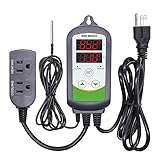
Choose a heater controller when temperature stability and fail-safe protection matter more than simplicity. Digital controllers generally cost about $18 to $50 for common home-aquarium applications, although advanced models can cost more. They require an electrical outlet, a temperature probe, and a compatible heater, but they can provide a clearer temperature reading and an independent control point.
For a typical freshwater aquarium, a guard is the lower-cost first upgrade. For valuable livestock, temperature-sensitive species, or a tank in a room with major seasonal changes, a controller offers the more meaningful upgrade. Neither product replaces a correctly sized heater, a thermometer, safe cable management, or regular observation.
Side by Side
| Factor | Aquarium heater guard | Heater controller |
|---|---|---|
| Primary purpose | Creates a protective barrier around the heater | Regulates heater operation using a separate temperature sensor |
| Comfort and peace of mind | Reduces worry about contact, impact, and accidental burns | Reduces worry about temperature drift and a heater staying on |
| Typical price | About $8–$25 | About $18–$50 |
| Durability | Usually plastic; can crack, discolor, or lose suction-cup grip | Controller body is durable, but probe, cord, and outlet connections need care |
| Maintenance | Remove algae and debris; inspect the guard and mounting points | Check probe placement, display accuracy, cords, and programmed settings |
| Space needed | Requires clearance around the heater, often about 1–2 inches | Needs an external control box, probe, and accessible outlet |
| Look | Visible inside the tank, often black or translucent plastic | Controller remains outside; only the probe and cord enter the tank |
| Resale and flexibility | Low-cost, size-specific accessory with limited resale value | More broadly reusable with compatible heaters and other temperature projects |
| Best for | Physical protection and crowded or active aquariums | Stable temperature, sensitive livestock, and added electrical control |
Where Aquarium Heater Guard Wins
A guard solves a straightforward mechanical problem without adding another electronic device. Glass and metal heaters can be damaged when they contact rocks, driftwood, gravel, magnetic cleaners, or a large fish. A guard creates separation and may also prevent fish from resting directly against a hot surface.
It is particularly useful when a heater must be installed near décor or in a tank with energetic inhabitants. Cichlids, plecos, larger goldfish, and other active fish can move objects or collide with equipment. A guard can also make routine cleaning less stressful because a net or scraper is less likely to strike the heater directly.
Installation is usually simple. Many models use suction cups and attach directly to the aquarium wall, while some fit over a particular heater shape. Check the guard’s internal diameter and length before buying. For example, the GOTOTOP Fish Heater Cover Aquarium Heater Protective Case is listed at 14.37 inches and includes suction cups; its listed price is under $20. The Xiaoyztan 17in Aquarium Heater Guard Cover is listed at 17 inches and costs under $10. Those dimensions describe the cover, not a universal fit for every heater, so compare them with your heater’s length and width.
The limitations are just as important. A guard does not measure water temperature, stop a defective thermostat from running continuously, or correct a heater that is too powerful for the aquarium. It can also reduce water circulation around the heating element if installed too tightly. Leave the clearance recommended by the heater manufacturer, keep the heater fully submerged when required, and inspect the guard after moving décor or performing maintenance.
Where Heater Controller Wins
A controller adds an independent temperature-management layer. The probe measures aquarium water, and the controller switches the connected heater on or off according to a set temperature and differential. This can be useful when the room temperature changes sharply overnight, during winter, or when the aquarium houses species with narrow temperature preferences.
The biggest advantage is redundancy. A heater’s built-in thermostat may eventually stick on or become inaccurate. A controller cannot guarantee that every failure will be prevented, but it can interrupt power when the measured water temperature reaches the controller’s upper limit. The controller itself must be configured correctly, and its probe must remain in the aquarium with good water movement.
Common home units include the Inkbird ITC-308 Digital Temperature Controller Thermostat, listed at about $36, and the BN-LINK Reptile Thermostat Temperature Controller, listed at under $20 with a stated 40–108°F range and 1,000-watt capacity. The BN-LINK’s broader intended uses include reptile tanks, greenhouses, incubators, and other heating applications, so confirm that its plug, temperature range, instructions, and electrical rating suit your aquarium setup.
A controller does add complexity. You need to route a probe safely, prevent water from running along cords into the outlet, and confirm that the heater’s wattage does not exceed the controller’s rating. The controller should be used with a grounded, properly protected aquarium electrical setup. It also does not physically protect the heater from a fish or decoration; a guard may still be appropriate.
Cost Over 5 Years
The five-year cost difference is usually modest, but the ownership pattern differs. A basic guard priced at $9 to $15 might last the entire period if its plastic remains intact and the suction cups hold. Budget for one replacement guard during five years, particularly if you frequently rearrange the aquarium or clean aggressively. That produces an estimated total of $18 to $30.
A controller priced at $19 to $36 may also last five years, but its probe and electrical connections are more important than the enclosure. Assuming one controller purchase and no replacement, the five-year cost is approximately $19 to $36. Allowing for a replacement probe or controller at the end of the period raises the practical budget to roughly $38 to $72. These figures exclude the heater, electricity, surge protection, and any professional electrical work.
If a controller protects a heater from running continuously, its value can exceed its purchase price, but that outcome is not guaranteed. A guard is the cheaper way to address impact risk. A controller is the better value when livestock, temperature sensitivity, or the cost of replacing a damaged aquarium makes temperature control the priority.
Which One for Your Home
Small apartment
Start with a guard if the aquarium is a modest freshwater setup and the heater is close to décor or a busy walkway. A compact guard keeps the in-tank solution inexpensive and avoids adding another box near a limited number of outlets. Choose a controller instead if the apartment has unreliable heating, substantial nighttime temperature drops, or a small tank that changes temperature quickly.
Family with kids or pets
A guard is the first choice when the aquarium is accessible to children, dogs, or cats. It helps protect the heater from bumps during cleaning or accidental contact with decorations. Mount the aquarium securely and keep electrical connections inaccessible; a guard is not a substitute for safe furniture placement. For valuable fish, combine the guard with a controller rather than treating either device as complete protection.
Rental
Renters generally benefit from the least invasive solution. A suction-cup guard does not require drilling and costs little to replace when moving. A controller can still be worthwhile, but it requires more cord organization and an accessible outlet. Use drip loops, avoid overloaded power strips, and do not modify the rental’s electrical system without permission.
Long-term home
If the aquarium will remain in place for years, a controller is usually the stronger investment, especially for planted tanks, breeding projects, marine systems, or sensitive species. Add a guard when the heater is exposed to active fish or hardscape. This combination addresses both major risks: physical damage and uncontrolled heating.
FAQ
Can an aquarium heater guard prevent overheating?
No. A guard is a physical cover and does not sense or regulate temperature. Preventing overheating requires a properly functioning heater thermostat, an accurate thermometer, or an external heater controller.
Can I use a heater controller without a guard?
Yes, provided the heater is installed according to its instructions and cannot be struck by fish, décor, or cleaning tools. A controller manages temperature; it does not protect the heater from impact or direct contact.
Does a heater guard fit any aquarium heater?
No. Compare the guard’s length, internal diameter, openings, suction-cup placement, and recommended heater size with your specific model. A cover that is too short or narrow may leave the heater exposed or restrict circulation.
Should I buy both?
Buy both when the aquarium contains valuable or temperature-sensitive livestock, the heater is vulnerable to impact, or you want two different layers of protection. For a simple, stable tank, choose the product that addresses your actual concern first: a guard for physical safety, or a controller for temperature control.
Ready to decide? Our #1 pick for 2026 is the Primary purpose.
Live price & availability on Amazon.
Related Reviews & Guides


6 Best Aquarium Sumps With Refugium 2026
What Size Heater for 20 Gallon Aquarium? Size Guide With Measurements (2026)