Last Updated: September 25, 2026
Choosing well is a calculation, not a guess at the biggest number: find the flow you need, then read it at your real total dynamic head. Knowing how to choose a pond pump means working from required GPH at your TDH, so the pump you buy still performs once lift and friction take their cut.
As an Amazon Associate we earn from qualifying purchases.
By David Nguyen
Find the Flow Your Pond Pump Must Deliver
Before comparing pumps, pin down what yours actually has to do. Measure the flow your features demand, the vertical lift to reach them, the friction your plumbing adds, and the pipe diameter carrying it all, because those four numbers combine into the requirement every pump is then judged against.
Measure What the Pump Must Run
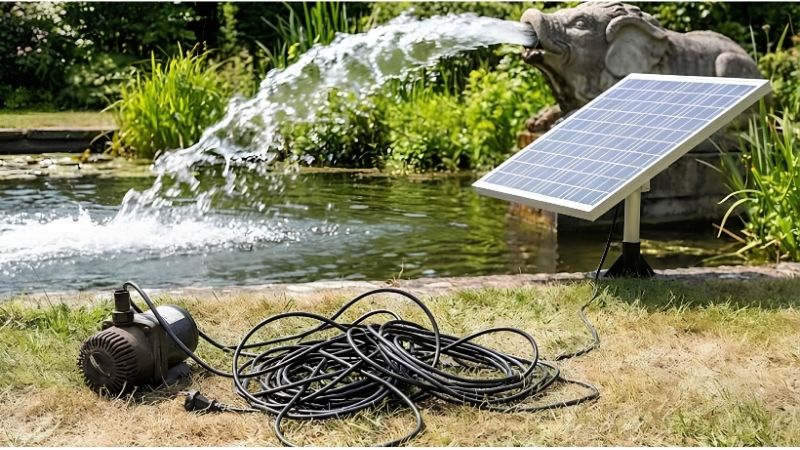
Start with the job. A pond aiming for roughly one turnover per hour needs delivered flow near its gallon count, but a waterfall usually raises that: a medium sheet runs about 1,500 GPH per foot of width, so a 2-foot spillway can want around 3,000 GPH at the top before any lift is added.
Diagnose the largest demand, because it drives the pump. If a fall needs 3,000 GPH while circulation needs only 500, the fall wins, so size to it. Missing this step is the classic error that leaves a pump adequate for the pond yet far too weak for the feature everyone actually looks at.
Measure the Vertical Head
Vertical head is the straight-line lift from the pump to the top of your fall or filter, and it directly cuts flow. Because pumps are rated at zero head, a unit that moves plenty on the bench delivers less at 5 or 10 feet of rise, so measure this height before trusting any flow figure.
The mistake here is guessing the lift low. Underestimating vertical head means choosing a pump for an easier climb than it faces, so it under-delivers once installed. Measure from the pump’s actual position to the discharge point, not from the waterline, to capture the full rise the pump must overcome.
Add Plumbing Friction
Friction from pipe and fittings adds to your total dynamic head. A simple estimator adds about 1 foot of head per 10 feet of tubing, so a 5-foot lift with 20 feet of pipe lands near 7 feet of TDH before fittings, which raise it further with each elbow and valve on the run.
Horizontal pipe absolutely counts, contrary to a common belief. Friction accrues along every foot, not just the vertical section, so measure the whole run. Skipping horizontal losses understates TDH and leaves the pump working against more head than you planned for, quietly cutting the flow you sized for.
Check the Pipe Diameter
Pipe size sets how much friction a given flow creates. At 3,000 GPH, 2-inch pipe loses only about 0.05 foot of head per foot, so a wider line keeps TDH low, while narrower pipe multiplies losses over the same distance and pushes the pump further down its curve than the diameter alone suggests.
The trap is reusing whatever pipe is on hand. A capable pump on undersized tubing behaves like a weaker pump, so decide diameter as part of sizing, not after. For higher flows or long runs, wider pipe often recovers more delivered flow than upsizing the pump would, at a fraction of the cost.
Choose a Pond Pump Step by Step
With the requirement in hand, selection becomes four ordered steps. Plot the flow you need against your total dynamic head, read each candidate’s curve at that head, add a working margin, then recheck equipment and electrical needs, and the table below maps common sizing symptoms to a first action.
| Sizing Symptom | Sign Alongside | Likely Cause | First Action |
|---|---|---|---|
| Waterfall looks thin | Filter flow also weak | TDH underestimated | Recalculate TDH and resize |
| Flow drops over time | Pump strains or runs noisy | Undersized pipe or clog | Upsize pipe; clean the intake |
| High power bill | Pond over-circulating | Oversized pump | Right-size to real turnover |
| Fall starves in weeks | Adequate only on day one | No curve margin | Choose flow with headroom |
Step 1: Plot Required GPH Against TDH
First, set your operating point: the required flow and the total dynamic head you calculated. If your fall needs 3,000 GPH and your TDH is about 7 feet, that single point, 3,000 GPH at 7 feet, is what every pump must meet, and it replaces the vague max-GPH shopping most buyers start with.
Write the point down and use it as a filter. Any pump whose curve does not reach 3,000 GPH at 7 feet is out, no matter how impressive its zero-head rating looks. Fixing the operating point first turns a confusing spec sheet into a simple pass-or-fail test for each candidate you consider.
Step 2: Read the Curve at Your Head
Second, read each pump’s published flow at your head, never interpolating unpublished points. The AquaSurge 4000, for instance, is rated 3,750 GPH at 5 feet, 3,350 at 10 feet, and 2,250 at 15 feet, so at a 7-foot TDH you rely on the nearest published figures rather than inventing a value between them.
Stay on documented numbers. Guessing a flow between two published heads can overstate what a pump delivers, so if your TDH sits between listed points, choose conservatively toward the higher head. Reading the real curve, not a made-up midpoint, keeps your selection honest and your fall from starving.
Step 3: Choose a Working Margin
Third, pick a pump that clears your operating point with room to spare. A unit that only just meets 3,000 GPH at 7 feet has no cushion, so a clogging filter or an extra fitting drops it below target within weeks; a modest margin keeps flow comfortable as the system loads up in normal use.
Avoid over-margining, though. A pump vastly larger than the requirement over-circulates the pond and wastes watts every hour, so aim for headroom, not excess. The goal is sitting comfortably on the curve above your point, close enough that efficiency stays reasonable while everyday fouling cannot starve the feature.
Step 4: Recheck Equipment and Electrical
Fourth, confirm the pump suits your filter, UV, and electrical setup before buying. Match flow to any UV’s rated limit so contact time holds, verify the pump’s plug and cord reach a protected outlet, and follow the specific manual and GFCI requirements for outdoor water equipment without improvising the wiring.
Skipping this step invites avoidable failures. A pump that over-flows a UV, trips a circuit, or lacks proper ground-fault protection is a problem regardless of its flow, so treat electrical and equipment compatibility as part of the choice, not an afterthought handled once the pump is already in the water.
Frequently Asked Questions
The same sizing questions come up whenever someone works out how to choose a pond pump, and each answer returns to flow at total dynamic head. These cover what TDH means, sizing a 2-foot waterfall, why max GPH misleads, and what happens when tubing is smaller than recommended.
What Is Total Dynamic Head?
Total dynamic head is the total resistance a pump works against: vertical lift plus friction from pipe and fittings. It is the head at which you read a pump’s real flow, so a pump rated 3,750 GPH at 5 feet delivers less at a 7-foot TDH, which is why TDH, not lift alone, decides the pump.
Estimate it before shopping. Add your vertical rise to roughly 1 foot per 10 feet of tubing, then account for fittings, and read the pump’s curve at that number. Sizing to TDH rather than to the zero-head rating is the single habit that separates a pump that performs from one that disappoints.
How Do I Size a 2-Foot Waterfall?
Start from width: a 2-foot medium spillway often wants around 3,000 GPH at the top, using the guide of about 1,500 GPH per foot of width or roughly 125 GPH per inch. A thinner veil needs less and a thick sheet needs more, so decide the look, then set the flow target.
Then meet that flow at your head. If the spillway sits atop a tall climb, the pump must deliver near 3,000 GPH at your full TDH, which points to a larger unit than the width alone implies. Width sets the target; total dynamic head sets the pump that actually reaches it.
Is Max GPH the Right Number to Compare?
No. Max GPH is measured at zero head, so comparing pumps on it lines up numbers you will never see once lift and friction apply. The figure that predicts real performance is delivered flow at your total dynamic head, which is why every step here reads the curve at your head, not the peak claim.
Two pumps with matching max ratings can perform very differently installed, so always compare at the same head. A slightly lower peak paired with a published curve beats a bold, unrated maximum, because only the at-head figure tells you whether the pump meets your operating point.
What If My Tubing Is Smaller Than Recommended?
Expect lost flow. Narrow tubing raises friction sharply at higher flows, so a pump on undersized pipe behaves like a weaker, smaller unit; the fix is usually to widen the pipe rather than to buy a bigger pump just to fight the restriction you created with the smaller line.
If you cannot change the pipe, resize the pump to the higher TDH the narrow line creates and accept the extra running cost. But widening the pipe is almost always the better answer, since it recovers delivered flow cheaply and keeps the pump operating where it is efficient on its curve.
Final Thoughts
Knowing how to choose a pond pump comes down to a repeatable process: find the required flow, calculate total dynamic head from lift and pipe, read each curve at that head without interpolating, add a working margin, and confirm equipment and electrical fit. Size to the operating point, not the max.
Related Reviews & Guides

Activated Carbon in Aquarium Filter: When It Actually Helps
Best Mesh Lid for Aquarium: Top Compared DIY Screen Picks