Last Updated: September 27, 2026

Firestone W56PL452020 EPDM Rubber Pre Cut and Boxed Pond Liner, Midnight Blue, 20-Foot length x 20-Foot Width x 0.045-Inch Thick
Included for 'Common Mistakes When Buying a Pond Liner: Best Expert Guide' because the listing specifies Midnight Blue and 20-Foot length x 20-Foot Width x 0.045-Inch Thick, details this guide uses to compare options.
View on Amazon
Firestone 5 x 10 PondGard 45 Mil EPDM Pond Liner Fish Safe
Included for 'Common Mistakes When Buying a Pond Liner: Best Expert Guide' as a relevant option in this category; details come from the product listing.
View on Amazon
Firestone W56PL451015 EPDM Rubber Pond Liner, 10-Foot Length x 15-Foot Width x 0.045-Inch Thick
Included for 'Common Mistakes When Buying a Pond Liner: Best Expert Guide' because the listing specifies 10-Foot Length x 15-Foot Width x 0.045-Inch Thick, details this guide uses to compare options.
View on Amazon
PondGard 10 x 20 Firestone 45 Mil EPDM Pond Liner, UV Radiation Resistance, Black
Included for 'Common Mistakes When Buying a Pond Liner: Best Expert Guide' because the listing specifies UV Radiation Resistance and Black, details this guide uses to compare options.
View on AmazonFour errors account for most wasted liner purchases: mixing sizing formulas, forgetting that depth counts twice, assuming fish safety from a material name, and omitting underlayment. The common mistakes when buying a pond liner are all avoidable with arithmetic and published wording.
As an Amazon Associate we earn from qualifying purchases.
By David Nguyen
How Pond Liner Buying Mistakes Happen
Each error begins with a reasonable assumption applied without checking the source. Formulas differ between manufacturers, depth behaves differently from length, material names describe chemistry rather than application, and protective products get treated as optional extras rather than essentials.
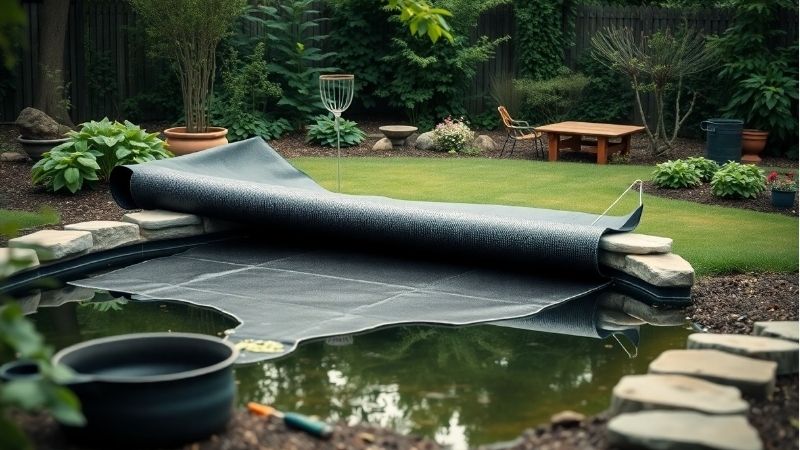
Competing Formulas Assume Different Overlap
Two published methods circulate widely, and they produce different answers. The Pond Guy adds one foot of total allowance, giving pond length plus twice the depth plus one foot, while smartpond adds two feet in total, producing pond length plus twice the depth plus two feet instead.
Neither is wrong, because they assume different overlap around the rim. The watch-out threshold is mixing them, calculating with the tighter allowance and then planning a generous stone edge, which consumes exactly the margin that the tighter formula never included in its figure.
Depth Is Doubled Because Liner Travels Twice
Liner descends one pond wall and climbs the other, so maximum depth enters both dimensions twice over. A pond measuring 2 feet deep therefore adds four feet to the length and four feet to the width before any overlap allowance is added, which is where most underestimates originate.
The threshold worth watching is any late change of depth made during the excavation itself. Digging six inches deeper than originally planned adds a foot to both required dimensions, which frequently moves an order from one standard sheet size up into the next available one entirely.
Material Names Do Not State Fish Safety
A material name describes chemistry, not intended application. Pond-grade EPDM such as Aquascape’s 45 mil sheet carries explicit fish-safety wording, while identical-sounding roofing membrane is formulated for buildings and has never been assessed for continuous immersion in a stocked pond.
Treat any missing wording as a definite answer rather than as a simple oversight. The threshold is any listing describing waterproof membrane, landscaping sheet or general-purpose liner without naming ponds or fish, which should stay out of any stocked pond entirely until confirmed.
Protection Is Budgeted Last or Not at All
Underlayment is frequently treated as an upsell rather than as part of the purchase, which is how thin sheets end up directly on gravel and roots. Concentrated pressure at a few contact points causes most early failures, and those pressure points are invisible once the water is in.
The threshold is any excavation where stones, shale or roots remain visible across the base even after clearing. Budget the protection alongside the liner right from the outset, and remember some warranties require the manufacturer’s own underlayment product for extended coverage.
What It Looks Like in Practice
These four scenarios show the same flawed assumptions failing in different gardens: a sheet arriving short, a late depth change, roofing membrane in a stocked pond, and a puncture traced back to skipped protection. Each one was entirely avoidable before the order was ever placed.
| Factor | Normal Range | Watch-out Threshold | What to Do |
|---|---|---|---|
| Overlap allowance | 1 to 2 ft in total by formula | Mixing two different methods | Pick one published source |
| Edge overlap | 12 to 18 in ideal | Below roughly 10 in | Order the next size |
| Depth in formula | Counted twice per axis | Late excavation changes | Recalculate before buying |
| Fish safety | Stated pond-grade wording | Generic membrane naming | Confirm in writing |
A Sheet Arrives Four Inches Too Short
The buyer calculated using the tighter one foot allowance, then built a substantial rock edge that demanded far more overlap than the formula ever provided. The liner reached the rim but left nothing to tuck beneath stone, so soil began washing behind the sheet after the very first heavy rainfall.
The fix afterwards is expensive, involving either an added seam or a complete replacement sheet. Choosing the more generous two foot allowance at the outset, or simply ordering the next standard size up, would have cost a very small fraction of what the eventual correction required.
A Late Depth Change Outgrows the Order
Excavation revealed unexpectedly soft ground, so the builder deepened the pond by six inches for stability, which added a foot to both of the required dimensions. The liner ordered against the original drawing then finished level with the rim rather than extending usefully beyond it.
Ordering after the excavation rather than before it removes this particular failure entirely. Where the sheet must be bought early, choosing a size above the calculated minimum comfortably absorbs the changes that almost every excavation produces once the digging actually begins in earnest.
Roofing Membrane Reaches a Stocked Pond
A builder sourced EPDM at a substantially lower price, reasoning that the material name itself simply matched pond-grade sheeting. In reality the product was roofing membrane, formulated purely for weatherproofing buildings and never assessed for continuous immersion alongside fish.
Pond-grade products publish fish-safety wording precisely because that assurance is the difference being sold. Where a listing omits it entirely, requesting written confirmation before stocking costs nothing and takes far less time than replacing a liner beneath established fish.
A Puncture Traced Back to Skipped Protection
Underlayment was cut from the budget on a thin sheet laid over ground that still contained loose gravel and stone. Two summers later the level began dropping, and the damage sat precisely where a stone had been pressing steadily against the liner from the day it was first installed.
Repair then meant draining the pond, relocating the fish and waiting for the area to dry completely before patching. The protection originally omitted costs a tiny fraction of that whole disruption, which is why it belongs in the initial order rather than on a later shopping list.
Frequently Asked Questions
Four questions follow directly from these four errors: which formula to trust, how much overlap is genuinely needed, whether thickness compensates for poor preparation, and how to verify fish safety properly. Direct answers below, together with the exceptions that matter in practice.
Which Sizing Formula Should You Use?
Pick a single published source and then apply that method consistently throughout the project. The Pond Guy adds one foot of total allowance while smartpond adds two, and both work provided that your edge treatment matches the overlap that particular formula assumed when it was written.
Where the edging design is undecided, use the more generous method. Surplus trims away in minutes once the pond is filled, whereas falling short creates either an avoidable seam or an entirely new purchase, which makes the more cautious calculation the considerably cheaper error.
How Much Overlap Do You Actually Need?
smartpond suggests a minimum of roughly ten inches beyond the pond edge, with twelve to eighteen inches described as the ideal range, which reflects how much material a stone edge consumes. Steeper surrounding ground and heavier edging both push you firmly toward the upper figure instead.
That overlap anchors the sheet and stops soil washing behind it during heavy rainfall, which is a genuinely structural function rather than decoration. Treating it as optional trimming is how buyers end up with a liner that technically reaches the rim and yet fails within a single season.
Does Thicker Liner Compensate for Poor Preparation?
Only partially, and relying on thickness alone proves expensive. A thicker sheet resists a given point load better, though concentrated pressure from an unremoved stone eventually defeats material of any thickness once it has months of accumulated water weight pressing down on it.
Clearing the excavation properly and laying underlayment beneath it does considerably more for longevity than upgrading thickness alone. Where the budget forces a choice, preparation beneath a mid-range sheet generally outperforms thicker material laid hurriedly across uncleared, stony ground.
How Do You Verify Fish Safety Before Buying?
Look for explicit pond or fish wording from the manufacturer rather than inferring it from the material. Aquascape states fish safety for its 45 mil pond-grade EPDM, and comparable products publish similar language precisely because that assurance forms part of the specification.
Where a listing is ambiguous, ask the seller for written confirmation before livestock arrives. Construction and landscaping sheeting sold at similar prices occupies a genuinely different category, and the additives involved were chosen for entirely different industrial purposes.
Final Thoughts
Choose one formula, count the depth twice, insist on stated fish safety, and budget protection from the very start. The common mistakes when buying a pond liner all stem from assumptions that a two minute check against the published sources would have corrected before ordering anything.
Best Pond Liner for a Waterfall: Top Expert Buying Guide
Best Energy Efficient Pond Pump: Well-Researched Top Picks