Last Updated: October 4, 2026
Sizing a 500-gallon pond is less about the biggest pump and more about hitting roughly 500 GPH at your real lift without paying for capacity you never use. The best pond pump for a 500 gallon pond is the one whose delivered flow at your head matches about one turnover per hour, not the peak number on the box.
As an Amazon Associate we earn from qualifying purchases.
By David Nguyen
Quick answer: For most people in 2026, the best pond pump for a 500 gallon pond is the Aquascape Ultra 800 — our #1 rated choice. See the full ranked comparison, alternatives and buying advice below.
How to Choose a Pond Pump
A 500-gallon pond wants about one turnover per hour, so the target is roughly 500 GPH delivered at your actual head, not at zero head. From there you weigh how much margin you truly need, the wattage you pay for around the clock, and how far flow drops as lift climbs toward your filter or falls.
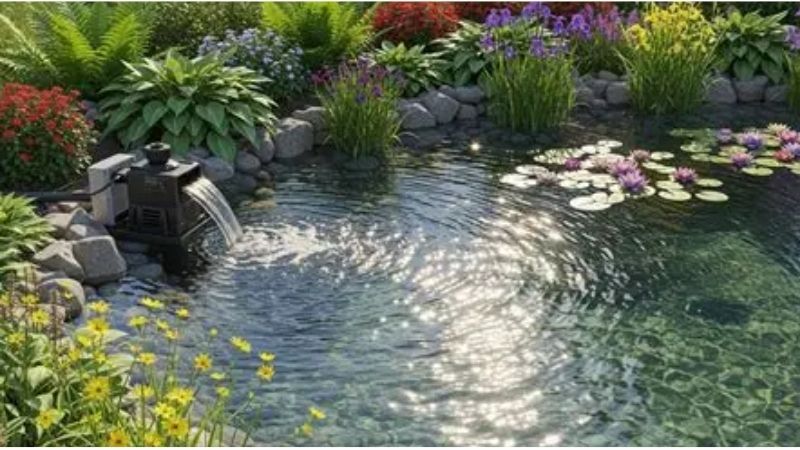
Start From a 500 GPH Target
Begin with the turnover math: a 500-gallon pond aiming for one turnover per hour needs close to 500 GPH reaching the filter at your lift. The Ultra 800 delivers exactly 500 GPH at 5 ft, so it lands on that baseline without the guesswork that a max-GPH sticker forces on you.
Treat 500 GPH as a floor, not a ceiling. Fish, a waterfall, or a longer plumbing run all raise the real demand, so a pond kept lightly stocked can sit right at one turnover while a koi pond of the same volume often wants noticeably more delivered flow to keep the filter fed.
Add a Useful Margin
Headroom protects flow as your setup ages and heads climb. The Ultra 1100 pushes 800 GPH at 5 ft, about 60% more than the Ultra 800, which buys margin for a small waterfall or a filter that clogs between cleanings without stepping up to a much larger pump you would only throttle.
Margin is not free, though. That 60% flow gain costs roughly 58.6% more wattage, since the Ultra 1100 draws 92W against the Ultra 800’s 58W. Buy the margin you will actually use, because oversizing a 500-gallon pond mostly moves water in circles while adding to the bill every hour it runs.
Compare 24/7 Wattage
Because a pond pump usually runs continuously through the warm season, wattage becomes a recurring cost. Run around the clock, the 58W Ultra 800 draws roughly 508 kWh a year, the 65W EcoWave 2000 about 570 kWh, and the 92W Ultra 1100 near 806 kWh, so multiply by your local rate first.
This is where the EcoWave 2000 earns a look: it delivers 860 GPH at 5 ft on just 65W, more flow per watt than the Ultra pumps here. For a 500-gallon pond that wants a little extra circulation, it moves more water for a smaller running-cost penalty than pushing an Ultra pump beyond its comfortable range.
Check Flow at Higher Head
Every foot of lift cuts output, and the ranking shifts as head rises. At 10 ft the AquaJet 1300 still delivers 625 GPH, comfortably above the 500 GPH target, while the Ultra 1100 falls to 300 GPH and the EcoWave 2000 to 400 GPH, dropping them below turnover for a 500-gallon pond.
So the right pump depends on your worst-case head, not just the 5-ft figure. A low, short run rewards the efficient EcoWave 2000; a tall waterfall or a long uphill line rewards the AquaJet 1300, which holds usable flow far higher and keeps a 500-gallon pond turning over where flatter curves would not.
Top Picks
These four pumps bracket a 500-gallon pond from an exact 5-ft fit to a high-head workhorse. Each is matched to a role rather than ranked blindly, because the right pond pump for a 500 gallon pond depends on your head height, stocking, and how much you are willing to spend running it every hour.
| Product | Best For | Key Spec | Watch Out For |
|---|---|---|---|
| Aquascape Ultra 800 | Best Overall | 500 GPH @5 ft; 58W | Little headroom above turnover |
| Aquascape Ultra 1100 | Best Value | 800 GPH @5 ft; 92W | Flow drops to 300 GPH at 10 ft |
| Aquascape EcoWave 2000 | Best for energy-conscious ponds | 860 GPH @5 ft; 65W | Weaker at high head |
| Aquascape AquaJet 1300 | Best for higher head | 1050 GPH @5 ft; 625 @10 ft | More pump than low-head ponds need |
Aquascape Ultra 800: Best Overall
The Ultra 800 takes the top slot because its 500 GPH at 5 ft maps directly onto a 500-gallon pond’s one-turnover target, the axis this search is really about. At around $150 on 58W, it hits the baseline without the oversizing that inflates both purchase price and running cost.
Its limit is headroom. Because it lands exactly on turnover, it leaves little spare flow for a waterfall or a clogging filter, and at 7.5 ft it drops to 275 GPH. If your head is modest and your pond lightly stocked it is the clean fit; add a feature and you will want the Ultra 1100’s margin instead.
Aquascape Ultra 1100: Best Value
For ponds that want breathing room, the Ultra 1100 delivers 800 GPH at 5 ft for about $225, roughly 60% more flow than the Ultra 800. That extra capacity covers a small waterfall, a longer run, or future stocking, which makes it the sensible buy when a bare 500 GPH feels too tight.
The catch is power and drop-off. It pulls 92W, near 806 kWh a year run continuously, and at 10 ft its flow falls to 300 GPH, below turnover for 500 gallons. It rewards moderate head where its 5-ft and 7.5-ft figures stay strong, not a tall lift where the AquaJet holds up far better.
Aquascape EcoWave 2000: Best for Energy-Conscious Ponds
When running cost is the priority, the EcoWave 2000 moves 860 GPH at 5 ft on only 65W, the strongest flow per watt in this group, for around $275. On a 500-gallon pond it gives comfortable circulation, about 1.72 turnovers per hour, without the wattage penalty of pushing a smaller pump hard.
Its weakness is head performance. Flow falls to 400 GPH at 10 ft, under turnover for 500 gallons, so it suits low-head loops rather than tall waterfalls. Its higher sticker also means the payback comes from the electric bill over a full season, not from the day you buy it, so plan to keep it running.
Aquascape AquaJet 1300: Best for Higher Head
The AquaJet 1300 is the pick when lift is your real constraint, delivering 1050 GPH at 5 ft and holding 625 GPH at 10 ft on 110W for about $350. It is the only pump here that stays above the 500 GPH target at 10 ft, which is what a tall waterfall on a 500-gallon pond needs.
At low head it is more pump than a simple 500-gallon pond requires, drawing roughly 964 kWh a year run continuously and over-circulating where an Ultra would suffice. Reserve it for genuine head or a wide spillway, where its flat curve turns a higher price into flow the smaller pumps cannot supply.
Frequently Asked Questions
A handful of questions decide most 500-gallon pond purchases, and they all come back to delivered flow rather than the number on the carton. These answers focus on the turnover you truly need, how far a rating falls at head, and what the pump adds to your power bill once it is running day and night.
Is 500 GPH Enough for a 500 Gallon Pond?
For a lightly stocked, low-head pond, yes: 500 GPH delivered is about one turnover per hour, the common starting point, and the Ultra 800 meets it at 5 ft. That keeps water moving through a modest filter without over-circulating a pond that has no waterfall or heavy fish load to feed.
Raise the target if you keep fish or run a spillway, since both demand more circulation and filtration contact. A koi pond or a wide waterfall on 500 gallons often wants well beyond one turnover, so size by your real load and lift rather than assuming a tidy 500 GPH covers every 500-gallon pond.
Should I Buy 500 or 1000 GPH?
It depends on features and head, not volume alone. A bare 500-gallon pond is served by roughly 500 GPH at your lift, but a waterfall, a UV loop, or a tall run can push the real need toward 800 to 1000 GPH delivered, which is where the Ultra 1100 or AquaJet 1300 start to make sense.
Avoid buying 1000 GPH just in case. On a low-head 500-gallon pond, that much delivered flow over-circulates the water and wastes watts every hour, so step up only when a specific feature or a high head justifies the extra capacity and the running cost that comes with it.
How Much Does Head Affect Flow?
A lot, and it decides which pump fits. The Ultra 1100 delivers 800 GPH at 5 ft but only 300 GPH at 10 ft, while the AquaJet 1300 holds 625 GPH at 10 ft. That gap is why two pumps with similar 5-ft ratings can behave completely differently once your lift climbs toward a filter or a fall.
Measure your total head before buying: vertical lift plus friction from pipe length and fittings. Then read the flow at that number, not at 5 ft, because a pump that clears turnover on the bench can quietly fall below it in a tall install and starve the filter you were trying to feed.
How Much Energy Does a 500 Gallon Pump Use?
It tracks wattage and runtime. Run continuously, the 58W Ultra 800 uses about 508 kWh a year, the 65W EcoWave 2000 near 570 kWh, and the 110W AquaJet 1300 roughly 964 kWh; multiply by your electricity rate to compare the real annual cost rather than just the purchase price.
Because pumps often run around the clock in season, the efficient choice is the smallest pump whose delivered flow meets your turnover at your head. An oversized pump on a 500-gallon pond pays a wattage penalty every hour for flow the pond never needed, which quietly outweighs a lower sticker.
Final Thoughts
The best pond pump for a 500 gallon pond is the one whose delivered flow at your real head lands near one turnover per hour for a running cost you can accept, not the model with the biggest max-GPH claim. Fix your head first, read the flow at that lift, and let real turnover pick the pump.
Ready to decide? Our #1 pick for 2026 is the Aquascape Ultra 800.
Live price & availability on Amazon.
Related Reviews & Guides

8 Best Fluval Filter Media Replacements for 2026
11 Best Fish Tank Heaters for Betta Fish (Reviewed)