Last Updated: November 24, 2026
At 10,000 gallons, a pond stops being a garden feature and becomes a small water system, and the pump choice changes with it. Submersible units in this class mean hauling a pump out of the water for every seal or impeller problem, and their flow falls off quickly against a tall filter or waterfall. An external, dry-mounted pump sits beside the pond where you can service it standing up, holds flow better under pressure, and is the standard for serious koi filtration at this volume.
The catch: external pumps are a dealer-driven corner of the pond market. The proven names in this class — the Sequence 4000 Series, the PerformancePro Cascade line and the Anjon Landshark — sell through pond specialists and large online retailers rather than listings that can be pinned down here. So this guide takes a different approach: how to size and judge an external pump for a 10,000-gallon pond, then the units to price first and the checks to run before you order.
Quick Picks
As an Amazon Associate we earn from qualifying purchases.
How to Choose
Flow at Your Real Head Height
A pump’s headline gallon-per-hour figure is measured at zero head — no lift, no filter, no plumbing resistance — and no real pond runs that way. What matters is the flow on the manufacturer’s curve at your total dynamic head: the vertical lift from pond surface to the highest discharge point, plus friction from pipe runs, elbows and the pressure of a bead or pressurised filter. For a 10,000-gallon pond, target a true turnover of the full volume every one to two hours after losses, so shortlist pumps whose curve still delivers roughly 5,000 to 10,000 gallons per hour at your calculated head, not pumps whose box number merely reaches it.
Motor Type, Watts and Running Cost
External pond pumps run twenty-four hours a day, so the wattage on the data sheet is a monthly bill, not a footnote. In this size class, purpose-built pond centrifugals use efficient TEFC (totally enclosed, fan-cooled) motors that move large volumes at a few hundred watts, while repurposed pool pumps of similar flow can draw two or three times as much. Multiply the rated watts by 24 hours and your local electricity rate before comparing prices: a pump that costs a little more but draws 150 fewer watts pays the difference back quickly and keeps paying it for the life of the motor.
Priming, Placement and Plumbing
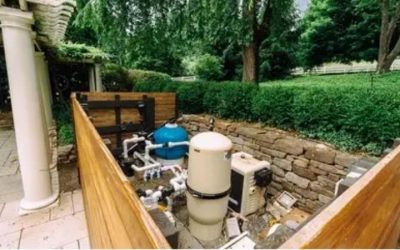
An external pump only works if it stays primed and flooded. Most pond centrifugals are not self-priming, so the standard arrangement places the pump below pond water level, fed through a bulkhead or over-the-wall line with a priming pot and leaf basket ahead of the intake, and check valves placed so the line cannot drain back when the power cuts. Check the port sizes before ordering — the serious units in this class typically use 2-inch threaded or union connections — and budget for unions on both sides so the pump can be removed for service without cutting pipe. Also leave clear working space around the pump; you will open that leaf basket often.
Solids Handling and What Sits Upstream
External centrifugals are clean-water pumps: their close-tolerance impellers are built for water that has already passed a skimmer, settling chamber or vortex, not for raw pond water full of leaves and string algae. Decide your pre-filtration first, because it decides whether an external pump survives. A leaf basket in the priming pot catches the coarse debris, but a pond that regularly pulls in heavy solids needs mechanical filtration ahead of the pump or a different pump type altogether. Also confirm the warranty terms in writing — coverage length and whether it is handled by the maker or the dealer vary widely in this market.
The External Pumps Worth Knowing
Sequence 4000 Series 8200SEQ22
The 8200SEQ22 is the size-correct flagship for this pond class: a maximum flow of 8,220 gallons per hour against a maximum head of 22.3 feet means it still delivers working turnover for a 10,000-gallon pond once a pressurised filter and plumbing losses take their share. The maker’s data sheet rates it at 450 watts and 4.0 amps on 115 volts, with a half-horsepower TEFC motor, 2-inch FNPT and buttress ports supplied with unions, and an 8-foot cord. Sequence sells through pond dealers and its own network rather than discount marketplaces, so get quotes from two dealers and confirm the exact model suffix before paying.
Sequence 4000 Series 5800SEQ21 and 6800SEQ22
Two smaller siblings suit 10,000-gallon ponds with gentler plumbing. The 5800SEQ21 is rated at 5,800 gallons per hour maximum, 21 feet of head and 296 watts from a third-horsepower TEFC motor drawing 2.6 amps — a sensible match where the filter sits close to pond level and the run is short. The 6800SEQ22 splits the difference at 6,840 gallons per hour, 22.2 feet of head and 376 watts. All three share the same 2-inch porting and 8-foot cord, so stepping up a size later does not mean replumbing. Compare the published flow curves at your head height rather than the maximum figures; that is where the three models genuinely separate.
PerformancePro Cascade C-1/4-44
The Cascade line takes the opposite approach to the high-flow Sequence models: low-RPM motors that trade peak flow for quiet running and long bearing life. The C-1/4-44 is the quarter-horsepower entry, rated at 4,400 gallons per hour, which is at the gentle end for a 10,000-gallon pond — think of it for a filter circuit where a second pump handles a waterfall, or for slower turnover on a lightly stocked water garden. PerformancePro sells through pond dealers and large online pond catalogues, so availability is good; confirm whether the priming pot and basket are included or listed separately.
Anjon Landshark LS5500
The Landshark LS5500 is the high-output alternative, rated at 5,575 gallons per hour from a 1.5-horsepower external motor — a spec sheet that reads more like a pool pump’s, which is exactly why it needs a closer look before it goes on a pond. That horsepower promises strong flow against high head, but the running watts and solids question deserve direct answers from the seller, since published figures for this line are thinner than Sequence’s data sheets. Anjon distributes widely through pond retailers, so stock is rarely the problem; have the dealer confirm amp draw, warranty route and continuous-duty rating.
Which One Fits Your Situation
Pressurised Bead Filter, Standard Koi Setup
Start with the Sequence 8200SEQ22. A bead filter is the biggest single head load in most koi systems, and this is the model in the group with flow to spare after that loss, so the pond still turns over at a healthy rate as the filter loads up between backwashes. Its 450-watt draw is also reasonable for the output delivered.
Low Filter, Short Pipe Run, Quiet Corner
If your filter sits near pond level and the plumbing run is short, the Sequence 5800SEQ21 covers the pond at notably lower wattage, and its smaller motor runs quietly beside a patio. Price the 6800SEQ22 alongside it — the step up is cheap insurance if you later add a waterfall or a taller shower filter.
Two Circuits: Filtration Plus a Separate Waterfall
Split the work. A PerformancePro Cascade C-1/4-44 on the filter circuit gives slow, quiet, continuous turnover, while a second, larger pump runs the falls only when you are there to enjoy them. Two smaller pumps also mean one can fail without the pond losing all circulation at once, and the waterfall pump’s off-hours save real electricity.
Tall Waterfall or Long Stream
Head height rules everything here, so shortlist by the flow curve at your measured lift, not by horsepower. The Landshark LS5500 and the Sequence 8200SEQ22 are the two to price, and the winner is whichever publishes the stronger verified flow at your head — ask both dealers for the curve in writing before deciding.
Common Mistakes
- Sizing from the maximum GPH on the box instead of the flow at your actual head height, which can leave a 10,000-gallon pond turning over at half the intended rate and starve the filter bacteria the fish depend on.
- Putting a clean-water external centrifugal on raw pond water with no skimmer, settling chamber or leaf basket ahead of it, then blaming the pump when the impeller clogs.
- Mounting the pump above water level without a priming pot and check valve, so it loses prime at every power cut and runs dry on restart — and a dry-running centrifugal can cook its seals in minutes.
- Comparing purchase prices without comparing watts, even though these pumps run continuously and the electricity gap overtakes the price gap within a season or two. Always do the twenty-four-hour maths before deciding which pump is really cheaper.
- Buying a pool pump as a substitute because the flow figure matches, without checking continuous-duty rating, amp draw or whether the seals suit permanent outdoor pond use.
Frequently Asked Questions
How many gallons per hour does a 10,000-gallon pond actually need?
Aim to circulate the full volume every one to two hours after plumbing losses, which means roughly 5,000 to 10,000 gallons per hour delivered at your system’s head height. Stocked koi ponds belong at the faster end; lightly stocked water gardens can run at the slower end without water-quality problems. Measure against the pump’s flow curve, never its maximum rating.
Can an external pump sit above the water level?
It can, but only with the right supporting hardware: a priming pot to fill the line, a check valve so the suction side cannot drain back, and pipework with no air traps. Most makers recommend flooded suction — pump below water level — because it removes the whole class of lost-prime failures.
Are external pumps more efficient than submersibles at this size?
Usually, yes. Purpose-built external centrifugals in this class move their rated flow at a few hundred watts with motors designed for continuous duty, and they hold flow better against filter pressure. A submersible of similar output also hides its condition underwater, while the external pump can be inspected in minutes.
Where is the best place to buy one of these pumps?
Pond dealers are the main channel for Sequence and PerformancePro, and they can confirm model suffixes, include the right priming pot and handle warranty claims. Large online retailers carry the Anjon line and sometimes the others. Wherever you buy, get the flow curve, amp draw and warranty terms in writing before paying.
Best Pond Aerator for a 500 Gallon Pond: Top Proven Picks
Common Mistakes When Buying a Pond Liner: Best Expert Guide