Last Updated: October 4, 2026
Wattage on the box only tells half the story; what matters is how many gallons a pump actually moves per watt at your real head. The best energy efficient pond pump is the one with the highest delivered GPH per watt at 5 ft, not simply the lowest power rating printed on its label.
As an Amazon Associate we earn from qualifying purchases.
By David Nguyen
Quick answer: For most people in 2026, the best energy efficient pond pump is the Aquascape EcoWave 5000 — our #1 rated choice. See the full ranked comparison, alternatives and buying advice below.
How to Choose a Pond Pump
Efficiency is not the smallest wattage number; it is the most water moved per watt at the head you actually run. To compare fairly, look at delivered GPH per watt at the same lift, add up the annual kilowatt-hours, and avoid oversizing, which quietly wastes energy on flow your pond never needed.
Compare GPH per Watt at the Same Head
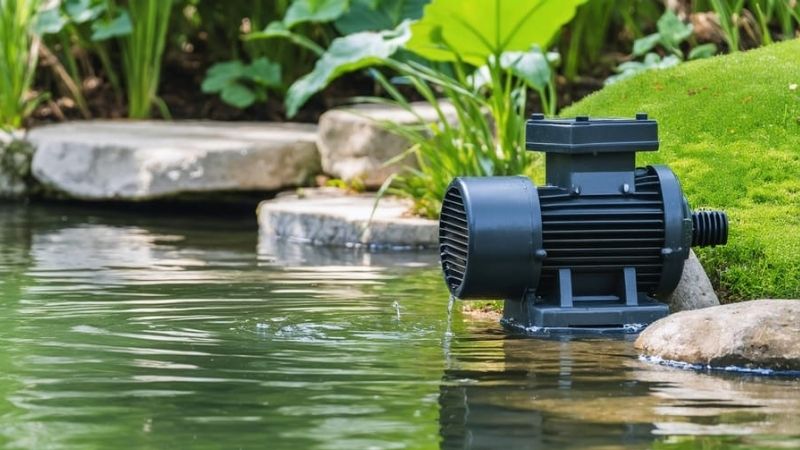
The only honest efficiency metric is delivered flow divided by wattage at one fixed head. At 5 ft, the EcoWave 2000 returns 13.23 GPH per watt, the 3000 gives 16.33, the 4000 reaches 17.00, and the 5000 tops the group at 21.37, so the largest model is also the most efficient here.
Comparing those ratios only works at identical head. A pump’s GPH per watt shifts as lift changes, so a figure taken at 5 ft cannot be set against one taken at 10 ft. Pin every efficiency comparison to the same head height, or the ranking simply reflects different test conditions instead.
Add Up Annual kWh
Efficiency per watt still meets a total power bill. Run continuously, the 65W EcoWave 2000 uses roughly 570 kWh a year, the 90W 3000 about 788 kWh, the 130W 4000 near 1,139 kWh, and the 150W 5000 around 1,314 kWh, so more efficient does not always mean less total draw.
Because pond pumps typically run around the clock in the warm months, those kilowatt-hours land on your bill whether the pump is efficient or not. The efficient move is choosing the smallest model whose delivered flow meets your turnover, so you buy high GPH per watt without paying for watts you never use.
Avoid Oversizing
A bigger, more efficient pump can still be the wrong buy. The EcoWave 5000 moves 3,205 GPH at 5 ft, far more than a modest pond needs; running it there means paying 150W to move water you will only throttle back. Size to your target flow first, then pick the efficient model that meets it.
Oversizing also stresses plumbing and can over-circulate a planted or fish pond. Matching the pump to a sensible turnover, often about once per hour, keeps both energy use and flow in a healthy range, so the efficiency rating pays off instead of being wasted on excess capacity you cannot use.
Re-check Efficiency at Higher Head
Published GPH per watt usually reflects a single head point, and the number changes as lift rises. A pump that looks efficient at 5 ft can lose ground at 10 ft as flow falls faster than wattage, so re-run the math at your real head before trusting a 5-ft efficiency figure for your build.
This matters most for tall waterfalls or long runs. If your head is well above 5 ft, ask for the flow at that lift and recompute GPH per watt, since the efficiency ranking can shuffle. The most efficient pump on paper is only efficient at the head where its rating was actually measured.
Top Picks
These four EcoWave models let you trade absolute wattage against flow per watt so you can match efficiency to pond size. The most energy efficient pond pump for you is the one whose delivered flow fits your turnover while posting strong GPH per watt at your real head, not simply the biggest number.
| Product | Best For | Key Spec | Watch Out For |
|---|---|---|---|
| Aquascape EcoWave 5000 | Best Overall | 3,205 GPH @5 ft; 21.37 GPH/W | Highest total draw at 150W |
| Aquascape EcoWave 3000 | Best Value | 1,470 GPH @5 ft; 16.33 GPH/W | Mid-size flow only |
| Aquascape EcoWave 2000 | Best for low total power | 860 GPH @5 ft; 65W | Lowest flow per watt here |
| Aquascape EcoWave 4000 | Best for higher head | 2,210 GPH @5 ft; 17.00 GPH/W | More pump than small ponds need |
Aquascape EcoWave 5000: Best Overall
The EcoWave 5000 leads on the metric that defines this search: 21.37 GPH per watt at 5 ft, the highest in the lineup and about 61.5% better flow per watt than the 2000. For around $400 it moves 3,205 GPH at that head, making it the efficiency benchmark for genuinely larger ponds.
Its catch is total consumption. At 150W it draws roughly 1,314 kWh a year run continuously, more than any model here, so its efficiency only pays off if your pond truly needs that flow. On a small pond it would be throttled and wasteful; on a big one, it delivers the most water per watt spent.
Aquascape EcoWave 3000: Best Value
The 3000 balances efficiency and cost at about $300, posting 16.33 GPH per watt and 1,470 GPH at 5 ft on 90W. It sits close to the 4000 on flow per watt while drawing fewer total watts, which makes it the sensible pick for mid-size ponds that do not need the 5000’s larger output.
The limitation is ceiling. At 1,470 GPH delivered, it will not feed a large waterfall or a very big pond, and pushing it at higher head erodes both flow and its efficiency edge. For a pond near the 1,000-gallon range at moderate lift, it captures most of the efficiency without the top-tier price.
Aquascape EcoWave 2000: Best for Low Total Power
When you want the smallest possible power footprint, the 2000 draws just 65W and about 570 kWh a year run continuously, the lowest absolute consumption here. At roughly $275 it delivers 860 GPH at 5 ft, enough for a compact pond where total watts matter more to you than peak flow per watt.
Its weakness is the efficiency ratio itself: 13.23 GPH per watt is the lowest of the four, so on a per-gallon basis it trails the larger models. It is the right call only when your pond is small and you value a low, steady draw over squeezing the most flow from every single watt spent.
Aquascape EcoWave 4000: Best for Higher Head
The 4000 offers a strong 17.00 GPH per watt and 2,210 GPH at 5 ft for around $350, giving it more reach for ponds with meaningful lift. It nearly matches the 5000’s efficiency while drawing 130W instead of 150W, a useful middle ground when your head runs above the usual norm.
It can be more pump than a small pond needs, though. At 2,210 GPH delivered it is built for larger volumes or taller waterfalls, and on a modest pond you would throttle it and lose the efficiency benefit. Confirm your head and turnover target before choosing it over the smaller, cheaper models.
Frequently Asked Questions
Shoppers chasing lower running costs tend to ask the same practical questions about what efficiency really means for a pump that runs day and night. These answers stay anchored to delivered flow, wattage, and head, the three numbers that decide how much a pump actually costs to keep circulating water.
Do Lower Watts Always Mean More Efficient?
No. Low wattage lowers your total bill but says nothing about how much water you get per watt. The 65W EcoWave 2000 draws the least power yet posts the lowest efficiency here at 13.23 GPH per watt, while the 150W 5000 is the most efficient at 21.37 despite its higher total draw.
So separate two questions: how much total power a pump uses, and how efficiently it converts that power to flow. A small pond may want low absolute watts; a larger one is better served by high GPH per watt, even if the total wattage is greater, because it moves far more water for it.
What Is the Most Useful Efficiency Metric?
Delivered GPH per watt at your real head is the metric that matters. It captures both flow and power in one figure, unlike wattage alone, and it is the basis for ranking these EcoWave pumps: 13.23, 16.33, 17.00, and 21.37 GPH per watt at 5 ft from the 2000 up through the 5000.
Just make sure the flow figure is taken at the head you will actually run. A GPH-per-watt number measured at 5 ft cannot be applied to a 10-ft install, so tie the metric to your lift for it to mean anything for your specific pond, plumbing, and waterfall height.
Can an Efficient Pump Be Oversized?
Yes, and it is a common mistake. The efficient 5000 moving 3,205 GPH at 5 ft is wasteful on a small pond that needs a fraction of that; you would pay 150W to move water you then restrict. Efficiency only helps when the pump’s flow matches your turnover instead of dwarfing it.
Right-sizing is the fix. Estimate your pond volume, aim for roughly one turnover per hour at your head, and pick the smallest efficient model that clears that target. That way the flow-per-watt rating translates into real savings rather than capacity you paid for but never actually use.
How Does Head Affect Efficiency?
Head lowers both flow and efficiency, because delivered GPH drops as lift rises while wattage stays roughly fixed. A pump rated for strong GPH per watt at 5 ft will show a weaker ratio at 10 ft, so its published efficiency is only valid at the head where it was originally measured.
For tall waterfalls or long pipe runs, recompute GPH per watt at your actual head before comparing models. The most efficient pump at 5 ft is not guaranteed to lead at 10 ft, so let your real operating point, rather than the best-case figure, decide the final ranking for your pond.
Final Thoughts
The most energy efficient pond pump is the one that delivers the flow your pond needs at the highest GPH per watt for your real head, not merely the lowest wattage on the shelf. Compare flow per watt at the same lift, tally the annual kilowatt-hours, and size to your turnover so efficiency shows as savings.
Ready to decide? Our #1 pick for 2026 is the Aquascape EcoWave 5000.
Live price & availability on Amazon.
Related Reviews & Guides

Best Pond Liner for a First Pond: Top Expert Buying Guide

Quick Picks: Best Aquarium Wave Makers and Powerheads