Last Updated: September 28, 2026
Running an air pump around the clock is where pond electricity quietly adds up, so the best energy efficient pond aerator is judged by delivered airflow at your depth, not by the wattage on the box. This guide turns watts into yearly kWh you can actually budget for.
As an Amazon Associate we earn from qualifying purchases.
By David Nguyen
How to Choose an Energy-Efficient Pond Aerator
Efficiency means useful airflow per watt at your real diffuser depth, not the lowest sticker wattage. A 4.5W pump that stalls under backpressure can move less air than a 6W unit tuned for depth, so read draw, rated volume and quoted depth together before ranking anything on a single number.

Rated Draw and Annual kWh
Start with continuous draw, since these pumps run 24/7. The Atlantic TAKIT0400 lists 4.5W; nonstop that is roughly 39 kWh a year, while a 6W unit like the Aquascape 2-Outlet lands near 53 kWh. Both figures assume constant use and your local rate, so treat them as a planning range.
Watts alone miss the point if the air never reaches the bottom. Backpressure rises with depth, so a pump can draw rated power yet deliver far less than its free-air spec. U.S. power rates have climbed lately, which is why buyers now sort aerators by yearly kWh, not the carton number.
Delivered Airflow at Depth
Airflow ratings mean nothing without a depth attached. Makers often publish maximum, free-air numbers that fall as the diffuser sits deeper, so a value quoted at the surface will not match four or six feet. Ask for airflow at the depth you run before comparing two pumps on air per watt.
That is why rated gallons is a weak efficiency filter. A unit rated for 1,000 gallons and one for 2,000 may be measured under different pressure, so the bigger label need not mean more air per watt. Match conditions first, then compare only aerators tested the same way.
Diffuser Design and Losses
The diffuser and airline decide how much output survives the trip down. Fine-pore discs make smaller bubbles and better transfer but add resistance, while long, narrow tubing bleeds pressure before the air arrives. A matched diffuser lets a modest pump run efficiently.
Plan the layout, not just the pump. Splitting output across too many diffusers drops pressure below what each stone needs, so more outlets is not more oxygen. Keep runs short, size tubing to the port, and confirm the diffuser depth stays inside the pump’s usable pressure window.
Duty, Season and Runtime
An efficient pump used carelessly still wastes power. In cool water that already holds oxygen, some owners shorten runtime or drop outlets, though a heavy fish load may need constant air. Any runtime cut changes the kWh math, so set your duty cycle before comparing annual cost.
Seasonality matters in cold climates. Summer heat lowers dissolved oxygen and pushes runtime up, while winter aeration is about surface gas exchange, not heating. Because summer is the peak oxygen-stress window, that is when an efficient aerator earns its price back through lower draw.
Top Picks
These four cover the common efficiency cases: lowest continuous draw, dual-outlet flexibility, quiet linear duty and deeper ponds. Ratings are manufacturer-stated and, where conditions differ, are not directly comparable, so pick by the depth and load you run, not by the largest airflow claim.
| Product | Best For | Key Spec | Watch Out For |
|---|---|---|---|
| Atlantic TAKIT0400 | Lowest continuous draw | 4.5W; rated ~1,000 gal | Rated gallons is not delivered air |
| Aquascape 2-Outlet | Two zones on one pump | 6W; rated ~2,000 gal | Draw rises with narrow tubing |
| HIBLOW XP-40 | Quiet, steady linear duty | 30 dBA at 1m (mfr) | Wattage not listed here |
| Atlantic TAKIT0800 | Deeper or larger ponds | Dual-outlet kit | Confirm depth curve first |
Atlantic TAKIT0400 — Lowest Draw
For a small, shallow pond the TAKIT0400 is the low-draw anchor at a listed 4.5W, rated to about 1,000 gallons. Nonstop that is roughly 39 kWh a year, which is the figure to budget against your utility rate rather than the airflow printed for free-air conditions.
The trade-off is headroom. That rating assumes a shallow diffuser, and pushing the stone deeper eats delivered air, so a deep build leaves this unit near its ceiling. It suits gently stocked ornamental ponds; koi or a diffuser past a few feet is the point to step up.
Aquascape 2-Outlet — Two Zones
The Aquascape 2-Outlet draws about 6W and is rated to roughly 2,000 gallons, buying two diffuser ports from one pump. Splitting air across two zones improves coverage in an irregular pond, and at continuous use its draw works out near 53 kWh a year at your rate.
More outlets is not free air, though. Each diffuser lowers pressure at every stone, so the honest comparison is delivered air per stone, not headline volume. Long or narrow airline raises effective draw further, so keep runs short and confirm both stones sit inside the pressure window.
HIBLOW XP-40 — Quiet Duty
HIBLOW’s linear-piston pumps are the durability reference here, and the XP-40 is listed at 30 dBA at one meter, pairing efficient, steady running with low noise for a unit near a patio. Linear designs are prized for long service intervals and rebuildable wear parts.
The catch for an efficiency shopper is data: a comparable wattage is not listed here, so rank it on quiet duty and suitability, not a per-watt claim we cannot verify. Confirm its pressure rating covers your diffuser depth, since any linear pump past its window loses output.
Atlantic TAKIT0800 — Deeper Ponds
When depth or volume climbs, the TAKIT0800 dual-outlet kit gives more headroom than the 0400 so the pump is not pinned at its ceiling. Extra capacity keeps the diffusers inside the pressure window, which usually protects delivered air per watt at depth better than forcing a smaller unit.
Size it by depth, not gallons alone. Confirm the maker’s depth curve reaches your diffuser before assuming the larger rating helps, since a bigger label measured under easier conditions can fall short at six feet. For deep ponds it is the safer default; for a micro-pond it is overkill.
Frequently Asked Questions
Buyers researching efficiency want yearly cost, whether wattage tells the whole story, how solar fits, and whether a bigger pump saves money. Each answer leads with the number or the call, then the condition that changes it, so you can apply it to your own depth, rate and stocking.
How much does it cost to run per year?
Multiply watts by 24, then 365, then divide by 1,000 for annual kWh, and apply your rate. A 4.5W pump is about 39 kWh a year; a 6W pump about 53. At a typical U.S. rate that is only a few dollars, but nonstop duty is what makes the small draw worth chasing over the years.
The figure moves with runtime and depth. Cutting outlets or hours lowers it, while a deep diffuser raises effective draw by working the pump against more pressure. Treat any annual number as a planning estimate tied to your rate, not a fixed bill you can quote to the dollar.
Is lower wattage always more efficient?
No. Efficiency is air delivered per watt at your depth, so a low-wattage pump that stalls under backpressure can move less oxygen than a slightly higher-draw unit built for depth. Read wattage alongside the airflow a maker quotes at a stated depth, never on its own.
Free-air airflow numbers flatter small pumps because they ignore a submerged diffuser’s pressure. Two units measured under different assumptions cannot be compared one to one, so match depth and pressure first, then let watts decide between genuinely comparable options.
Can a solar aerator save on electricity?
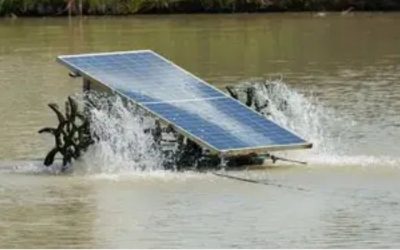
It can cut grid draw to almost nothing in daylight, but most direct-drive solar units stop after dark unless a battery is included. For continuous oxygen a panel alone is not equivalent to a mains pump, so check for onboard storage before treating solar as full-time aeration.
Air CFM figures also cannot be compared to water GPM, so ignore mismatched cross-unit claims in solar listings. If oxygen must hold overnight in a summer heat spell, plan for battery backup or a mains-plus-solar hybrid rather than a daytime-only panel over a stocked pond.
Does a bigger pump waste power?
Not necessarily. An oversized pump throttled to your diffusers can run efficiently and leaves headroom so it is not pinned at its ceiling, which often protects delivered air at depth. The waste comes from unused outlets or excess pressure bled off, not from capacity itself.
The failure mode is buying capacity you never allocate. If half the outlets sit capped and the diffusers stay shallow, you paid for watts that do no work. Size to your real depth and zone count, plug unused ports, and the extra capacity earns its draw instead of idling.
Final Thoughts
Efficiency in an aerator is delivered airflow at your depth per watt, tracked as yearly kWh you can budget, not the smallest number on the shelf. Sort the best energy efficient pond aerator by matched-condition airflow, keep airline runs short, and confirm the depth curve reaches your diffuser before ranking two pumps on cost.
Best Pond Filter System for a Waterfall: Strong Smart Picks
Best Budget Pond Aerator: Top-Rated and Reliable Picks