Last Updated: October 4, 2026
Turtles and koi generate far more solid waste than typical community fish, so filtration for them is about capacity and mechanical throughput, not a matching gallon label. The best canister filter for turtle and koi tank setups are chosen on real circulation and media baskets, and on keeping an indoor tank clearly separate from a koi pond.
As an Amazon Associate we earn from qualifying purchases.
As an Amazon Associate we earn from qualifying purchases at no extra cost to you. Prices and availability are accurate as of the date shown and are subject to change.
By David Nguyen
Quick answer: For most people in 2026, the best canister filter for turtle and koi tank is the Fluval FX6 — our #1 rated choice. See the full ranked comparison, alternatives and buying advice below.
How to Choose a Canister Filter for Turtle and Koi Tanks
Turtle and koi loads are heavy and messy, so a canister’s rating is a weak proxy for what it can actually keep clean. These criteria read circulation, mechanical capacity and load type apart, and they keep an indoor holding tank distinct from pond-scale koi, where aquarium ratings stop meaning very much at all.
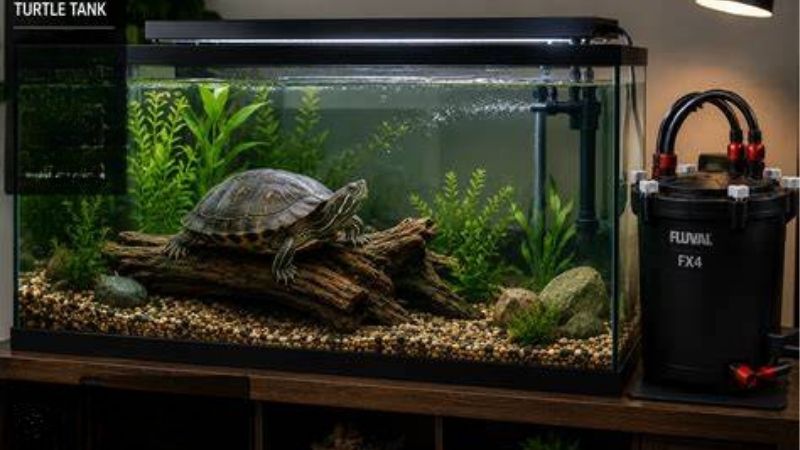
Look at Circulation Before Gallon Ratings
Gallon ratings summarize a maker’s intended range, but circulation is what turns over waste. The Fluval FX6 illustrates the gap, listing 925 GPH of pump output against 563 GPH of published filter circulation. For a turtle or koi tank, size against the circulation figure, since it reflects flow through loaded media rather than an open pump.
A large rating sits on paper; steadiness in a waste-heavy tank comes from flow, media volume and how often you clean, not the label number alone. Reading circulation first stops you from over-trusting a big gallon figure, because two filters with similar ratings can move very different amounts of water through their media in practice.
Prioritize Mechanical and Media Capacity
Solid waste is the main challenge, so mechanical and media capacity carry the load. The FX6 offers about a 5.28-gallon total canister volume, and the Penn-Plax Cascade 1500 uses five stackable media baskets. More room for coarse mechanical media means more debris trapped before it breaks down and fouls the water on a heavy tank.
Capacity also shapes running cost, since filter pads, floss and cartridges are consumables replaced on a schedule, and turtle or koi tanks clog them quickly. Choosing a canister that accepts bulk or reusable media rather than only proprietary cartridges keeps the 12-month cost down, which is a practical factor that raw basket count does not show.
Treat Turtle and Koi as Different Loads
Turtles and koi are not interchangeable loads, and the sources reflect that. The Cascade 1500 is described for turtle habitats up to 200 gallons, but no equivalent cited source confirms it for adult koi. Matching a filter to the specific animal, rather than a generic gallon figure, avoids badly undersizing a heavy koi system from the start.
Adult koi in particular outgrow aquarium assumptions, and a tank rating is not evidence a canister suits pond-scale fish. Use aquarium canisters for indoor turtle tanks or juvenile and temporary koi holding, and treat a permanent adult-koi system as a pond filtration question, since that is where dedicated pond filters and much higher flow belong.
Leave Maintenance Headroom
Heavy waste means frequent service, so leaving flow and access headroom pays off. The FX6 draws about 43W and the FX4 about 30W, while the SunSun HW-3000 advertises an adjustable 396 to 793 GPH. Adjustable flow can help dial circulation to the tank, though that listing is a retail figure rather than a strong manufacturer spec.
Because these filters run around the clock, wattage is a standing cost, and the FX6’s higher draw tracks its higher circulation. The HW-3000’s manufacturer generation is not clearly verified in the listing, so treat its adjustable range as advertised, and lean on brands with clearer current-generation spec pages when reliability matters.
Top Picks
These four span a turtle or koi tank from a budget adjustable unit to a high-capacity flagship, at prices checked in Sep 2026. The table gives each pick’s role and headline spec, and the notes below flag the one caveat, from a conflicting flow claim to unverified koi suitability, that a rating figure will not warn you about.
| Product | Best For | Key Spec | Watch Out For |
|---|---|---|---|
| Fluval FX6 | High-load large tanks | 563 GPH circulation; 5.28-gal canister | Large and premium-priced |
| Fluval FX4 | Medium/large turtle tanks | 450 GPH circulation; 3.9 L media | Less capacity than FX6 |
| Penn-Plax Cascade 1500 | Turtle-focused value | 200-gal rating; 5 baskets | Conflicting flow claim (350 vs 400) |
| SunSun HW-3000 | Adjustable budget option | 396-793 GPH; 9W UV | Manufacturer-generation data weak |
Fluval FX6: Capacity-First Pick
The FX6 is the capacity choice for a heavy turtle or large indoor tank, listing 563 GPH of filter circulation, about a 5.28-gallon canister volume, a 43W draw and a price near under $450 at Petco as of Sep 2026. On 100 gallons that circulation is roughly 5.63 tank volumes an hour before any supplemental flow is added.
Its drawbacks are physical size and premium pricing, since a canister this large needs real cabinet clearance and costs the most in this group. Its 400-gallon rating also should not be read as approval for a 400-gallon koi system, because that figure is an aquarium rating, not a pond-scale endorsement for adult koi at all.
Fluval FX4: Smaller FX Alternative
The FX4 is the smaller FX option for a medium to large turtle tank, listing 450 GPH of filter circulation, about 3.9 liters of media and a price around $350 at Petco as of Sep 2026. On 100 gallons that is roughly 4.5 tank volumes an hour, a strong baseline for a messy but not oversized turtle setup.
Its limitation is capacity relative to the FX6: 450 versus 563 GPH of circulation, about 25% less flow, not half, along with less media room. For a busy turtle tank the FX4 is often enough and saves money, while the heaviest loads justify stepping up to the FX6 rather than running the FX4 near its practical limits.
Penn-Plax Cascade 1500: Explicit Turtle Compatibility
The Cascade 1500 is the value pick whose listing explicitly names turtle habitats, rated to 200 gallons with five stackable media baskets for around $250 at Petco as of Sep 2026. That stated turtle use, plus generous mechanical baskets, is its main draw over filters that only imply suitability for messy reptiles.
Its real caveat is a conflicting flow claim: the current Petco page lists 400 GPH in the title but 350 GPH in the description, so no single figure can be printed as verified until a manual or spec sheet resolves it. Treat its flow as approximate for now and confirm the number with the maker before sizing a turtle tank around it.
SunSun HW-3000: Adjustable-Flow Budget Pick
The HW-3000 is the budget option with adjustable output, advertised at 396 to 793 GPH with a 9W UV lamp and marketed as a five-stage canister, for around $175 at Walmart as of Sep 2026. Adjustable flow lets you trim circulation to a smaller turtle tank or open it up for a heavier bioload as needed.
Its weak point is validation: the cited listing is a retailer page and the exact manufacturer generation is not clearly confirmed, so the specs are advertised rather than verified. Its 9W UV is also just a lamp rating with no published dose, so lean on the adjustable flow and low price as the value, and confirm parts availability before buying.
Frequently Asked Questions
Turtle and koi keepers ask a recurring set of questions about ratings, flow gaps and whether one filter covers every case. The answers below use the published circulation figures and flag where a number is unverified, like the Cascade’s conflicting flow or adult-koi suitability the sources simply do not confirm at all.
Is a 400-Gallon-Rated FX6 Necessary for a 100-Gallon Turtle Tank?
Not necessarily. The FX6 carries a 400-gallon aquarium rating, but its published circulation is 563 GPH, about 5.63 tank volumes an hour on 100 gallons, so the rating overstates how much filter you strictly need. Bioload matters more than the label, and a heavily stocked turtle tank can still justify that much flow.
For a moderately stocked 100-gallon turtle tank the FX4’s 450 GPH is often plenty and costs less, while the FX6 buys extra mechanical capacity and headroom for very messy setups. Choose by how hard the tank is fed and how often you want to clean, rather than treating the 400-gallon number as a requirement to match.
How Much More Flow Does FX6 Give Than FX4?
By published filter circulation, the FX6 moves about 25% more water than the FX4, roughly 563 GPH against 450 GPH. That is a useful step up for heavier loads, but it is well short of double, and describing the FX6 as twice as powerful would misstate the real difference between the two canisters here.
The FX6 also draws more power, about 43W against 30W, so the extra circulation carries a higher standing cost. On a genuinely heavy turtle or large indoor tank the added flow and capacity earn that difference, while a moderate load rarely needs it, keeping the choice a question of bioload rather than headline strength.
Is the Cascade 1500 a 350 or 400 GPH Filter?
The cited source is not consistent, so no single number can be treated as verified. The current Petco page lists 400 GPH in its headline but 350 GPH in the description, an internal conflict that leaves the true rated flow unconfirmed until a manufacturer manual or spec sheet finally settles the difference for buyers.
Until that is resolved, size a turtle tank using the filter’s five baskets and 200-gallon rating rather than a precise flow figure, and confirm the number directly with the maker before relying on it. Treating either 350 or 400 GPH as exact right now risks building your turnover math on a spec the listing itself contradicts.
Can the Same Filter Be Recommended for Adult Koi?
The cited sources do not confirm adult-koi suitability for any of these four models, so none can be endorsed for that use on the evidence at hand. An aquarium gallon rating, whether 200, 250 or 400, is not proof a canister suits pond-scale koi, which grow large and produce far more waste than tank fish.
For indoor turtle tanks or juvenile and temporary koi holding, these canisters can work within their rated ranges. A permanent adult-koi system, though, is really a pond filtration problem, where dedicated pond filters and much higher flow are the right tools, so keep the aquarium and pond use cases clearly separate when you plan.
Final Thoughts
The best canister filter for turtle and koi tank duty is decided by real circulation, mechanical capacity and the animal load, not a gallon rating. Keep indoor turtle tanks, temporary koi holding and adult-koi ponds as separate problems, treat unverified flow or koi claims with caution, and confirm pricing before you commit.
Ready to decide? Our #1 pick for 2026 is the Fluval FX6.
Live price & availability on Amazon.
Related Reviews & Guides

Best Canister Filter Media Order and Setup: Smart Guide

4 Best Aquarium Powerhead Wave Makers