Last Updated: October 4, 2026
A 150-gallon aquarium needs more than a filter that merely claims the right rating; capacity headroom, published circulation, media volume and maintenance access all shape how well it holds up. Choosing the best canister filter for 150 gallon aquarium service means weighing those together instead of trusting tank rating alone.
As an Amazon Associate we earn from qualifying purchases.
As an Amazon Associate we earn from qualifying purchases at no extra cost to you. Prices and availability are accurate as of the date shown and are subject to change.
By David Nguyen
Quick answer: For most people in 2026, the best canister filter for 150 gallon aquarium is the Fluval FX4 — our #1 rated choice. See the full ranked comparison, alternatives and buying advice below.
How to Choose a Canister Filter for 150 Gallons
At 150 gallons the gap between a filter’s rating and its real circulation gets expensive to ignore, and the units worth considering quote flow in different ways. These four criteria line up headroom, honest circulation, media volume and running power so you compare canisters on the same terms rather than whichever number a brand prints loudest.
Leave Capacity Headroom
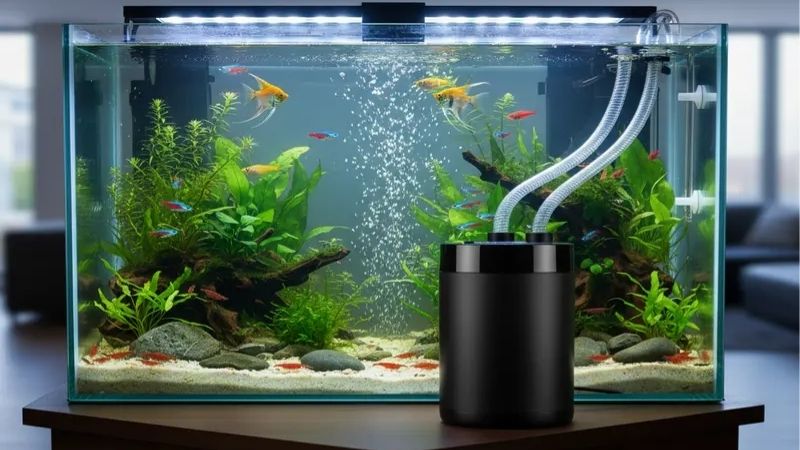
Rating headroom keeps a filter from running flat out on a large tank. For 150 gallons, the OASE BioMaster2 850 is rated up to 220 gallons, the Fluval FX4 up to 250, and the FX6 up to 400, so all three clear the target with margin. More headroom generally means steadier performance as stocking grows over time.
How that headroom is used matters as much as its size on a heavily stocked 150-gallon tank. A canister with an accessible pre-filter, like the BioMaster2 850, lets you restore flow without a full teardown, which can matter more day to day than raw rating when waste builds fast and circulation would otherwise drift down between cleanings.
Compare Real Published Circulation Where Available
Where a maker publishes true filter circulation, use it. Fluval lists 450 GPH for the FX4 and 563 GPH for the FX6, both loaded-media figures on 150 gallons giving roughly 3.0 and 3.75 turnovers an hour. That FX6 number is circulation, not the separate 925 GPH pump output that some retail listings quote for it.
The OASE BioMaster2 850 lists a 395 GPH maximum flow, which is a peak figure closer to a pump rating than to loaded circulation. Comparing it directly against Fluval’s circulation numbers without labeling the difference makes the OASE look slower than it is in practice, so read each spec for what it measures before ranking the three units.
Check Media Capacity
Media capacity governs biological headroom and how long a filter holds flow between cleanings, which matters on a waste-heavy 150-gallon tank. The BioMaster2 850 lists about 8 liters of total filter volume, a generous figure, but each maker measures capacity against its own definition rather than a shared industry standard.
Because of that, liters and gallons of media are not interchangeable across brands, so avoid treating a bigger printed volume as more filtration. Read each manufacturer’s figure with its own definition attached, and weigh media capacity alongside circulation and pre-filter access rather than letting one volume number decide the purchase.
Compare 24/7 Power Draw
Running cost scales with wattage on a filter that never stops. The FX4 draws about 30W, the FX6 about 43W, and the BioMaster2 850 about 25W where published. The FX6’s extra circulation comes with the highest draw of the three, a gap that compounds across a year of continuous operation on a large tank.
On a 150-gallon setup that already runs heaters and pumps around the clock, filter wattage is a real line in the monthly bill rather than a rounding error. The lower-draw BioMaster2 850 trades some circulation for efficiency and pre-filter convenience, so the right pick balances turnover against the continuous power a big canister adds daily.
Top Picks
Two Fluval canisters and one OASE cover the 150-gallon range from value to high-capacity to maintenance-focused, and the fourth entry compares them by load. The table gives each pick’s role and headline spec, and the notes below add the one drawback that a rating figure alone will not warn you about before purchase.
| Product | Best For | Key Spec | Watch Out For |
|---|---|---|---|
| Fluval FX4 | value/performance | 450 GPH circulation | Less flow than FX6 |
| Fluval FX6 | higher load/headroom | 563 GPH circulation | 43W draw |
| OASE BioMaster2 850 | prefilter maintenance | 395 GPH max; 220-gal rating | Max flow not directly comparable |
Fluval FX4: Value Pick
The FX4 is the value choice for 150 gallons, listing 450 GPH of filter circulation, a 250-gallon rating and a price near under $350 on 17 Sep 2026. That circulation equals about 3.0 turnovers an hour on the target volume, a solid baseline for a moderately stocked large tank with room to spare above 150 gallons.
Its limitation is simply less flow than the FX6, 450 against 563 GPH, which shows up as thinner margin on a heavily stocked 150-gallon setup. Since the FX6 costs only about 5.7% more at checked prices, the FX4 makes the most sense when the tank’s bioload is moderate and the roughly $20 saving matters more than extra circulation.
Fluval FX6: High-Capacity Pick
The FX6 is the high-capacity option, publishing 563 GPH of filter circulation, a 400-gallon rating, a 43W draw and a price around $375. On 150 gallons that circulation is about 3.75 turnovers an hour, and its generous rating leaves plenty of headroom for aggressive stocking or a future move to a larger tank later.
The trade-off is power: at 43W it draws the most in this group, a continuous cost that adds up on a tank already running heaters and pumps. Its 563 GPH is filter circulation, not the 925 GPH pump output some listings advertise, so buy it for the honest circulation and headroom rather than the inflated pump figure on the box.
OASE BioMaster2 850: Maintenance-Focused Pick
The BioMaster2 850 targets easier upkeep, with a 395 GPH maximum flow, a 220-gallon rating, about 8 liters of total filter volume and a price near under $400. Its integrated pre-filter is built to be serviced without opening the main body, which keeps circulation steadier between full cleanings on a busy 150-gallon tank.
The caveat is that 395 GPH is a published maximum, not loaded circulation, so it is not directly comparable to Fluval’s circulation numbers and real turnover sits lower once media is packed. You pay premium-mid money for maintenance convenience and rating headroom rather than the highest circulation figure among these three canisters.
FX4 vs FX6 vs BioMaster2 850 for Different Loads
Reading each unit correctly, the FX4 gives about 3.0 turnovers an hour, the FX6 about 3.75, and the BioMaster2 850 about 2.63 using its maximum flow rather than loaded circulation. A moderately stocked 150-gallon tank sits comfortably on the FX4, while heavier bioloads lean toward the FX6’s extra circulation and larger rating.
Those multiples are starting points, not fixed rules, because real turnover shifts with stocking, media condition, hose restriction and head height. If maintenance access ranks above peak flow, the BioMaster2 850’s pre-filter can outweigh its lower published number, so weigh how the tank is used rather than ranking purely on the turnover figure.
Frequently Asked Questions
Shoppers sizing a canister for 150 gallons keep circling the same comparisons between the FX4, FX6 and BioMaster2 850. The answers below rely on the published circulation figures and the dated price checks behind them, while flagging where a maximum-flow number needs a caveat before it becomes the basis for a decision.
Is the FX4 enough for 150 gallons?
The FX4’s published 450 GPH of filter circulation equals about 3.0 turnovers an hour on a 150-gallon tank, which is a reasonable baseline before you apply any personal turnover target. With a 250-gallon rating it also clears the tank size with headroom, so it is not running at its ceiling the way a smaller canister would.
Whether 3.0 turnovers suits your tank depends on stocking, plant mass and how the return is set up, so treat it as a starting point rather than a guarantee. A heavily stocked or messy setup may prefer the FX6’s extra circulation, while a moderate community is well served by the FX4 at a lower price and draw.
How much stronger is FX6 circulation?
By published filter circulation, the FX6 moves about 25.1% more water than the FX4, roughly 563 GPH against 450 GPH. That is a meaningful step up for heavier stocking, but it is well short of double, and calling it twice as strong would misstate the real difference between the two canisters on any tank.
Because the FX6 costs only about 5.7% more at checked prices, that 25.1% flow gain comes cheap in purchase terms, though it carries a higher 43W draw. The extra circulation earns its place on a busy 150-gallon tank, while a moderate bioload rarely needs it, making the choice a question of stocking rather than headline power.
Is the BioMaster2 850 rated above 150 gallons?
Yes. The OASE BioMaster2 850 carries a manufacturer maximum of 220 gallons, so a 150-gallon tank sits well within its rated range with 70 gallons of headroom. That margin lets it run below its ceiling, which supports steadier long-term performance on a moderately to heavily stocked large tank over the years.
Rating headroom does not translate directly into circulation, though, since the 395 GPH figure is a published maximum rather than loaded flow. The real advantage of that 220-gallon rating is comfortable margin paired with the accessible pre-filter, which together hold circulation steady between the deeper cleanings a busy 150-gallon tank needs.
Is FX6 worth the extra purchase price?
At prices checked on 17 Sep 2026, the FX6 ran about $375 against roughly $350 for the FX4, a gap near $20 or about 5.7%. For that small premium you gain about 25.1% more filter circulation and a jump from a 250-gallon to a 400-gallon rating, which is strong value if you genuinely need the headroom.
Prices on large canisters shift, so treat that roughly $20 gap as a dated snapshot and recheck before buying. If your 150-gallon tank is moderately stocked the FX4’s flow is usually enough and the saving stands, while heavier bioloads or upgrade plans make the FX6’s extra circulation and rating the better long-term buy.
Final Thoughts
Landing on the best canister filter for 150 gallon aquarium duty means comparing honest circulation against maximum-flow figures, then weighing rating headroom, media volume and power for your stocking. Let bioload and maintenance access decide between the FX4, FX6 and BioMaster2 850, and confirm current pricing before you commit.
Ready to decide? Our #1 pick for 2026 is the Fluval FX4.
Live price & availability on Amazon.
Related Reviews & Guides


Best Aquarium Controller With Leak Detection: Expert Pick
Best Pond Aerator for a 500 Gallon Pond: Top Proven Picks