Last Updated: September 29, 2026
The right ATO starts from your installation, not a brand list. Learning how to choose an auto top off system means turning five physical facts, water type, evaporation, reservoir position, vertical lift and sensor mounting, into a shortlist, then eliminating models that cannot meet the head or compatibility before comparing price or features.
As an Amazon Associate we earn from qualifying purchases.
By David Nguyen
Find Your Auto Top Off Requirements
Choosing an ATO well begins with measurements, because head, water type and mounting eliminate more models than features do. The four below come first: measure how much water evaporates, measure the reservoir-to-outlet rise, measure the sensor panel and glass, and identify the failure modes you want backed up.
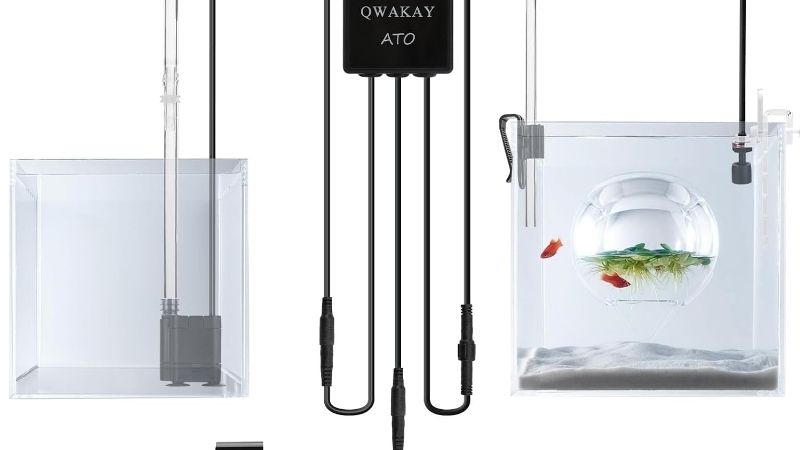
Measure How Much Water Actually Evaporates
Start with the demand the ATO must meet, which is evaporation. Bulk Reef Supply lists surface area, water movement, temperature and humidity as the drivers, so measuring the actual daily water loss over normal operation tells you far more than the tank’s nominal gallons could ever hope to convey on their own.
So log the real daily drop before shopping, since that figure sizes both the pump duty and the reservoir. Evaporation, not display volume, is what the system replaces, which is why an early measurement keeps the rest of the decision grounded in what your tank actually does day to day in practice.
Measure Reservoir-to-Outlet Vertical Rise
Next, measure the vertical rise the pump must overcome. The lift from the reservoir pump up to the outlet is what decides which pumps can even deliver water at all, so it is then compared against each model’s published maximum head rather than against the tank’s overall size or the pump’s own headline flow rating.
So take that measurement first and treat it as an eligibility gate. Because you match lift to head, not tank gallons to pump gallons-per-hour, a clear rise figure immediately rules out any pump whose published maximum head sits below your run, before any real feature comparison even begins.
Measure Sensor Mounting Area and Glass Thickness
Then check where the sensor will mount and how thick that panel is. A magnetic optical sensor has a rated glass thickness, so measuring the sump or the tank wall carefully really matters: the Duetto2 mounts up to 12.7 millimeters, while the full Tunze sensor is separately rated up to 15 millimeters of glass or acrylic.
So measure the panel before assuming a sensor will attach. If your glass is 13 millimeters, the Duetto2’s 12.7-millimeter limit rules it out while the full Tunze remains eligible, a clean dimensional elimination that has nothing to do with price and everything to do with physical panel fit alone.
Identify Failure Modes You Want Backed Up
Finally, decide which failures you most want protected against. Optical backup, a timer, a float valve, leak detection and pump dry-run protection each solve a different failure problem, so naming the failure modes that worry you shapes which safety architecture you should really be comparing among the eligible units.
So list the backstops you want before weighing brands, since they differentiate eligible systems. Once the head, water type and mounting have narrowed the field, the safety features become the deciding factor, which is why knowing the failures you care about turns a shortlist into a final, confident choice.
Fix It Step by Step
With the measurements in hand, the choice becomes a short elimination sequence rather than a feature contest. The table walks four steps, water type and size ceiling, vertical lift, sensor panel, then failure protection, each turning one input into a decision that removes ineligible models before comparing price.
| Step | Input | Worked Example | Decision |
|---|---|---|---|
| 1 | Water type + size ceiling | Freshwater / 75 gal | Drop seawater-only or 66-gal models |
| 2 | Vertical lift | 7 ft | Drop pump max head below 7 ft |
| 3 | Sensor panel | 13 mm | Drop magnet rated only to 12.7 mm |
| 4 | Failure protection | Overfill + siphon + dry run | Compare actual backup mechanisms |
Step 1: Eliminate Incompatible Water-Type and Size Models
Begin by removing anything that fails on water type or a stated size ceiling. The ReefATO+ is seawater only, so it drops off a freshwater build, and the Tunze Nano is scoped to about 66 gallons, so it drops off a 75-gallon tank before any other spec on the sheet is even considered.
So apply these hard limits first, because they are absolute rather than a matter of degree. A seawater-only sensor cannot read fresh water, and a stated volume ceiling is a firm boundary, which is why these two hard checks clear the field faster than any feature comparison could at this early filtering stage.
Step 2: Eliminate Pumps That Cannot Meet the Lift
Next, remove any pumps whose maximum head sits below your measured rise. A 7-foot installation immediately excludes the roughly 6-foot IceCap pump on published data, since its head endpoint falls under the required lift and it simply cannot deliver reliably to that raised outlet at all.
So treat the lift figure as a straight cutoff against each maximum head. Remember these are eligibility checks, not flow margins, because maximum head is a zero-flow endpoint, so passing the cutoff keeps a pump in the running rather than proving its delivered flow at your height.
Step 3: Check Sensor and Tube Geometry
Then verify both the sensor placement and the tubing geometry carefully. XP Aqua says to keep the optical sensor well away from microbubbles and direct light, while Red Sea requires a siphon break when the outlet-and-reservoir geometry could let water keep flowing on after the pump has fully stopped.
So confirm both a clean sensor location and safe outlet routing before comparing anything else. These are conditional, geometry-driven checks rather than universal rules, so preserving the exact conditions the makers state keeps false alarms and unintended siphons out of the finished, running install.
Step 4: Compare Safety, Price and Convenience Last
Only now, among the models still standing, compare safety architecture, price and convenience. Current reference prices run from the N-Fill at $69.99 and the IceCap at $109.71 to the Duetto2 at $169.99, the ReefATO+ at $225 and the full Tunze near $249.99 at BRS as of 09/2026 for a quick reference.
So let price and features decide between eligible systems, not lead the choice. Because the physical filters have already removed the mismatches, this final step compares real backup mechanisms and cost on a level field, which is exactly why it belongs right at the very end of the buying workflow.
Frequently Asked Questions
These answers keep the focus on measurement-first selection, since head, water type and mounting decide more than features. Each opens with the direct answer and the reason behind it, so the workflow stays a matter of eliminating on physics before comparing brands, price or app conveniences.
What Is the Most Important ATO Specification?
There is no single most important spec, because a model must first clear several hard gates. Water compatibility, vertical lift and sensor mounting all have to pass before anything else matters, and only then does the safety architecture differentiate the systems that still remain eligible for the tank.
So think in a sequence rather than a single headline number. The physical requirements decide what is even possible on your tank, which is why naming one spec as most important is less useful than working through compatibility, lift and mounting before comparing safety, price and app-convenience features.
Should I Choose an ATO Based on Tank Gallons?
Only where a manufacturer states an explicit tank-volume limit, such as the Tunze Nano’s roughly 66-gallon ceiling for its controller. Outside of those stated ceilings, tank gallons do not define pump head or evaporation, so they are a poor axis for organizing the entire selection process on their own.
So use gallons only as a compatibility ceiling, not as the sizing rule. Beyond an explicit manufacturer limit, the decision still rests on measured evaporation, lift and mounting, which is why matching a tank’s size to a pump’s flow is a shortcut that tends to mislead most buyers in the end here.
How Much Headroom Should I Leave Below Max Head?
No universal percentage was verified, so there is no reliable rule to leave a fixed margin below maximum head. Instead, avoid designing right at the maximum and seek actual flow-curve data where a maker provides it, since maximum head is the endpoint of useful pumping rather than a design target.
So leave sensible room below the ceiling without inventing a specific figure. Because delivered flow falls as the pump nears its maximum head, choosing a pump whose head comfortably exceeds your lift is safer than picking one right at the edge, even though no exact margin is documented anywhere.
Do I Always Need a Siphon Breaker?
No, because the need depends on the specific reservoir-and-outlet geometry. Red Sea ties the requirement to cases where the outlet sits below the reservoir water surface, so a siphon breaker is essential in that layout but it is not automatically required in every single ATO plumbing installation.
So evaluate your own plumbing rather than universalizing the rule. Where gravity could continue a fill after the pump stops, the breaker is necessary, and where the geometry cannot siphon it may not be, which is why preserving the maker’s exact condition matters far more than a single blanket answer here.
Final Thoughts
Knowing how to choose an auto top off system means measuring before comparing: water type, evaporation, lift and sensor fit come first, and each eliminates models that fail the head or compatibility. Only then do safety, price and convenience decide, built from installation physics rather than a brand shortlist.
Related Reviews & Guides




Best pH and Temperature Monitor for Aquarium: Expert Pick

Best Tempered Glass Aquarium Lid: Top Compared Fit Picks Guide