Last Updated: October 4, 2026
The best lava rock for aquarium filtration is stone actually sized and documented for biological media, not any decorative volcanic rock. This guide compares four current options on media size, aquarium-safety claims and price, and explains why porous looks alone do not prove real filtration capacity.
As an Amazon Associate we earn from qualifying purchases.
By David Nguyen
Quick answer: For most people in 2026, the best lava rock for aquarium filtration is the CAUSEWAY Lava Rock — our #1 rated choice. See the full ranked comparison, alternatives and buying advice below.
How to Choose Lava Rock Media
Choosing lava rock as filter media means matching it to a real filtration job: size it to your filter chamber, verify it is meant for aquarium use, keep mechanical filtration ahead of it, and resist judging biological capacity by how porous a rock happens to look.
Choose filter-chamber size
Size the lava to your filter chamber first, since media that is too large wastes space and too small can clog flow. CAUSEWAY publishes a 2-to-3-centimeter media size, which suits canister and sump baskets, so check a rock’s size against the chamber it will sit in before buying.
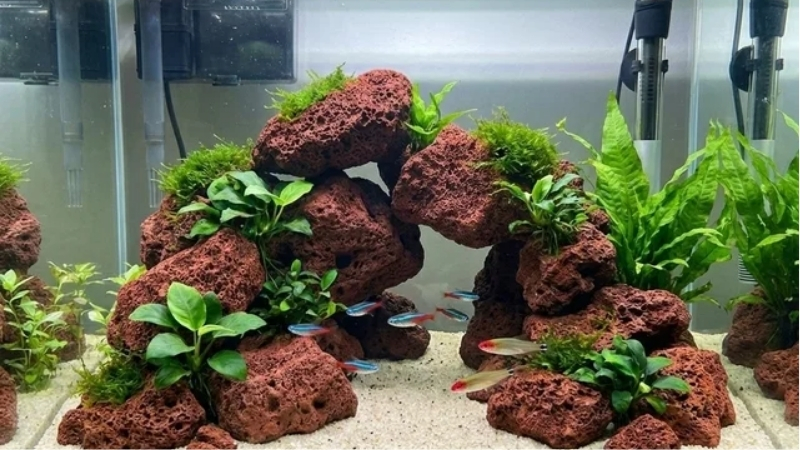
Decorative aquascaping lava, like a 4-by-4-by-4-inch block, is far too big for a filter basket and belongs in the tank instead. Buy media-sized pieces for filtration and larger rocks for hardscape, and do not try to force an oversized decorative stone into a role it does not fit.
Verify aquarium use
Verify the exact product is meant for aquarium use, since not all volcanic rock sold for gardens or grills is safe in a tank. CAUSEWAY claims pH-neutral aquarium use, while some hardware-store lava is sold without any aquarium safety documentation, which leaves its chemistry and coatings unknown.
Landscape lava can carry dust, dyes or residues you do not want in an aquarium, so confirm the listing describes aquarium or inert use. When a product does not state it, treat it cautiously and rinse thoroughly. Buying stone documented for aquariums avoids gambling on an untested rock in your filter.
Use mechanical filtration upstream
Keep mechanical filtration ahead of lava media, because porous rock clogs with debris if it is doing the straining. Foam or floss upstream catches particles first, letting the lava focus on hosting bacteria, which is the biological role it is actually suited to in a filter.
Without upstream mechanical media, lava’s crevices trap detritus and channel flow, reducing its effectiveness and fouling the water. Arrange the filter so water passes mechanical media, then the lava, so the rock stays a clean home for nitrifying bacteria rather than a debris trap needing constant rinsing.
Do not equate porous appearance with surface area
Do not judge biological capacity by how porous a rock looks, since appearance is not a measured surface-area rating. Lava rock lacks the published square-meters-per-liter figures that purpose-made biomedia list, so you cannot assume a craggy stone hosts more bacteria than a smoother one just by eye.
Because no shared surface-area standard exists across these products, percentage comparisons of biological capacity are invalid. Lava is a reasonable, cheap biomedia, but if you need a known capacity, engineered media publishes it. Treat lava as adequate rather than assuming a porous look guarantees superior filtration performance.
Top Picks
These four cover the best lava rock for aquarium filtration, from a bagged media-sized product to large hardscape lava. Compare them on media size and aquarium documentation, remembering that none publishes a surface-area rating, so you cannot rank their biological capacity by the numbers.
| Product | Best For | Key Spec | Watch Out For |
|---|---|---|---|
| CAUSEWAY Lava Rock | Best Overall Filter Media | 1kg; 2-3cm; filter bag; pH-neutral claim | Media, not hardscape; ~under $30 (09/2026) |
| Aquaticscapes Tumbled Lava | Inert Media | ~1 in; inert claim | Sold by the pound; ~under $10/lb (09/2026) |
| Home Depot GSL3477 | Bulk Pieces | 1.18-1.96 in; 10 pcs | Not aquarium-documented; ~under $50/10 (~$4.60 each) |
| Aqua Natural Lava | Hardscape Rock | 4x4x4 in; 3.3 lb | Too big for filter; ~$4.19 (PetSmart, 09/2026) |
CAUSEWAY: Best Overall Filter Media
CAUSEWAY 1-kilogram lava is the cleanest literal filter-media match, publishing a 2-to-3-centimeter media size, including a filter bag and claiming pH-neutral aquarium use, at about $25. Everything about it is set up for a filter chamber rather than for decorating the tank itself.
The included bag makes it easy to drop into a canister or sump, and the stated pH-neutral claim suits keepers wary of chemistry shifts. It carries no surface-area rating, so treat its capacity as adequate rather than measured. For the exact filter-media job, it is the most documented option here.
Aquaticscapes 1-in
Aquaticscapes tumbled lava is a media-sized option at about $10 per pound, with roughly 1-inch pieces and an inert claim. At about 2.54 centimeters, that size sits inside CAUSEWAY’s 2-to-3-centimeter range, so it fits filter chambers while costing less by weight for keepers buying in bulk.
A matching size does not prove matching porosity, though, so do not assume it performs identically to other lava. The inert claim is reassuring for chemistry, but rinse it well before use. Sold by the pound, it lets you buy exactly the amount your filter needs without a fixed pack size.
GSL3477
Home Depot’s GSL3477 is a bulk option at about $45 for ten black porous stones of 1.18 to 1.96 inches, roughly $4.60 per stone. It offers a lot of volcanic rock for the price, useful for filling a large sump or a big hardscape where you need many pieces at once.
It is a landscape product, not aquarium-documented, so its chemistry and any residues are unverified, meaning you should rinse thoroughly and test water after adding it. The pieces skew large for fine filter baskets. Treat it as budget bulk stone you vet yourself rather than a documented aquarium media.
Aqua Natural Hardscape Lava
Aqua Natural black or red lava is a hardscape rock at about $4.19, measuring 4 by 4 by 4 inches and weighing 3.3 pounds. This is decorative aquascaping stone for inside the tank, giving a bold porous rock for layouts rather than media sized for a filter chamber at all.
At this size it will not fit a filter basket, so do not buy it for filtration; use it as a visible feature that also hosts some bacteria in the display. As hardscape it is cheap and characterful. Just match your purchase to the job, since this rock decorates rather than filters.
Frequently Asked Questions
These are the questions keepers ask most about lava rock in filtration, from whether it works as biomedia to whether it changes pH. Each answer gives a direct response, then the caveat that decides how it applies to your filter and your water.
Does lava work as biomedia?
Yes, as a home for nitrifying bacteria. Lava rock’s porous surface hosts the bacteria that process ammonia and nitrite, so it works as biological media in a filter. It is a long-standing budget alternative to engineered biomedia, and many keepers run it successfully in canisters and sumps.
It does not chemically absorb ammonia, though; the bacteria do the work, not the rock. Lava also lacks a published surface-area rating, so its capacity is not quantified like purpose-made media. It is adequate and cheap, but if you need a known biological capacity, engineered media states its numbers.
What size is best?
For filtration, media-sized pieces of roughly 2 to 3 centimeters, or about an inch, suit filter chambers, as with CAUSEWAY’s stated range. That size packs enough surface into a basket while leaving flow paths open, which is the balance a biological media needs to work without clogging.
Larger decorative blocks belong in the tank as hardscape, not in the filter. Match the piece to where it goes: media size for the filter, bigger rock for the display. Buying the wrong size, like a 4-inch block for a canister, wastes the stone’s potential and disrupts your filter’s flow.
Does lava change pH?
Good aquarium lava is generally close to pH-neutral, and CAUSEWAY claims pH-neutral use, so quality lava rock should not shift chemistry much. Not all lava is neutral, though, so do not assume any volcanic stone is safe for parameters without checking the specific product first.
Landscape or undocumented lava can carry dust or residues that affect water, so rinse thoroughly and test after adding it. For sensitive setups, choose a product that states its chemistry. Treat pH-neutral as a per-product claim to verify, not a blanket property of all lava rock everywhere.
Should lava be rinsed?
Always. Lava rock carries fine dust and grit from handling and packaging, so rinse it thoroughly under water until the runoff is clear before adding it to a filter or tank. Skipping this clouds the water and can send dust into the filter, where it settles and reduces flow.
Rinsing is especially important for landscape or undocumented lava, which may carry more residue than aquarium-labeled products. A good rinse takes minutes and prevents a cloudy tank after setup. Treat it as a mandatory prep step for any lava rock, whether it is going into the filter or the display.
Final Thoughts
The best lava rock for aquarium filtration is media sized and documented for aquarium use: CAUSEWAY leads for the exact filter job with its stated size, bag and pH-neutral claim, while cheaper pieces and hardscape lava suit other roles. Keep mechanical media upstream, rinse well, and confirm current prices before buying.
As an Amazon Associate we earn from qualifying purchases at no extra cost to you. Prices and availability are accurate as of the date shown and are subject to change.
Ready to decide? Our #1 pick for 2026 is the CAUSEWAY Lava Rock.
Live price & availability on Amazon.
Related Reviews & Guides
Common Mistakes When Buying an Aquarium Overflow Box Guide
Best Power Filter for 20 Gallon Tank: Smart, Reliable Picks