Last Updated: October 7, 2026
The best Apple AirTag dog collars are the ones that keep the tracker flat, enclosed, and difficult to pull free while matching your dog’s neck size, coat, activity level, and tolerance for extra hardware; for most dogs, a purpose-built collar with an integrated holder is safer than clipping an AirTag to a loose accessory.
Quick answer: For most people in 2026, the best apple airtag dog collars for secure fit is the Toy or very small dog — our #1 rated choice. See the full ranked comparison, alternatives and buying advice below.
Quick picks by dog and use case
- Best for everyday walks: an adjustable nylon collar with a stitched or riveted AirTag pocket.
- Best for dogs that swim or hike: a waterproof TPU or silicone holder mounted securely to a biothane or coated-webbing collar.
- Best for small dogs: a slim collar with a low-profile holder and a 10–15 mm strap width.
- Best for strong pullers: a 20–25 mm nylon or biothane collar with a metal D-ring and a separate, enclosed AirTag mount.
- Best budget approach: a conventional collar plus a screw-closed or locking AirTag holder, provided the holder cannot slide over the buckle.
- Best for puppies: an inexpensive adjustable collar and replaceable holder, because both the neck size and chewing risk can change quickly.
What matters more than the collar’s appearance
1. AirTag-holder security
A holder should prevent three types of failure: the AirTag falling out, the holder sliding around the collar, and the entire collar breaking or opening. A silicone sleeve is light and convenient, but it is not automatically secure. Look for a closed back, a snug retaining lip, and a mounting method that cannot slide over the buckle or D-ring.
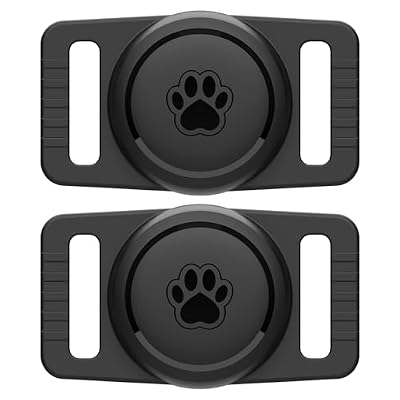
GOCII for Airtag Dog Collar Holder 2 Pack,Waterproof Dog Collar Holder for Apple AirTag(Gen 1 & 2),Silicone Air Tags Case for Dog Collars(Black)
Included for 'Best Apple AirTag Dog Collars for Secure Fit' because the listing specifies Waterproof Dog Collar Holder for Apple AirTag(Gen 1 & 2) and Silicone Air Tags Case for Dog Collars(Black), details this guide uses to compare options.
View on Amazon
Upgrade Dog Collar with AirTag Holder, IP68 Waterproof, Red, L
Included for 'Best Apple AirTag Dog Collars for Secure Fit' because the listing specifies IP68 Waterproof and Red, details this guide uses to compare options.
View on Amazon
Premium Airtag Dog Collar,with IP68 Waterproof AirTag Holder,Pink,L
Included for 'Best Apple AirTag Dog Collars for Secure Fit' because the listing specifies Pink, details this guide uses to compare options.
View on AmazonFor an active dog, a screw-fastened or riveted holder is preferable to a simple slip-on loop. The AirTag should sit flat against the collar rather than hang like a pendant. A dangling tracker can knock against furniture, catch on branches, or become a tempting chew target. The speaker openings must remain unobstructed, and the holder should not cover the AirTag’s removable battery door.
Elevation Lab’s TagVault Pet is a useful example of the enclosed-holder design: it is intended to protect an AirTag from bumps and help prevent accidental release. Products such as Belkin’s Secure Holder with Strap demonstrate the opposite trade-off: a strap-based mount is easy to move between collars, but its security depends heavily on how tightly it is fitted and where it is positioned. A generic open silicone loop is best reserved for calm, supervised use.
2. Collar material and hardware
- Nylon: affordable, light, widely adjustable, and easy to replace. It can retain water and develop frayed edges over time.
- Biothane or coated webbing: smooth, quick-drying, and easy to wipe clean. It is a strong choice for mud, rain, and swimming, although the coating and stitching still need inspection.
- Leather: comfortable and attractive when maintained, but it can absorb water and may stiffen or crack if repeatedly soaked.
- Silicone or TPU: useful for the holder because it cushions the AirTag and resists splashes. As a complete collar material, it may be less breathable and can irritate some dogs if dirt remains underneath.
For a dog that pulls, prioritize a properly sewn collar with a robust buckle and D-ring. The AirTag holder is not a substitute for a load-rated walking attachment. If the D-ring is used for a leash, the holder should be positioned away from it so leash tension does not twist or crush the tracker.
3. Correct sizing
Measure around the middle of the neck with the coat lying naturally, then add room for movement. You should normally be able to slide two fingers between the collar and the neck, but not pull the collar over the dog’s head. Check the fit while the dog is standing, because the neck shape can change when the head lowers.
| Dog type | Typical collar width | Useful adjustable range | Preferred AirTag setup | Approximate added weight |
|---|---|---|---|---|
| Toy or very small dog | 10–15 mm | 20–30 cm | Low-profile enclosed holder; avoid dangling mounts | 15–25 g including holder |
| Small to medium dog | 15–20 mm | 28–45 cm | Stitched pocket or locking silicone/TPU holder | 18–30 g including holder |
| Large dog | 20–25 mm | 40–60 cm | Riveted or screw-fastened holder on nylon or biothane | 20–35 g including holder |
The AirTag itself is about 32 mm wide, 8 mm thick, and 11 g. A holder can add another 4–20 g, depending on whether it is a thin sleeve or a heavily protected enclosure. On a tiny dog, that difference is proportionally significant: a 25 g collar accessory is roughly 2.3 times the mass of the tracker alone.
Head-to-head: the main collar designs
| Design | Security | Weather resistance | Comfort | Best use |
|---|---|---|---|---|
| Integrated stitched pocket | High if the pocket closes securely | Good; depends on fabric and seams | Very good; lies flat | Daily wear and small dogs |
| Riveted or screw-closed holder | Very high | Very good with sealed TPU or silicone | Good, but can be bulky | Hiking, escape-prone, or active dogs |
| Slip-on silicone sleeve | Moderate | Good against rain and splashes | Good if it does not slide | Low-cost everyday use |
| Hanging pendant holder | Moderate to low | Usually good | Can swing, tap, or snag | Calm dogs under supervision |
For most households, the best balance is a flat integrated pocket or an enclosed holder fixed to a standard collar. Products sold as AirTag pet collars can be convenient, but inspect the holder and collar separately: a secure tracker compartment does not compensate for a buckle that opens easily or a collar that is too wide for a small dog.
Weather resistance and ownership costs
Apple rates AirTag as IP67, meaning it is designed for limited dust protection and temporary immersion under laboratory conditions. That does not make every collar holder waterproof. Water can enter through seams, battery openings, screw channels, or a loose silicone edge. After swimming or heavy rain, remove the tracker when practical, wipe the collar and holder, and let everything dry before reassembly.
A typical AirTag battery lasts about one year, but sound playback, frequent location updates, and cold conditions can shorten the interval. A replacement CR2032 battery is the main recurring cost. If a complete collar costs $15–$40 and is replaced every 12–24 months, its collar-only cost works out to roughly $0.60–$3.30 per month, before battery replacement. A cheaper collar that must be replaced after chewing or fraying may cost more over time than a washable, replaceable-holder design.
Decision matrix
| Your situation | Choose | Avoid |
|---|---|---|
| Low budget, calm adult dog | Nylon collar plus a snug enclosed sleeve | Oversized tactical holders |
| Frequent swimming or wet weather | Biothane or coated webbing plus sealed TPU/ silicone mount | Unsealed fabric pockets that stay damp |
| Escape-prone dog | Correctly fitted martingale-style collar where appropriate, with a fixed holder | Loose pendant attachments |
| Small dog sensitive to weight | 10–15 mm collar and the lightest enclosed holder available | Metal cases and wide heavy collars |
| Large, strong, active dog | 20–25 mm collar, reinforced stitching, and riveted or screw-fastened mount | Thin fashion collars and slide-on loops |
Setup and maintenance checklist
- Insert the AirTag and confirm that the holder fully retains its edges or closes completely.
- Pair it in the Find My app, give it a clear name, and verify that the contact information in Lost Mode is current.
- Fit the collar using the two-finger check, then inspect whether the holder can slide toward the buckle or pass over it.
- Walk the dog indoors for several minutes and check for rubbing, swinging, or abnormal scratching.
- Once a month, inspect stitching, rivets, screws, buckle cracks, fraying, and stretching. Replace the collar at the first sign that its strength or fit is compromised.
- After mud or salt water exposure, rinse the collar according to its material instructions, dry it completely, and check the battery compartment.
Final recommendation
Choose a low-profile, enclosed AirTag holder on a correctly sized nylon or biothane collar. Use a stitched pocket for comfort and normal walks, or a riveted or screw-fastened mount for swimming, hiking, strong pullers, and dogs that investigate every accessory with their teeth. The most secure AirTag collar is still only a locating aid, not a substitute for a visible ID tag, an up-to-date microchip record, a properly fitted collar, and supervision in unsecured areas.
Ready to decide? Our #1 pick for 2026 is the Toy or very small dog.
Live price & availability on Amazon.
Related Reviews & Guides



Best Hey Dude Shoes for Everyday Comfort
Best Camping Tents for Comfortable Trips