Last Updated: October 4, 2026
The Short Answer
For a 40-gallon aquarium, choose a filter rated for at least 40 gallons and preferably for 50 to 60 gallons. The most useful target is a flow rate of about 200 to 300 gallons per hour (GPH), giving the aquarium roughly five to seven turnovers per hour. A filter rated at exactly 40 gallons can work for a lightly stocked tank, but extra capacity is helpful when the aquarium contains many fish, messy eaters, live plants, or decorations that restrict water movement.
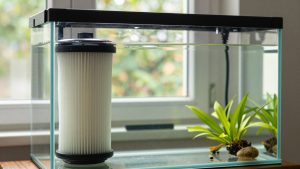
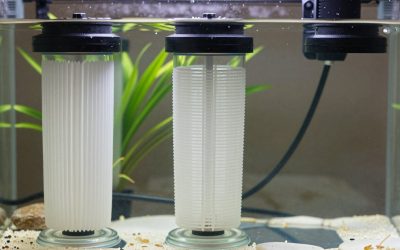
For most community aquariums, a hang-on-back (HOB) filter in the 200-to-300-GPH range is the easiest choice. An internal filter rated around 170 to 300 GPH can also work, especially when the tank has no room behind it. A canister filter is useful for a heavily stocked 40-gallon tank, although it costs more and takes longer to clean.
As an Amazon Associate we earn from qualifying purchases at no extra cost to you.



As a practical 2026 buying guide, look beyond the gallon rating. Check the filter’s actual width, height, intake depth, clearance behind the tank, media capacity, adjustable flow, and replacement-cartridge cost.
Standard Sizes
The table below shows common filter formats for a 40-gallon aquarium. Dimensions are representative product sizes and can vary by model, so compare them with the manufacturer’s measurements before buying. One inch equals 2.54 centimeters.
| Filter type | Typical rating | Approximate physical size | Approximate power | Best use |
|---|---|---|---|---|
| Compact internal filter | 100–170 GPH | 3.5–4.5 in W × 3–4 in D × 8–10 in H (8.9–11.4 × 7.6–10.2 × 20.3–25.4 cm) |
5–10 W | Lightly stocked 40-gallon tanks or supplemental circulation |
| Large internal filter | 170–300 GPH | 4–5 in W × 3.5–5 in D × 10–13 in H (10.2–12.7 × 8.9–12.7 × 25.4–33 cm) |
8–15 W | Freshwater tanks without rear clearance |
| Medium HOB filter | 200–300 GPH | 10–13 in W × 6–9 in D × 7–10 in H (25.4–33 × 15.2–22.9 × 17.8–25.4 cm) |
5–12 W | Most standard 40-gallon community aquariums |
| Canister filter | 250–400 GPH | 9–11 in W × 9–11 in D × 14–20 in H (22.9–27.9 × 22.9–27.9 × 35.6–50.8 cm) |
15–35 W | Heavily stocked tanks and greater media capacity |
Flow ratings are usually measured with little or no media resistance. Once the filter is filled with sponge, carbon, ceramic media, or a clogged cartridge, actual circulation may be lower. This is why a 215-GPH or 300-GPH model is generally more suitable than a filter rated at only 100 GPH.
Example choices include the Tetra Whisper IQ 215 GPH Power Filter, commonly priced around $35 to $45, and the Tetra Whisper IQ 300 GPH Power Filter, commonly around $45 to $60. The 215-GPH model suits a normally stocked tank, while the 300-GPH version provides more headroom if its flow can be adjusted for slower-moving fish.
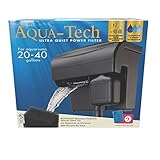
The Tetra Whisper 170 GPH Internal Power Aquarium Filter, generally priced around $30 to $40, is a space-saving option. It occupies aquarium volume and may require more frequent cleaning because its media chamber is relatively compact. The Aqua-Tech Ultra Quiet Power Filter for 20-to-40-gallon aquariums, generally around $35 to $45, is another basic HOB-style option. Prices change by retailer, promotions, and included media.
How to Measure Your Space
- Measure the tank’s back rim. Record the straight, usable width in inches. Leave room for lids, light brackets, cords, and access to the filter body. A 12-inch-wide filter may not fit on a narrow section of rim.
- Measure clearance behind the aquarium. Most HOB filters need approximately 3 to 6 inches (7.6 to 15.2 cm) behind the tank, depending on the motor housing and intake tube. If the aquarium sits against a wall, measure the actual gap rather than guessing.
- Check the water depth. Internal filters usually have a minimum and maximum waterline. A 40-gallon breeder tank is often shorter than a tall 40-gallon aquarium, so confirm that the intake and return sit correctly at the intended water level.
- Measure the stand opening. Canister filters need a cabinet compartment large enough for the body, hoses, and shutoff valves. Allow several inches above the canister for removing the lid and servicing the media.
- Check the rim and lid. A filter may fit the tank but conflict with a glass canopy or hinged lid. Look for cutouts, adjustable brackets, and the position of the intake tube before installation.
- Plan for electrical safety. Measure the distance to the outlet and leave a drip loop in every cord. Do not use a power strip where splashing water can reach it, and keep the power supply above the aquarium’s waterline when possible.
By Room or Use Case
Living Room Community Aquarium
A 200-to-300-GPH HOB filter is usually the best balance of size, maintenance, and performance. Choose an adjustable model if the aquarium contains small tetras, bettas, gouramis, or other fish that dislike strong currents. A pre-filter sponge on the intake can protect small fish and extend the time between cleanings.
Bedroom or Quiet Space
Noise matters more in a bedroom, office, or studio. Select a model advertised for quiet operation, but also check that the tank is filled high enough for the return stream to avoid splashing. A rattling sound can come from an air gap, an unseated impeller, or a dirty intake rather than from an oversized filter. An internal filter avoids the waterfall sound of some HOB models but takes up space inside the aquarium.
Heavily Stocked Fish Tank
Use a filter rated for about 60 gallons or a canister rated at 250 to 400 GPH. More media volume is often more valuable than simply increasing water speed. Choose a model with a large sponge or reusable media baskets, and clean mechanical media regularly. If the flow is too forceful, aim the return at the glass or add a spray bar rather than selecting an undersized filter.
Planted Aquarium
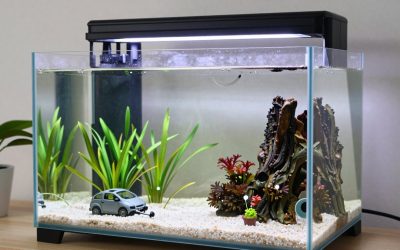
A 200-to-250-GPH filter is often sufficient for a moderately stocked planted 40-gallon aquarium. Avoid excessive surface agitation if the aquarium is being operated with injected carbon dioxide, since vigorous turbulence can increase gas exchange. Use a pre-filter sponge and maintain gentle, even circulation around dense plant growth.
Freshwater Turtle or Messy Eaters
Turtles and large, messy fish produce more waste than a typical community stocking plan. A canister filter or two filters working together is more appropriate than a small internal unit. Aim for roughly 300 GPH or more in rated capacity, while keeping the return flow safe and avoiding exposed heaters or strong suction points.
Common Sizing Mistakes
- Choosing by gallon rating alone: A “40-gallon” label is a starting point, not a guarantee of strong real-world flow. Compare GPH and media capacity.
- Buying the largest filter without controlling the current: Excessive flow can stress slow-swimming fish, uproot plants, and push food into corners. Adjustable flow, a spray bar, or a baffled return can solve this.
- Ignoring the tank shape: A 40-gallon breeder and a tall 40-gallon aquarium hold similar volumes but have different heights, footprints, and circulation patterns.
- Forgetting maintenance clearance: A filter that barely fits may be difficult to remove, prime, or clean.
- Counting a filter’s maximum rating as actual flow: Media, tubing, elevation, and debris reduce circulation over time.
- Replacing only disposable cartridges: Replacing all biological media at once can remove beneficial bacteria. Rinse reusable media in removed aquarium water and replace media in stages.
FAQ
Is a 200-GPH filter enough for a 40-gallon aquarium?
Yes, a 200-GPH filter can be enough for a normally stocked 40-gallon aquarium when the media is clean and the fish load is moderate. It provides about five nominal turnovers per hour. Choose closer to 250 or 300 GPH for heavy stocking, frequent feeding, or reduced flow caused by dense media.
Can a filter be too powerful for a 40-gallon tank?
Yes. The risk is not usually damage to the aquarium; it is excessive current that makes fish hide, struggle to swim, or lose access to food. Use adjustable flow, a spray bar, a sponge pre-filter, or a return aimed at the glass. A larger filter with controlled output can still be useful because it often provides more media capacity.
Should a 40-gallon aquarium have two filters?
One properly sized filter is usually sufficient. Two filters can improve circulation and provide backup if one stops, but they increase equipment, maintenance, and current. Two smaller filters may be practical for a heavily stocked aquarium or a tank with dead spots, provided their combined flow is appropriate for the inhabitants.
How often should a 40-gallon aquarium filter be cleaned?
Inspect the intake and flow every week. Rinse mechanical sponges or pads when flow noticeably slows, often every two to four weeks, using water removed during an aquarium water change. Avoid washing biological media under untreated tap water or replacing every media component at the same time.
Ready to decide? Our #1 pick for 2026 is the Compact internal filter.
Live price & availability on Amazon.
Related Reviews & Guides

Do I Need a Uv Aquarium Filter? An Honest Answer (2026)
6 Best Aquarium Plant Liquid Fertilizers 2026