Last Updated: October 10, 2026
- Best Mini ITX Cases for Compact Gaming Builds: A 2026 Buying Guide
- Quick comparison: the picks at a glance
- Best overall: Fractal Design Terra
- Best for large graphics cards: Cooler Master NR200P V2
- Best small footprint: Lian Li A4-H2O
- Best airflow per liter: SSUPD Meshlicious
- Best console-style build: Fractal Design Ridge
- Best budget entry: Cooler Master NR200 (original)
- How to choose: the four numbers that decide everything
- Frequently Asked Questions
Quick answer: For most people in 2026, the best mini itx cases for compact gaming builds is the Fractal Design Terra — our #1 rated choice. See the full ranked comparison, alternatives and buying advice below.
Best Mini ITX Cases for Compact Gaming Builds: A 2026 Buying Guide
The best mini ITX case for most compact gaming builds is the Fractal Design Terra, because its adjustable central spine lets you shift internal volume between GPU and CPU cooler clearance, accommodating graphics cards up to roughly 322 mm long and 72 mm thick while still fitting a 77 mm-tall CPU cooler in the same chassis. If you want maximum GPU room instead, the Cooler Master NR200P V2 fits cards up to 356 mm; if you want minimum footprint, the Lian Li A4-H2O lands close to 11 liters and still takes a 240 mm radiator. Every one of these cases forces a trade-off between GPU length, cooler height, airflow path and cable room — the sections below map those trade-offs to specific builds.
Quick comparison: the picks at a glance
| Case | Best for | Volume | Max GPU | Max CPU cooler | Radiator support | Typical street price |
|---|---|---|---|---|---|---|
| Fractal Design Terra | Best overall balance | 10.4 L | ~322 mm (spine-dependent) | ~77 mm (spine-dependent) | None (air only) | $170–200 |
| Cooler Master NR200P V2 | Best for big GPUs | 18.3 L | ~356 mm | ~67 mm on air in vertical GPU mode | 240 / 280 mm | $110–140 |
| Lian Li A4-H2O | Best small footprint | ~11 L | ~322 mm (2.5-slot) | ~55 mm on air / 240 AIO | 240 mm | $150–180 |
| SSUPD Meshlicious | Best airflow per liter | ~14.3 L | ~336 mm (3-slot, GPU riser) | ~73 mm | 240 / 280 mm | $120–150 |
| Fractal Design Ridge | Best console-style HTPC | ~12.6 L | ~325 mm (2.5-slot) | ~70 mm | None (air only) | $130–160 |
| Cooler Master NR200 (original) | Best budget entry | 18.3 L | ~330 mm | ~155 mm (tower air) | 240 mm | $70–100 |
Prices are broad market ranges as of 2026 and move with sales and regional stock. Dimensions come from the manufacturers’ own spec sheets; always re-check them against the exact revision you buy, because these cases have been through multiple versions.
Best overall: Fractal Design Terra
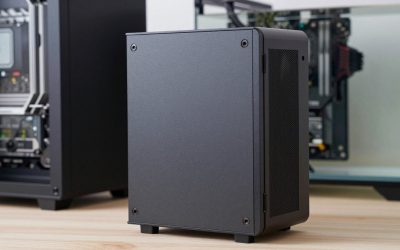
The Terra’s trick is a movable central spine. The motherboard and GPU sit on opposite sides of one bracket that you slide across nine positions, redistributing the same 10.4-liter shell. Push it toward the GPU side and you get the full ~322 mm of card length but only about 48 mm of cooler height — enough for a low-profile air cooler but nothing more. Pull it toward the CPU side and you get the full 77 mm of cooler clearance, but GPU length drops to roughly 200 mm, which rules out most modern triple-fan cards.
Who it suits: a builder who wants a genuinely small, aluminum-paneled case that fits on a desk, pairs a mid-length two-slot or 2.5-slot GPU with a low-profile cooler, and accepts air-only cooling. Main trade-off: you are solving a two-variable equation every time you change a part, and there is no radiator mount at all, so a 150 W-plus CPU needs a cooler chosen specifically for that 48–77 mm window.
Best for large graphics cards: Cooler Master NR200P V2
At 18.3 liters the NR200P V2 is not the smallest case here, but it removes the GPU anxiety that defines most SFF builds. Per Cooler Master’s spec sheet it takes cards up to 356 mm long and 3.5 slots thick when the GPU is mounted vertically on the included PCIe riser, with a 240 mm or 280 mm radiator on the side. Choose horizontal GPU mounting instead and you get the classic NR200 layout with more room for a tower air cooler.
Who it suits: anyone building around a 300–360 mm flagship graphics card who still wants a case that fits under a monitor riser or beside a desk. Main trade-off: the vertical GPU layout caps CPU air coolers at roughly 67 mm, so plan on the side radiator for a high-wattage CPU; and 18.3 L is roughly 75% more volume than the Terra, which is the price of that GPU room.
Best small footprint: Lian Li A4-H2O
The A4-H2O is a sandwich-layout case at roughly 11 liters, with the GPU on a riser behind the motherboard and a 240 mm radiator slot at the top. Lian Li’s own figures put maximum GPU length at about 322 mm with a 2.5-slot thickness, and CPU air cooler height at only about 55 mm — which is why the case is effectively designed around the 240 mm AIO it is named for.
Who it suits: a builder who wants the smallest possible desk footprint and is willing to run a liquid cooler for the CPU. Main trade-off: air cooling is nearly off the table, the riser cable adds a component that can fail or need a BIOS PCIe-gen adjustment, and the tight interior makes cable routing a genuine planning exercise rather than an afterthought.
Best airflow per liter: SSUPD Meshlicious
Meshlicious wraps a mesh panel around a vertical motherboard layout at about 14.3 liters, so intake air reaches the GPU and CPU directly rather than through a front filter and a maze of panels. It supports GPUs up to roughly 336 mm in three-slot form on a riser, CPU coolers up to about 73 mm, and either a 240 mm or 280 mm radiator.
Who it suits: builders in warm rooms or with power-hungry components who prioritize temperatures over the last few liters. Main trade-off: the mesh lets dust in faster than a filtered solid panel, so budget for more frequent cleaning, and the vertical GPU orientation means the card’s own fans face the side panel — a card with a flow-through cooler benefits, an older blower-style card benefits less.
Best console-style build: Fractal Design Ridge
The Ridge stands or lies flat like a game console at around 12.6 liters, with a PCIe riser running the GPU parallel to the motherboard. Fractal lists GPU clearance at roughly 325 mm for a 2.5-slot card and CPU cooler height at about 70 mm, with no radiator support.
Who it suits: living-room and media-cabinet builds where the case needs to sit horizontally and look intentional. Main trade-off: no liquid cooling and a shallow cooler window, so it pairs best with a 65–105 W CPU rather than a 250 W flagship.
Best budget entry: Cooler Master NR200 (original)
The first-generation NR200 is the cheapest way into a real SFF build at around $70–100, and it remains unusually forgiving: roughly 330 mm of GPU length, up to about 155 mm of tower CPU cooler height, and a 240 mm side radiator mount. Main trade-off: it is the largest case on this list at 18.3 L and uses a standard internal layout rather than a sandwich, so it gives up the space efficiency that makes SFF interesting — but it is the right first case for someone who has never built small.
How to choose: the four numbers that decide everything
Measure and compare these four figures before you buy anything, because in SFF they constrain each other rather than sitting independently:
- GPU length and thickness. Read the manufacturer’s clearance figure and subtract 5 mm for the power cables if they exit the back of the card. A 320 mm clearance case and a 322 mm card is a failed build.
- CPU cooler height. Low-profile air coolers occupy roughly 37–70 mm; tower coolers start around 110 mm and reach 155 mm+. If your case’s limit is under 75 mm, you are choosing between a low-profile air cooler and an AIO, not a tower.
- Radiator support. A 240 mm AIO needs its own clearance for the pump block, tubing bend radius and fan thickness. In a sandwich case the radiator and the GPU compete for the same side of the chassis.
- Cable room behind the motherboard tray. Custom-length or flat ribbon cables solve most of this; a 24-pin ATX cable with a stiff braided sleeve does not bend into a 15 mm gap.
A worked sizing example
Suppose your GPU is 304 mm long, 50 mm thick and draws 320 W, and your CPU is a 125 W part. In the Terra, you would need to slide the spine toward the GPU side, giving roughly 322 mm of GPU length but only about 48 mm of cooler height — so a 125 W CPU on a 48 mm cooler will run hot and loud. In the NR200P V2 with vertical GPU mounting, the 304 mm card fits with 52 mm to spare, and the side 280 mm radiator handles the CPU comfortably. In the A4-H2O, the card fits the 322 mm limit, but you must use the 240 mm AIO because 55 mm of air cooler height is not enough for 125 W. The same parts produce three different acceptable builds depending entirely on which case you start from.
Decision matrix
| Your situation | Pick | Why |
|---|---|---|
| First SFF build, tight budget | NR200 (original) | Forgiving clearances, 155 mm cooler height, cheapest entry |
| Flagship 350 mm GPU | NR200P V2 | 356 mm GPU limit, 3.5-slot, riser included |
| Smallest desk footprint | Lian Li A4-H2O | ~11 L with a 240 mm radiator |
| Hot room, thermal priority | SSUPD Meshlicious | Mesh panels, direct GPU intake |
| Media cabinet / horizontal | Fractal Design Ridge | Console form factor, 325 mm GPU |
| Frequent part swapping | NR200P V2 or original NR200 | Tool-less panels, standard layout |
Ownership realities: what wears and what to watch
The first thing to degrade in an SFF build is not a component but the dust situation. Mesh-front and mesh-side cases need cleaning every two to four months in a typical home; filtered solid-panel cases can stretch to six months. The second is the PCIe riser cable in sandwich and console cases — it is a moving-part-adjacent component that gets flexed during assembly, and a riser that is marginally seated produces black screens or PCIe link errors rather than an obvious failure. Third, low-profile coolers are noisier than their wattage rating suggests, because a 40 mm fan spinning to move 125 W of heat is working near its limit; if noise matters more than size, a 240 mm AIO in a sandwich case is usually the quieter answer. The most common first-build mistakes are ordering a GPU that exceeds clearance by a few millimeters, buying a tower air cooler for a case with a 70 mm limit, and using stock braided cables in a chassis with under 20 mm of cable space.
Frequently Asked Questions
Is mini ITX worth it compared to micro ATX in 2026?
Mini ITX wins on footprint — 10–18 L versus 25–40 L for most micro ATX cases — and gives up motherboard expansion, since ITX boards have a single PCIe slot and typically two DIMM slots. If you never add a second card or more than two RAM sticks, ITX costs you almost nothing in capability and a meaningful amount in build effort.
Can I air-cool a high-wattage CPU in a mini ITX case?
Yes, but only in cases with 70 mm or more of cooler height, such as the NR200P V2 in horizontal GPU mode or the Meshlicious. Below roughly 60 mm of clearance — the Terra at its CPU-side extreme and the A4-H2O — you are limited to low-profile coolers, and a 240 mm AIO is the practical choice for a 125 W or higher CPU.
Do I need a PCIe riser cable?
Sandwich, vertical and console-style cases require one because the GPU does not sit in a slot directly on the motherboard. The NR200P V2 includes one; the original NR200 and most traditional-layout cases do not need one at all. If you buy a riser separately, match its PCIe generation to your card and board — mismatches are a common cause of boot and stability problems.
How much GPU clearance do I actually need to leave?
Leave at least 5 mm beyond the card’s stated length for power-cable bends, and more if the cables exit the top or side rather than the rear. On thickness, a card listed as 2.5 slots generally needs a case rated for 2.5 slots or better, since the riser and backplate add a small amount of depth.
Which case is easiest for a first-time small-form-factor builder?
The original Cooler Master NR200, because its 155 mm cooler limit and standard internal layout mean ordinary parts fit without a spreadsheet. The NR200P V2 is a close second if you need current-generation GPU length support. Sandwich cases like the A4-H2O are the least forgiving for a first build.
Does a smaller case mean worse temperatures?
Not automatically. A mesh case like the Meshlicious can outperform a larger solid-panel case because intake air reaches components directly. What small cases do reliably is restrict cooler height and radiator size, so temperatures depend more on which cooler you can physically fit than on the case volume itself.
Ready to decide? Our #1 pick for 2026 is the Fractal Design Terra.
Live price & availability on Amazon.
Related Reviews & Guides



Best Gaming CPUs Under $300
Best CPUs for Music Production