Last Updated: October 8, 2026
- Quick answer: which pizza steel should you choose?
- Pizza steel comparison by thickness and size
- Thickness: faster preheat versus stronger heat recovery
- How large should a pizza steel be?
- Choosing by your baking situation
- Preheating and positioning
- Seasoning, cleaning, and long-term ownership
- Steel versus cordierite pizza stone
- Price and value
- Final verdict
The best pizza steel for a home oven is usually a 1/4-inch-thick, rectangular low-carbon steel plate around 14 × 16 inches: it offers a strong balance of browning, heat recovery, manageable preheating, and fit in most 30-inch ovens.
Quick answer: which pizza steel should you choose?
- Best all-rounder: A 1/4-inch steel, approximately 14 × 16 inches, for one or two pizzas per session.
- Best for frequent baking: A 3/8-inch steel if your oven rack can support roughly 25–30 lb and you regularly bake several pizzas consecutively.
- Best for small ovens: A 1/4-inch steel no wider than 12–14 inches, with rounded corners or a deliberately compact footprint.
- Best budget approach: A plain, food-safe A36 or equivalent low-carbon steel plate with smoothly finished edges, rather than a thin decorative or coated metal sheet.
- Best for easy storage: A 1/4-inch plate with a carrying handle, storage bag, or dimensions small enough to stand safely in a cupboard.
The familiar product category includes established options such as the Baking Steel Original and thicker Baking Steel Pro, as well as competing plain-steel baking plates from brands such as NerdChef. The important choice is the steel’s thickness, dimensions, finish, and fit—not the logo on the plate.

Primica Pizza Steel XL for Oven & Grill,16"x13.4", The Ultimate Crust Game Changer, Perfect for Oven Baked Pizza with higher Conductivity, Premium Baking Alternative to Pan and Stone
Included for 'Best Pizza Steel for Home Ovens' because the listing specifies 16"x13.4" and The Ultimate Crust Game Changer, details this guide uses to compare options.
View on Amazon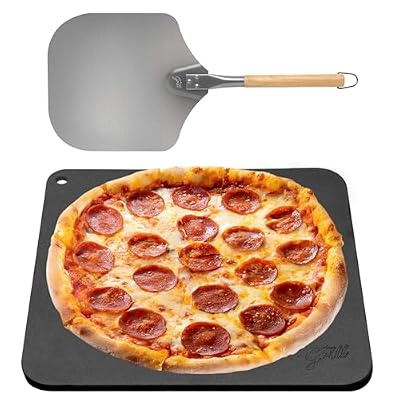
Pizza Steel PRO by Hans Grill | XL 1/4" Thick Square Conductive Metal Baking Steel for Oven and BBQ Cooking Pizzas | Bake and Grill Bread and Calzone with our Cast Iron Pizza Stone
Included for 'Best Pizza Steel for Home Ovens' as a relevant option in this category; details come from the product listing.
View on Amazon
NerdChef Steel Stone - High Performance Pizza Baking | Made in USA (14.5" x 16" x 1/4") - (.25" Thick - Standard)
Included for 'Best Pizza Steel for Home Ovens' because the listing specifies High Performance Pizza Baking and Made in USA (14.5" x 16" x 1/4"), details this guide uses to compare options.
View on Amazon
Artisan Steel - High Performance Pizza Steel Made in the USA - 16" x 14.25" (.25" Thick)
Included for 'Best Pizza Steel for Home Ovens' because the listing specifies High Performance Pizza Steel Made in the USA and 16" x 14.25" (.25" Thick), details this guide uses to compare options.
View on AmazonPizza steel comparison by thickness and size
| Steel type | Typical size | Approximate weight | Preheat at 500°F / 260°C | Heat recovery | Best use |
|---|---|---|---|---|---|
| 3/16 inch | 14 × 16 inches | 10–13 lb | 35–50 minutes | Good | Smaller ovens, occasional pizza |
| 1/4 inch | 14 × 16 inches | 16–19 lb | 45–60 minutes | Very good | Most home cooks and standard ovens |
| 3/8 inch | 14 × 16 inches | 24–29 lb | 60–75 minutes | Excellent | Multiple pizzas and heavy bottom browning |
| 1/2 inch | 14 × 16 inches | 31–38 lb | 75–100 minutes | Exceptional | High-volume baking, if the oven and storage allow it |
These are useful planning figures rather than universal specifications. Actual weight changes with corner radius, handles, dimensions, and steel density. A thicker plate stores more energy, but it also takes longer to heat and is harder to lift when hot.
Thickness: faster preheat versus stronger heat recovery
A pizza steel works by transferring stored heat directly into the dough. Thickness determines how much heat it can store. A 1/4-inch steel is normally the best compromise for a home oven because it reaches working temperature within a practical preheat window while still recovering quickly after the first pizza.
A 3/8-inch steel is useful when the first pizza is excellent but the second one consistently has a pale or soft base. Its extra thermal mass means the surface temperature falls less when cool dough is placed on it. The trade-off is a longer preheat and substantially more weight.
A 1/2-inch steel can perform well, but it is often excessive for a household baking schedule. It may need more than an hour to heat through, can strain a lightweight oven rack, and is inconvenient to move. It makes more sense for frequent batches than for one pizza on a weekend.
How large should a pizza steel be?
Measure the oven rack, not just the oven door. Subtract at least 1 inch from the rack’s usable width and depth so the steel can be inserted without scraping the side walls. Also check the distance between the rack and the oven door glass: a plate that fits side to side may still be awkward to load.
For a typical 30-inch range, a 14 × 16-inch steel usually leaves room for airflow and fits a 12-inch pizza comfortably. A 16 × 16-inch plate provides more usable area but may be too tight for some ovens. A 12 × 14-inch steel is safer for compact ovens and still supports a 10- to 11-inch pizza.
Do not treat the entire steel as cooking space. Leave a margin around the dough for launching and turning. As a practical calculation, a 12-inch pizza has an area of about 113 square inches, while a 14 × 16-inch steel has 224 square inches. The steel can physically accommodate two small pizzas, but a domestic oven may not bake both evenly because airflow and top heat become limiting factors.
Choosing by your baking situation
| Your situation | Recommended choice | Why |
|---|---|---|
| One pizza every few weeks | 3/16- or 1/4-inch steel | Lower weight and shorter preheat matter more than maximum recovery. |
| Weekly 12-inch pizzas | 1/4-inch steel, 14 × 16 inches | Good balance of browning, size, price, and storage. |
| Three or more pizzas per session | 3/8-inch steel | Better recovery between launches. |
| Small apartment oven | Compact 1/4-inch steel | Enough thermal mass without blocking airflow or overloading the rack. |
| Limited cupboard space | 12–14-inch steel or one with a storage sleeve | Large plates are difficult to store safely and can damage shelves. |
| Maximum bottom browning | 3/8-inch steel | Retains more heat during loading and successive bakes. |
Preheating and positioning
- Place the steel on a sturdy rack. For pizza, start in the upper-middle position if the top needs more color, or the lower-middle position if the base is underbaked.
- Allow the oven to reach its maximum normal baking temperature. Many home ovens operate around 500–550°F (260–290°C). Avoid exceeding the steel or oven manufacturer’s stated limit.
- Preheat for 45–60 minutes for a 1/4-inch steel. The air reaching the target temperature is not proof that the steel’s center is hot.
- Launch efficiently. Use a lightly floured peel, keep toppings moderate, and transfer the pizza quickly so the steel loses less heat.
- Wait between pizzas when necessary. A 1/4-inch plate commonly benefits from 8–15 minutes of recovery; a thicker steel may need less recovery but more initial preheat.
If the top of the pizza is pale while the base is already dark, move the steel higher or reduce the bake time rather than automatically buying a thicker plate. If the base is pale on every pizza, extend the preheat first; insufficient preheating is more common than insufficient steel thickness.
Seasoning, cleaning, and long-term ownership
Most uncoated carbon-steel pizza plates need seasoning. Wash off manufacturing oil according to the maker’s instructions, dry the plate immediately, apply an extremely thin film of high-smoke-point cooking oil, and heat it until the surface darkens. Repeat several times if desired. A thin, uneven-looking patina is normal.
- Do not soak the steel or put it in a dishwasher.
- Scrape off baked cheese and flour after the plate cools.
- Wipe with a barely damp cloth, then dry completely over low heat.
- Apply a very thin oil film after cleaning if the kitchen is humid or the plate will be stored for weeks.
- Do not use water to cool a hot steel; thermal shock and warping are avoidable risks.
The seasoning is not a nonstick coating in the same sense as PTFE. Dough should still be launched with a peel, and excess oil, wet toppings, or sugary sauce can burn onto the surface. Rust is usually a maintenance problem rather than an immediate failure: scrub the affected area, dry it thoroughly, and rebuild the seasoning.
Steel versus cordierite pizza stone
Steel generally heats the underside faster and recovers better between pizzas. It is particularly forgiving when a home oven cannot reach the temperatures of a dedicated pizza oven. A cordierite stone is often lighter and can produce a gentler bake, but it is more vulnerable to cracking from impacts, sudden temperature changes, and moisture trapped in the material.
Steel’s disadvantages are its weight, hotter bottom heat, and need for rust prevention. If your dough burns underneath before the toppings finish, raise the rack, lower the oven temperature slightly, use a thicker dough, or switch to a stone. The most expensive or thickest steel is not automatically the best match for every oven.
Price and value
General market pricing for uncoated pizza steels is commonly about $50–$100 for thinner or compact plates, $80–$150 for established 1/4-inch models, and $120–$200 or more for extra-thick plates, large formats, handles, or bundled accessories. A simple cost-per-use calculation helps: a $100 steel used twice a month for three years costs about $1.39 per bake before electricity. If you make pizza weekly, the same steel costs about $0.64 per bake over three years.
For most households, spend the money on the correct dimensions and a 1/4-inch or 3/8-inch thickness rather than decorative finishes. Verify that the steel is food-safe, the edges are smooth, and the dimensions fit your actual oven rack.
Final verdict
Choose a 1/4-inch, 14 × 16-inch uncoated carbon-steel plate as the best pizza steel for a home oven in the broadest sense. Move to 3/8 inch when you bake several pizzas in one session and can manage the weight. Choose a smaller 1/4-inch model for compact ovens or limited storage. Whichever format you buy, accurate sizing, a full preheat, careful seasoning, and correct rack placement will influence the result more than a small difference between brands.
Ready to decide? Our #1 pick for 2026 is the 3/16 inch.
Live price & availability on Amazon.
Best Auto Air Dryers in 2026: Specs and Prices Compared

Best Pizza in New York City in 2026: Specs and Prices Compared