Last Updated: October 8, 2026
- Best French Patio Doors by Situation
- Material Comparison: Vinyl, Fiberglass, Wood, and Aluminum
- Glass: The Upgrade That Changes Comfort and Security
- Thresholds and Weather Sealing
- Security Hardware and Everyday Operation
- Swing Clearance: Measure the Door, Not Just the Opening
- Installation Requirements That Affect the Final Result
- Ownership Costs and What Wears First
- Bottom Line
The best French patio doors for most homes are fiberglass or well-built vinyl units with low-E insulated glass, a multipoint lock, an adjustable sill, and factory-applied weather seals; choose aluminum-clad wood instead when interior appearance matters more than price and maintenance.
Quick answer: For most people in 2026, the best french patio doors for style and security is the Lowest practical budget — our #1 rated choice. See the full ranked comparison, alternatives and buying advice below.
Best French Patio Doors by Situation
| Situation | Best door type | Useful target specifications | Why it fits |
|---|---|---|---|
| Lowest practical budget | Insulated vinyl | U-factor about 0.25–0.35; dual-pane low-E glass; adjustable sill | Good insulation and low maintenance without the cost of wood or premium fiberglass |
| Rain, snow, and strong seasonal temperature changes | Fiberglass or aluminum-clad wood | Compression weather seals; sill pan; corrosion-resistant hardware; optional triple glazing | Stable frames and better resistance to swelling, movement, and moisture damage |
| High-security ground-floor opening | Fiberglass or wood door with multipoint locking | Three-point or five-point lock; reinforced strike area; laminated glass option | More secure locking and stronger resistance to forced impact than a basic single latch |
| Traditional interior design | Wood or aluminum-clad wood | Factory-finished exterior; kiln-dried wood interior; insulated low-E glass | Provides natural grain and can be stained or painted to match the room |
| Limited swing clearance | Out-swing French door or hinged-and-sliding alternative | Confirm exterior landing depth and local egress rules; allow at least 36 inches of clear path | Keeps furniture out of the door arc, though exterior drainage and security details need closer planning |
Material Comparison: Vinyl, Fiberglass, Wood, and Aluminum
Vinyl
Vinyl French doors usually offer the lowest purchase price and require little painting or sealing. Look for welded or mechanically reinforced frames, substantial sash construction, and a sill that drains water rather than trapping it. White and light colors are the safest choices in strong sun; dark vinyl can expand more noticeably unless the manufacturer specifically approves that finish.

2 Panel, Folded Out, (0R2L) Outswing, Right to Left, Folding Patio Door, Aluminum Folding Door (Black, H80*W72)
Included for 'Best French Patio Doors for Style and Security' because the listing specifies Folded Out and (0R2L) Outswing, details this guide uses to compare options.
View on Amazon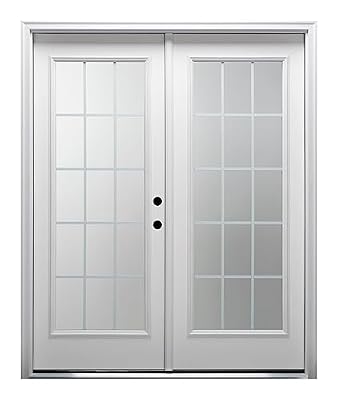
National Door Company Z029254L Steel, Primed, Left Hand In-swing, Exterior Prehung Double Door, Internal Grilles Full Lite, 72"x80", Clear,White
Included for 'Best French Patio Doors for Style and Security' because the listing specifies Primed and Left Hand In-swing, details this guide uses to compare options.
View on Amazon
National Door Company Z002397R Steel, Primed, Right-Hand Inswing, Center Hinged Patio, Clear Glass with Internal Blinds, 67" x 81.75"
Included for 'Best French Patio Doors for Style and Security' because the listing specifies Primed and Right-Hand Inswing, details this guide uses to compare options.
View on AmazonVinyl is a sensible choice for a sheltered opening, rental property, or moderate climate. It is less convincing when the opening is unusually large, heavily used, or exposed to intense heat and cold. Some low-cost units also have lighter hardware and less precise adjustment, which can allow the active panel to sag over time.
Fiberglass
Fiberglass combines low maintenance with better dimensional stability. It generally resists swelling, shrinking, and denting more effectively than ordinary wood, making it a strong choice for a patio that receives direct weather. It costs more than basic vinyl, but the frame is less likely to need seasonal adjustment.
Fiberglass is often the best all-round material when security, insulation, and ownership simplicity matter equally. Check whether the finish is factory-applied and whether replacement weather stripping and lock components remain available for the product line.
Wood and aluminum-clad wood
Wood provides the most natural appearance and can be repaired or refinished, but it needs more disciplined maintenance. Water must not sit at the bottom rail, and any damaged exterior finish should be repaired before moisture reaches the wood.
Aluminum-clad wood places a durable metal skin on the exterior while preserving a wood interior. It is a premium solution, particularly for a prominent living space, but the initial price is commonly about $3,000–$8,000 installed, compared with roughly $1,500–$4,500 for many vinyl or fiberglass installations. Actual cost varies significantly with size, region, wall repairs, glass, and trim.
Aluminum
Thermally improved aluminum is strong and supports slim sightlines, but ordinary aluminum conducts heat readily. For a conditioned room, choose a thermally broken frame and inspect the stated U-factor rather than assuming that a metal frame is energy efficient. Aluminum is especially attractive for contemporary architecture, but it can transmit more exterior sound than a heavier insulated frame.
Glass: The Upgrade That Changes Comfort and Security
Dual-pane low-E glass is the sensible baseline for most climates. The insulated air space reduces heat transfer, while the low-emissivity coating limits radiant heat loss or solar gain. In a cold climate, a lower U-factor is valuable; in a sunny warm climate, compare both U-factor and solar heat-gain coefficient (SHGC). A typical efficient target is a U-factor near 0.25–0.30, though local climate and code requirements should guide the final specification.
- Clear glass: usually the least expensive, but it provides weaker insulation and more glare control.
- Low-E dual pane: the best value for most replacements.
- Triple pane: useful in very cold or noisy locations, but heavier and more expensive; confirm that hinges and rollers are rated for the added weight.
- Laminated glass: holds together after impact and can improve security and sound reduction. It is not the same as a door being burglar-proof.
- Tempered glass: breaks into smaller granules and is commonly required near walking surfaces, but it does not remain in one sheet like laminated glass.
- Obscure or decorative glass: improves privacy while admitting light, but may reduce visibility and can cost more to replace.
For a vulnerable ground-floor opening, laminated, insulated glass is often the most useful security upgrade. Ask whether the glass package is certified for the relevant impact or forced-entry standard rather than relying on marketing language.
Thresholds and Weather Sealing
The threshold is where attractive French doors most often fail in real ownership. A low-profile sill is easier to cross and can be preferable for accessibility, but it gives water less vertical distance to drain. A higher performance sill may have a raised center dam, adjustable contact points, and a sloped exterior surface. It needs a properly built landing and can be less convenient for wheeled movement.
For any sill, require a continuous sill pan or manufacturer-approved pan system, end dams, compatible sealant, and a positive slope away from the house. Sealant alone is not a substitute for drainage. The rough opening should also receive flashing tape or a flashing system in the sequence specified by the manufacturer.
Compression gaskets around the panels generally seal better than a simple brush seal in exposed weather. Inspect the corners: gaps, crushed seals, or a door that must be forced shut indicate an adjustment or installation problem. Replaceable weather stripping is a practical advantage because seals commonly wear before the frame does.
Security Hardware and Everyday Operation
A French door should have more than a decorative handle and one latch. A good configuration includes a deadbolt or multipoint lock, reinforced strike plates, long structural screws into framing, and shoot bolts that secure the inactive panel at the top and bottom. On many pairs, the inactive panel must be opened first; confirm that this matches how the household uses the doorway.
Multipoint hardware usually engages at three or more locations and can improve resistance to prying while pulling the panels evenly against the weather seals. It is not automatically better if it is poorly adjusted. Ask about replacement cylinders, handles, strike plates, and lock cases before buying, particularly for a nonstandard door.
For children, pets, or frequent entertaining, consider a lever handle that is easy to operate but pair it with a properly positioned deadbolt or multipoint lock. A keyed lock on the inside may create an emergency egress concern, so follow local building requirements.
Swing Clearance: Measure the Door, Not Just the Opening
A nominal 60-by-80-inch French door pair does not occupy only a 60-inch rectangle. Each leaf may swing through approximately 30 inches, plus handle projection and furniture clearance. Before ordering, mark the arc on the floor with tape. Keep tables, cabinets, aquarium stands, and other obstacles outside that arc.
For an in-swing pair, allow at least 36 inches of unobstructed approach where possible. For an out-swing pair, inspect the exterior landing, steps, railing, snow accumulation, and screen-door position. An out-swing door can preserve indoor floor space but may be unsuitable where the exterior landing is narrow or exposed to heavy weather.
Do not assume a larger opening is a simple upgrade. A wider or taller unit may require a new header, structural engineering, relocation of electrical work, or changes to siding and interior flooring.
Installation Requirements That Affect the Final Result
- Verify the rough opening. Measure width and height in several places, check whether the opening is square, and identify the wall type and load-bearing structure.
- Confirm the finished floor height. The threshold must meet the interior floor without creating a trip edge or blocking drainage outside.
- Plan flashing before the door arrives. The sill pan, side flashing, head flashing, and sealant must work as one water-management system.
- Set the frame plumb and square. A small diagonal error can make one leaf bind, leave an uneven center gap, and overload the locking hardware.
- Adjust hinges and lock points after anchoring. Do not use excessive force to close a misaligned door; correct the frame and shims first.
- Test drainage and operation. Spray water over the exterior, operate both panels repeatedly, and check that the seals contact evenly without rubbing.
For a replacement in an existing wall, professional installation is usually worthwhile when there is rot, masonry, structural alteration, a raised foundation, or a complicated weather exposure. A low installation quote can become expensive if it excludes interior trim, exterior cladding repair, disposal, painting, or structural work.
Ownership Costs and What Wears First
Hinges, rollers where used, weather seals, screens, and lock cylinders generally wear before the main frame. Clean tracks and thresholds with a soft brush and mild detergent; avoid abrasive powders that damage finishes. Lubricate hinges and multipoint mechanisms only with the product-approved lubricant, since heavy grease can collect grit.
Inspect the bottom rail and sill twice a year. Keep leaves and grit out of drainage channels, and never drill through a sill unless the manufacturer provides that procedure. Re-caulk exterior trim when the joint cracks or separates, but do not seal over designed drainage openings.
As a simple value check, a $2,800 installed door used five times per week for 15 years amounts to about 3,900 opening cycles, or approximately $0.72 per cycle before maintenance. A $5,000 premium door used at the same rate costs about $1.28 per cycle. The cheaper door is not automatically better value if it needs early hardware replacement, leaks, or requires repainting every few years.
Bottom Line
Choose insulated vinyl for value, fiberglass for the best balance of durability and security, aluminum-clad wood for premium appearance, and thermally broken aluminum for a slim modern design. Regardless of material, prioritize low-E insulated glass, a properly drained threshold, continuous weather seals, reinforced multipoint hardware, and an installation plan that accounts for swing clearance and water management. Those details matter more than decorative panel patterns when selecting the best French patio doors for long-term comfort and security.
Ready to decide? Our #1 pick for 2026 is the Lowest practical budget.
Live price & availability on Amazon.
Related Reviews & Guides


Best Dive Computers for Recreational Diving
Best Ellipticals for Seniors: Safe, Low-Impact Picks