Last Updated: September 27, 2026
A reactor only helps once its output tracks what your tank actually consumes, and copied bubble counts cause more swings than they fix. This calcium reactor setup and tuning guide walks assembly, purging and tuning to your own alkalinity trend rather than to someone else’s numbers.
As an Amazon Associate we earn from qualifying purchases.
By David Nguyen
Quick answer: Our top pick in 2026 is the Starting effluent (AquaReady T-1) — our #1 rated choice. See the full ranked comparison, alternatives and buying advice below.
Set the Reactor Up and Read the Starting Numbers
Setup decides whether tuning is even possible, so build the reactor correctly, calibrate the probe and establish a stable feed before touching output. The table lists brand-specific starting points as examples, not universal targets, since effluent, pH and flow vary by model and media and must be confirmed per tank.
| Parameter | Typical Starting Point | Condition | Source |
|---|---|---|---|
| Starting effluent (AquaReady T-1) | ~2 drops/sec | model-specific | AquaReady |
| Internal pH (AquaReady T-1) | 6.5-6.8 pH | model/media-specific | AquaReady |
| Starting flow (CoralVue example) | 20-30 mL/min | after purge, source-specific | CoralVue |
| Adjustment interval (BRS) | at least 24 hours | one small change at a time | BRS |
| Stability confirmation (BRS) | 3-5 days | consecutive stable readings | BRS |
Assemble and Leak-Test the Reactor
Start by assembling the reactor to the maker’s diagram, seating o-rings and tightening unions by hand plus a light turn, never overtightened. Before adding media or CO2, run water through it and watch every joint, because a slow leak found dry on the bench is far cheaper than one discovered under a full sump later.
Fill the chamber with the specified media and reassemble, then leak-test again under running flow. Confirm the recirculation pump primes and moves water without air locks, since a reactor that passes a static test can still weep once the pump pressurises the loop, and catching that now avoids salt creep during tuning.
Calibrate the pH Probe
Accurate tuning depends on a trustworthy probe, so calibrate it with fresh two-point buffer solutions before relying on any reading. A drifting or old probe will send you chasing an internal pH that is not real, which is one of the most common reasons a carefully tuned reactor still fails to hold the tank steady.
Recalibrate on a schedule, since probes age and reference junctions foul over months of use. Treat the internal pH figure as meaningful only when the probe is known-good, and remember the target is model and media specific, so a calibrated probe plus the maker’s range beats any number copied elsewhere.
Establish a Stable Feed
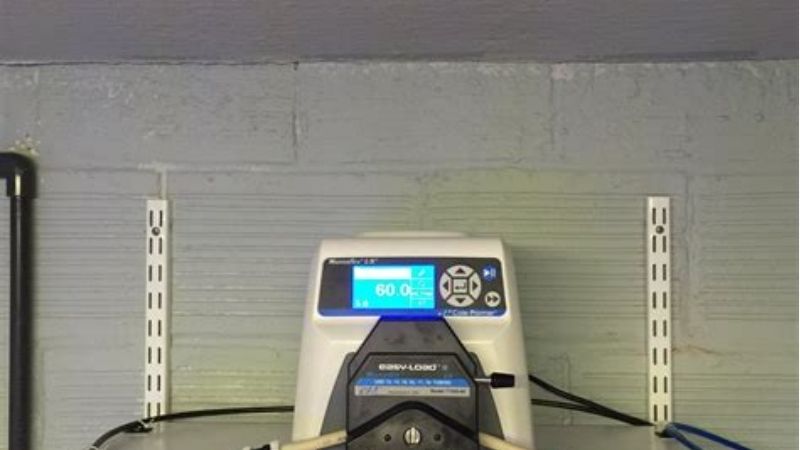
The reactor needs a consistent supply of tank water, so set the feed pump or gravity line to a steady, repeatable rate before dialing output. An erratic feed makes effluent chemistry wander no matter how well the CO2 is set, so a stable input is the foundation every later adjustment is measured against.
Match the feed to the reactor’s design, using the maker’s suggested starting flow such as the roughly 20 to 30 millilitres per minute a CoralVue example cites after purging. Confirm the rate holds over hours, not seconds, since a feed that sags as a pump warms or a line clogs will quietly undo your careful tuning.
Purge Air and Set the First CO2
Trapped air changes internal pressure and pH, so purge the chamber fully before setting gas, following the reactor’s bleed procedure until effluent runs cleanly. Only then introduce CO2 at a conservative rate, because starting gas into an air-locked chamber gives meaningless readings and can waste a whole session.
Set the first CO2 rate low and source-specific rather than to a remembered bubble count, since protocols vary across AquaReady, BRS and CoralVue. A gentle start lets you raise output deliberately in the next stage, which is far safer for the tank than opening gas wide and trying to walk a runaway reactor back down.
Adjust the Reactor to Your System
With setup sound, tuning becomes a patient loop of small changes tied to your tank’s alkalinity trend, not to any published bubble count. Test at repeatable times, change one variable, and wait for stability before the next move, since the reactor must match your measured demand, not a number from another reef.
Tune to Your Tank’s Alkalinity Trend
The single reference that matters is your aquarium’s alkalinity trend, so track it before and during tuning rather than aiming at a target effluent number. If tank alkalinity is drifting down, the reactor is under-supplying; if it climbs, output is too high, and that direction is what each adjustment should correct.
This is why a table built on gallons or copied settings misleads, since two tanks of equal volume can need very different output. Let the measured trend on your own system, not a generic figure, decide whether the next change raises or lowers effluent, because the reactor exists to hold that line steady over time.
Set Source-Specific Starting CO2
CO2 rate drives how much the effluent dissolves, so begin from the maker’s source-specific starting point rather than a universal figure. Protocols genuinely differ between brands, and a rate that suits one reactor and media can over-drive another, so the starting gas should come from your unit’s documentation.
From that baseline, change gas in small increments and watch internal pH settle before judging the result. Avoid treating a single pH like 6.5 as correct everywhere, because the workable internal pH depends on model and media, and the honest target is whatever holds your tank’s alkalinity trend level across days.
Test at Repeatable Intervals, One Change at a Time
Consistency in measurement is what makes tuning legible, so test alkalinity at the same time and in the same way each day. Change only one variable, gas or feed, between tests, because moving two at once hides which one caused the shift and turns a methodical process into guesswork that can swing the tank hard.
Give each change time to express itself, waiting at least around 24 hours as a BRS workflow suggests before the next adjustment. Small, spaced, single changes let the reactor and tank equilibrate, and make it obvious when you have gone far enough, protecting sensitive corals from the rapid moves they dislike.
Confirm Stability Before Walking Away
A reactor is not tuned until the tank holds steady on its own, so confirm three to five consecutive days of stable alkalinity, as common workflows advise, before considering the job done. A single good reading can be luck, while several in a row show the output genuinely matches the tank’s current demand.
Even then, revisit periodically, since demand rises as corals grow and media depletes over time. Treat tuning as maintenance rather than a one-off event, and when the trend starts slipping, return to single, spaced changes rather than one large correction, keeping the whole system calm as consumption climbs.
Frequently Asked Questions
Setup and tuning questions usually circle back to targets people hope are universal, from internal pH to effluent dKH. These answers keep the focus on your own tank’s trend and your reactor’s documentation, because the workable numbers vary by model and media and cannot be safely copied between different reef systems.
What Internal pH Should the Reactor Run?
There is no single correct internal pH, because the workable range depends on the reactor model and the media inside it. Manufacturers publish their own figures, such as an AquaReady range near 6.5 to 6.8, and those brand-specific numbers are a starting point to confirm on your tank, not a universal law to copy.
Judge the setting by results rather than the number itself, since the right internal pH is the one that keeps your aquarium’s alkalinity trend steady. Use a freshly calibrated probe, start from the maker’s range, and adjust gently, since chasing a figure borrowed from another reactor often destabilises a tank.
What Effluent dKH Am I Aiming For?
Effluent dKH varies widely with media, flow and CO2, so a blanket target like 25 to 40 dKH is not something to universalise. What matters is the combination of effluent strength and flow that supplies your measured demand, which two different reactors may reach at quite different effluent readings on different systems.
Rather than fixating on a single effluent figure, set feed and gas so the tank’s alkalinity holds, then note whatever effluent that produces on your system as your own reference. This keeps you tuning to real demand instead of forcing a number that may be wrong for your particular media and reactor combination.
Should I Adjust Flow or Bubble Rate First?
Both feed flow and CO2 bubble rate affect output, but changing them together makes results unreadable, so adjust one at a time. Many keepers stabilise the feed first, since a steady input is the baseline, then use CO2 as the finer control over how much the effluent dissolves and therefore how much buffer it carries.
Whichever you choose, move it in small steps and let the tank respond before touching the other. The goal is a repeatable cause and effect you can read in the alkalinity trend, and that clarity disappears the moment flow and gas are both in motion, which is how tanks end up oscillating instead of settling down.
How Long Between Adjustments?
Leave enough time for each change to show in the water before making another, which common workflows put at roughly 24 hours or more for small moves. Rushing produces overlapping effects that you cannot untangle, so patience between adjustments is not caution for its own sake but the only way to tune cleanly.
For confirming that tuning has landed, look for three to five days of stable readings rather than a single result. Because demand shifts as the reef grows, plan to revisit the settings over time, treating the interval between changes as a deliberate part of a process that keeps the tank steady through growth.
Final Thoughts
The point of any calcium reactor setup and tuning guide is to match output to your own tank’s alkalinity trend, never to a copied bubble count or a universal pH. Build carefully, calibrate the probe, tune one variable at a time, and confirm several days of stability before trusting the reactor to hold your demand.
Ready to decide? Our #1 pick for 2026 is the Starting effluent (AquaReady T-1).
Live price & availability on Amazon.
Related Reviews & Guides

Best Wavemaker for SPS Dominant Reef: Smart Top Picks
Hydra 32 vs Hydra 64 Which AI Light to Buy: Expert Top Pick