Last Updated: October 8, 2026
- Best ellipticals for seniors: quick recommendations
- What matters most when choosing an elliptical for seniors
- Head-to-head comparison
- Choose by situation, not by feature count
- How much space do you really need?
- Ownership realities: what wears first
- How to set up a senior-friendly elliptical
- Final buying advice
The best ellipticals for seniors are models with a low step-up height, stable handrails, a comfortable 18–20-inch stride, easy resistance controls, and a footprint that leaves clear walking space around the machine.
Best ellipticals for seniors: quick recommendations
- Best overall for most homes: Horizon EX-59, because its simple console, 18-inch stride, fixed handlebars, and compact footprint favor easy operation and stability.
- Best budget-friendly full-size option: Schwinn 430, with a 20-inch stride and a broad feature set, provided the user has enough room for its longer frame.
- Best for a smoother, more substantial machine: Sole E25, with a 20-inch stride, heavier construction, and quiet magnetic resistance, although it costs more and takes up more space.
- Best for limited space: a compact front-drive elliptical with a 14–16-inch stride and transport wheels. It is easier to fit, but may feel less natural for taller users.
A machine should not be chosen by price or screen features alone. For older users, the safest choice is usually the elliptical that is easiest to approach, mount, control, and leave without twisting or reaching.

MERACH Under Desk Elliptical, Leg Exerciser While Sitting for Seniors
Included for 'Best Ellipticals for Seniors: Safe, Low-Impact Picks' because the listing specifies Leg Exerciser While Sitting for Seniors, details this guide uses to compare options.
View on Amazon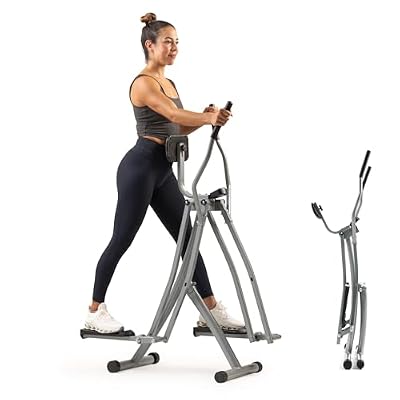
Sunny Health & Fitness Smart Air Walk Elliptical Glider with 30-Inch Stride
Included for 'Best Ellipticals for Seniors: Safe, Low-Impact Picks' as a relevant option in this category; details come from the product listing.
View on Amazon
Cubii JR1 Under Desk Elliptical, Seated Bike Pedal Exerciser, Seniors, Aqua
Included for 'Best Ellipticals for Seniors: Safe, Low-Impact Picks' because the listing specifies Seated Bike Pedal Exerciser and Seniors, details this guide uses to compare options.
View on AmazonWhat matters most when choosing an elliptical for seniors
1. Step-up height and entry design
Step-up height is the vertical distance from the floor to the lowest usable pedal. A difference of a few inches can noticeably change how easy it is to get on and off. Look for a published step-up height around 8–10 inches where possible; compact machines may be lower, while some tall rear-drive models are higher.
Fixed handlebars are valuable during entry and exit because they provide a steady gripping point. Moving handlebars are useful during exercise, but they should not be the only support. Place the elliptical with at least 24 inches of unobstructed space on the easiest side to approach, and avoid positioning it beside furniture that could catch a foot.
2. Balance support
Prioritize long, nonmoving handlebars with textured or padded grips. They should remain reachable throughout the stride without requiring the user to lean forward. A wide base and heavier frame generally reduce rocking, but weight alone does not guarantee stability. Check whether the machine has adjustable levelers for uneven flooring.
Do not use the moving arms as a substitute for a mobility aid. If balance is uncertain, a physical therapist or clinician can help determine whether an elliptical is appropriate and how it should be positioned.
3. Stride length
A longer stride often feels more natural, but it also increases machine length. An 18-inch stride suits many average-height users. A 20-inch stride is preferable for taller users or anyone who dislikes a cramped motion. A 14–16-inch stride can work in a small room, but may feel short for a user above about 5 feet 8 inches.
Stride length is not the same as the machine’s total length. A long stride can produce a long frame, so measure both the user’s fit and the available floor space.
4. Pedal comfort and traction
Pedals should be wide enough to keep the feet centered, have a textured surface, and allow a small amount of natural heel movement. Deeply sculpted pedals can feel secure but may make repositioning difficult. Very narrow pedals can cause pressure on the outside of the foot during longer sessions.
Before buying, check the pedal spacing, sometimes called the Q-factor. A wide spacing can feel uncomfortable for some users, while an overly narrow stance may not suit everyone. Supportive footwear is preferable to slippers or loose shoes, and the pedals should be wiped regularly so dust does not reduce traction.
5. Resistance controls
Large resistance buttons on the fixed handlebars are easier to use than a small touchscreen menu. At least 10 resistance levels provide useful progression; 16–25 levels offer finer adjustments but are not automatically better. A simple manual or quick-start mode is helpful when the user does not want to navigate workout programs.
Magnetic resistance is usually quieter and smoother than friction-based resistance. It also avoids the regular replacement of friction pads. For seniors, quiet operation matters because it makes conversation, television, and audible safety cues easier during exercise.
Head-to-head comparison
| Model or type | Approx. stride | Approx. footprint | Weight capacity | Best fit |
|---|---|---|---|---|
| Horizon EX-59 | 18 in | 69 × 26 × 64 in | 300 lb | Simple controls and moderate spaces |
| Schwinn 430 | 20 in | 70.1 × 28 × 63.1 in | 300 lb | Budget buyers needing a longer stride |
| Sole E25 | 20 in | 70 × 24 × 66 in | 350 lb | Frequent use and a sturdier feel |
| Compact front-drive type | 14–16 in | 55–65 × 24–28 × 60–68 in | 250–300 lb | Small rooms and occasional use |
Dimensions and capacities can vary by production version and region, so confirm the current manufacturer specification before ordering. Allow additional clearance above the listed height and around the pedals. A ceiling height of at least 8 feet is a sensible starting point, but users with a long reach or higher stepping motion may need more.
Choose by situation, not by feature count
| Your situation | Best direction | Why |
|---|---|---|
| First elliptical and uncertain about routine | Horizon EX-59 or similar 18-inch model | Lower complexity and usually easier to fit than a heavy premium machine |
| Taller user with regular use | Schwinn 430 or Sole E25 | 20-inch stride reduces the cramped feeling of shorter machines |
| Small apartment or spare room | Compact 14–16-inch model | Shorter frame, though the shorter stride must be acceptable |
| Several users exercising frequently | Sole E25 or another heavier-duty model | More substantial construction and a higher stated capacity |
| Balance is the main concern | Model with long fixed handlebars and low entry | Support and access matter more than programs or display size |
How much space do you really need?
Do not plan around the machine’s listed footprint alone. A 70-inch-long elliptical needs room for the frame, pedal movement, approach, and safe exit. A practical planning rectangle is about 84 inches long by 48 inches wide for a full-size machine. This leaves roughly 7 inches beyond the front and rear on a 70-inch frame and about 10 inches at each side of a 28-inch-wide frame; more clearance is preferable near the user’s main entry side.
Measure doorways, hallways, stair turns, and the final room before ordering. A machine that fits the exercise area may still be difficult to deliver or reposition.
Ownership realities: what wears first
- Pedal straps and footbeds: Straps, textured surfaces, and pedal hinges receive repeated pressure. Replace damaged straps rather than continuing with a loose foot position.
- Rollers and tracks: Front-drive designs may collect dust and hair around their rollers. Vacuum and wipe these areas according to the manual; do not flood them with lubricant.
- Pivot hardware: Squeaks commonly come from loose fasteners or dry pivot points. Inspect bolts periodically and use only the lubricant specified by the manufacturer.
- Console batteries and power cords: Some consoles use batteries while others require an adapter. Keep cords away from walking paths and replace corroded batteries promptly.
- Perspiration and corrosion: Wipe handlebars, pedals, and frame surfaces after each session. Sweat left on metal or electronic contacts can shorten their life.
A common mistake is increasing resistance before establishing a comfortable stride. Start with a low setting, confirm that both feet remain centered, and increase duration or resistance gradually. Stop if there is pain, unusual dizziness, chest discomfort, or loss of balance, and seek appropriate medical advice.
How to set up a senior-friendly elliptical
- Place it on a level, solid floor with a non-slip mat if the manufacturer permits one.
- Position the easiest-to-reach fixed handle toward the room’s open space.
- Adjust the leveling feet until the frame does not rock.
- Check that the user can step onto the lowest pedal while holding a fixed handle, without reaching behind the body.
- Set resistance to the lowest or an easy level for the first sessions.
- Keep a phone or call device nearby, but not where it creates a trip hazard.
Final buying advice
For most seniors, the Horizon EX-59 is the balanced choice when simple controls, an 18-inch stride, and a manageable footprint are more important than a large program library. Choose the Schwinn 430 when a 20-inch stride and lower general market price are priorities and the room can accommodate its length. Choose the Sole E25 when the machine will be used frequently and a heavier, more substantial build justifies the higher general market range.
Expect roughly $700–$1,000 for many capable midrange ellipticals and about $1,000–$1,800 or more for sturdier premium models, excluding delivery or assembly. The best elliptical is the one the user can approach confidently, operate without excessive reaching, and leave safely after every session.

Best Hisense QLED TVs: Top Picks for Every Budget
Spiced Cocktails for Cold Nights