Last Updated: September 21, 2026
A calcium and alkalinity program works best when it is built from what your corals actually consume, not a number copied from a forum. Building the best dosing schedule for calcium and alkalinity starts with measuring demand, then matching a product-specific dose to it.
As an Amazon Associate we earn from qualifying purchases.
By David Nguyen
Quick answer: For most people in 2026, the best dosing schedule for calcium and alkalinity is the 100 gal on ESV B-Ionic — our #1 rated choice. See the full ranked comparison, alternatives and buying advice below.
How to Build a Calcium and Alkalinity Dosing Schedule
A schedule has four moving parts: measure your real demand, calculate a dose from your specific product, separate the two parts in time, and split the daily total across several additions. The numbers below are starting points, not universal prescriptions.
| Input | Result | Note | Exception |
|---|---|---|---|
| 100 gal on ESV B-Ionic | ~25 mL of each part/day to start | Based on 1 mL per 4 gal/day | Adjust to measured consumption |
| Two concentrated parts | Separate by about 1 hour | Cited BRS/ESV approach | Diluted or automated micro-doses differ |
| Dial-in testing | Daily for at least 5 days | Establishes real daily demand | Extend if parameters swing |
| Stable system testing | Weekly | Confirms dose still matches uptake | Retest after any change |
Measure Demand
Start by testing calcium and alkalinity daily for at least five days without dosing changes, so you can see how far each drops per day. That drop is your real consumption. There is no single correct mL/day, because uptake depends on coral mass, growth rate, and lighting.
Record the daily fall in dKH and ppm calcium separately, since they do not move in lockstep. A tank losing about 1 dKH per day needs enough alkalinity additive to replace exactly that, which you only learn by measuring rather than assuming a figure.
Calculate the Product-Specific Dose
Convert demand into a dose using your product’s own instructions, since concentrations differ between brands. ESV B-Ionic, for example, lists a starting point of 1 mL of each part per 4 gallons per day, so a 100-gallon system starts near 25 mL of each component daily.
Treat that figure as a starting estimate, then adjust to your measured consumption. Remember ppm calcium is not the same quantity as mL of additive, and a dKH target is not a dose, so never swap a chemistry number for a volume. If you find yourself dosing more than a couple of milliliters per gallon per day to hold alkalinity, that often signals demand has outgrown two-part, where a calcium reactor or kalkwasser can become more economical.
Separate the Parts
Add the two concentrated parts apart in time so they do not react in the water column and precipitate. The cited BRS and ESV approach separates concentrated two-part additions by about one hour, which is a practical spacing for manual dosing.
If a doser splits each part into many small daily shots, the effective separation is already built in and the strict one-hour gap matters less. For hand dosing, keep the parts on opposite ends of the hour to be safe.
Split the Daily Total
Splitting the daily total into several smaller doses keeps parameters steadier than one large addition. A 25 mL daily requirement dosed as four to six portions limits swings in pH and alkalinity compared with a single slug of the same volume.
More frequent, smaller doses also reduce local precipitation near the dosing outlet. The exact number of splits is a preference, but more divisions generally smooth the curve, especially on smaller systems where one big dose moves parameters quickly.
Adjust the Schedule for Your Reef
A starting schedule is only a baseline. Coral type, growth, brand changes, and automation each shift how much you dose and how often you verify it. Adjust the numbers as your system changes rather than locking in one figure.
Mixed Reef Vs SPS
Demand rises with stony coral load. A softie-dominant tank may hold parameters on a small dose, while an SPS system consumes far more. Red Sea’s mixed-reef program targets around 450 ppm calcium and 11.5 dKH, but those are program targets, not a universal setpoint for every tank.
Pick a target band that suits your corals and hold it steadily, since stability matters more than the exact number. Raise the dose gradually as SPS colonies grow and pull more, rechecking every few days during the change.
Changes in Coral Growth
As corals grow, they consume more, so a dose that held last month can fall behind. Retest whenever growth is visible or you add frags, since demand can climb steadily rather than in sudden steps.
Watch for a slow downward drift in alkalinity as the early sign your dose is now too small. Increase in small increments, roughly matching the daily fall you measure, instead of making one large jump. Constant retesting also means test reagents are a real recurring cost in a dosing program, so budget for replacement kits alongside the two-part additive itself.
Switching Brands
Different two-part and balling products have different concentrations, so a dose in mL does not transfer between brands. When switching, recalculate from the new product’s instructions rather than reusing your old volume.
Overlap carefully during a switch: match the new product’s per-gallon starting dose, then verify with daily tests for several days. A brand change is effectively a new dial-in, not a straight swap of numbers.
Automation
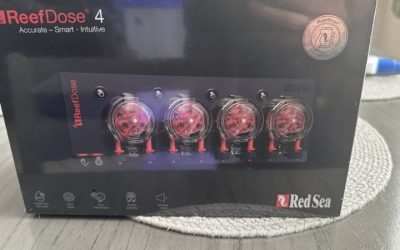
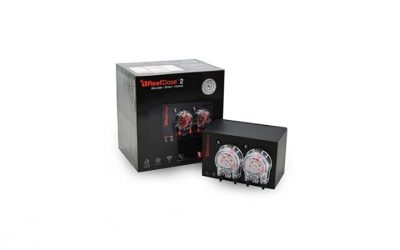
A doser turns your schedule into small automated shots, but it does not replace testing. Program the measured daily total, spread it across multiple additions, and keep the two parts separated in the timing.
Automation makes it easy to forget verification, so keep a weekly test on a stable system and daily tests whenever you change the dose. The pump follows your number; only testing tells you the number is still right. App-connected dosers and controllers add convenience, but they lock you into an ecosystem, so weigh replacement-part and reagent availability before committing to one brand’s automation.
Frequently Asked Questions
Keepers most often ask whether the two parts can go in together, how often to dose and test, and how long to measure before trusting a schedule. The answers hinge on your product and how stable your system is.
Can You Dose Calcium and Alkalinity at the Same Time?
Not in concentrated form. Added together, the two parts can react and precipitate, wasting product and clouding the water. The cited BRS and ESV method separates concentrated additions by about an hour.
Heavily diluted or automated micro-doses reduce the risk because the concentration at any moment stays low. Even then, spacing the parts is the safer habit on a manual routine. Alkalinity additions can also nudge pH upward briefly, so dosing across the day rather than in one shot keeps that swing small on sensitive systems.
How Often Should You Dose?
Split the daily total into several smaller doses rather than one. Four to six portions a day keep alkalinity and pH steadier than a single addition of the same volume.
The right count depends on system size and demand; smaller tanks benefit from more, smaller doses. Automation makes many splits effortless, but the total still comes from your measured consumption. Pricier automated dosers see their deepest discounts during Prime Day and Black Friday, so timing that purchase can offset the upfront cost of moving off manual dosing.
How Long Should You Test Before Setting a Dose?
Test daily for at least five days while dialing in, so you capture the real daily drop before committing to a dose. A single test is a snapshot, not a trend.
If parameters swing during that window, extend the testing rather than averaging noisy numbers. Once the dose holds parameters flat, you can move to less frequent checks. A basic reef test kit covers many checks but is consumed steadily, so heavy dial-in periods burn through reagents faster than a stable maintenance phase.
How Often Should You Test a Stable System?
Weekly is a reasonable interval once the dose is stable and parameters hold. That cadence catches slow drift from coral growth before it becomes a swing.
Return to daily testing after any change, such as new corals, a lighting upgrade, or a brand switch. Stability sets the schedule while a change resets it, and each reset consumes another round of test reagents to re-establish the real daily demand.
Final Thoughts
The best dosing schedule for calcium and alkalinity is measured, not copied: test daily for at least five days, calculate from your product such as ESV B-Ionic at 1 mL per 4 gallons, separate the parts by about an hour, and split the total across the day. Retest weekly once stable and after any change.
Ready to decide? Our #1 pick for 2026 is the 100 gal on ESV B-Ionic.
Live price & availability on Amazon.
Related Reviews & Guides



6 Best Sump Reef Aquariums 2026
6 Best Chillers For Saltwater Aquarium 2026