Last Updated: October 4, 2026
Two-part dosers only stay accurate when the reservoirs behind them are sized and shaped for your cabinet. Picking the best dosing container set for two part calcium and alkalinity means matching chamber volume, footprint, and refill access to your real daily demand rather than a round number.
As an Amazon Associate we earn from qualifying purchases.
By David Nguyen
Quick answer: For most people in 2026, the best dosing container set for two part is the Simplicity 3x2L — our #1 rated choice. See the full ranked comparison, alternatives and buying advice below.
How to Choose a Two-Part Dosing Reservoir
Choose a reservoir set by how much additive you dose per day, how much cabinet space you have, and whether you want built-in level warnings. The right size holds several days of solution without crowding your doser, tubing, or return pump.
Capacity Per Chamber
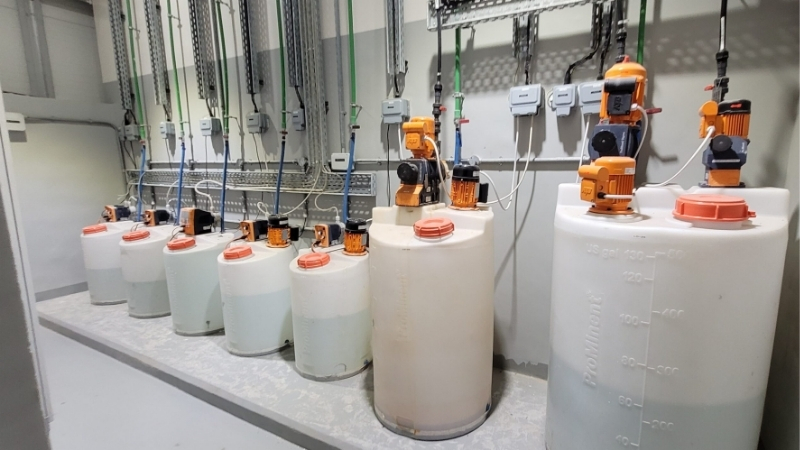
Size each chamber to your measured daily dose. A tank using about 25 mL of each part per day drains a 2 L chamber in roughly 80 days on paper, though you refill sooner to avoid pulling air. The Simplicity 3x2L holds 2 L per chamber; the ReefBreeders Trio holds 1.5 L each.
Reservoir volume is cheap to buy, but the surrounding consumables are not: dosing tubing and pump ecosystems drive most long-term cost. Buy a size that outlasts a typical work week, and remember the AquaReady DC-2 uses a separate 3 L jug per part, so a two-part setup needs two units. Over a year, the reservoir itself is a minor cost next to additive refills and replacement dosing tubing, so budget for those recurring items rather than fixating on the container price.
Cabinet Footprint
Measure the exact opening of your stand before ordering. A tall, narrow bottle clears a low cabinet lip that a wide tub will not. The Simplicity 3x2L packs three chambers in one body, while two AquaReady DC-2 jugs at 3 L each spread the footprint wider but let you place the parts apart.
Footprint also affects service. Leave room to lift a lid, top off, and reach the dosing lines without moving the pump. Group calcium and alkalinity reservoirs on opposite sides of the sump area so a spill or crystallized alkalinity residue never contaminates the other part.
Two Vs Three Chambers
A classic two-part program needs two chambers, but a third is useful for magnesium or a trace supplement. The Simplicity 3x2L and ReefBreeders Trio give three chambers; the Neptune DDR gives two. Do not read 3×2 L as 6 L per additive, since each part still lives in its own 2 L chamber.
Three chambers add flexibility only if your doser has the heads to use them. Pair chamber count to pump heads: a two-head pump cannot dose three reservoirs at once, so an extra chamber sits idle until you expand the pump side of the system.
Level Sensing
Level sensing warns you before a reservoir empties and a line runs dry. The Neptune DDR includes two optical sensors, but that warning is tied to its ecosystem: the sensing advantage depends on running it with an Apex and DOS rather than as a standalone jug.
Without sensors, a marked chamber and a calendar reminder do the same job manually. The ReefBreeders Trio uses 50 mL graduations so you can eyeball remaining volume, which is often enough on a tank you inspect daily.
Top Picks
These four reservoir sets cover the common two-part situations: a compact three-chamber body, a low-cost separated pair, a graduated trio, and a sensor-equipped set for automated systems. Prices are manufacturer or retailer snapshots as of 09/2026 and move with sales.
| Product | Best For | Key Spec | Watch Out For |
|---|---|---|---|
| Simplicity 3x2L | Best overall | 3×2 L chambers; ~under $100 (as of 09/2026) | 2 L per part, not 6 L per additive |
| AquaReady DC-2 | Best value | 3 L per jug; ~under $70 each (as of 09/2026) | Two-part needs two units |
| ReefBreeders Trio | Best for manual level checks | 3×1.5 L; 50 mL graduations; ~under $90 | 4.5 L total, shorter runtime per chamber |
| Neptune DDR | Best for automated ecosystems | 2×2 L; 2 optical sensors; ~under $300 | Sensing needs Apex + DOS |
Simplicity 3x2L
The Simplicity 3x2L is the best overall pick for a correctly sized, compact set: three 2 L chambers in one body at about $100 as of 09/2026. It suits a two-part program with room for a third supplement, and it fits most mid-size cabinets without spreading across the sump.
Its limitation is no built-in level sensing, so you monitor refills yourself. The chambers are 2 L each, not a shared 6 L pool, so plan refills per part. For a busy keeper who inspects the tank daily, manual checks are usually enough to avoid a dry line.
AquaReady DC-2
The AquaReady DC-2 is the value pick at about $65 each as of 09/2026, using a 3 L jug per part. Because a two-part setup needs two units, budget for the pair, but you gain the freedom to separate calcium and alkalinity across the cabinet.
The trade-off is a wider overall footprint and two lids to service instead of one. There is no integrated sensor, and the larger single jug per part means a longer interval between refills, which some keepers prefer over a multi-chamber body.
ReefBreeders Trio
The ReefBreeders Trio offers three 1.5 L chambers, 4.5 L total, at about $90, with 50 mL graduations printed on each chamber. Those markings make manual level checks quick, a practical alternative to electronic sensing on a tank you already watch daily.
At 1.5 L per chamber it holds less per part than a 2 L set, so refill intervals are shorter on high-demand systems. It is a strong choice when you want three parts and visible volume, but it is not the longest-running option in this group.
Neptune DDR
The Neptune DDR is the pick for automated systems at about $250, with two 2 L chambers and two optical level sensors. Its real value appears inside the Neptune ecosystem: the sensing and alerts depend on running it with an Apex controller and a DOS doser.
As a standalone jug it is expensive for 4 L of capacity, and it has only two chambers, so a three-part program needs another reservoir. Choose it when you already run, or plan to run, the Apex and DOS hardware it is designed around. Pricier automation like this often sees its deepest discounts during Prime Day and Black Friday, so timing a purchase around those windows can offset the premium.
Frequently Asked Questions
Common questions about two-part reservoirs cluster around sizing, chamber count, sensors, and whether bigger is automatically better. The short answers depend on your measured daily dose and how you monitor the system.
How Big Should a Two-Part Reservoir Be?
Size it to hold at least a week of your measured daily dose. If you dose about 25 mL of each part per day, roughly 175 mL a week, a 2 L chamber like the Simplicity 3x2L covers many weeks before refilling.
Higher-demand SPS systems drain faster, so a set that lasts a week on a soft-coral tank may need topping off sooner on a heavy stony system. Match volume to consumption, then refill before a line pulls air.
Can You Use Three Chambers for a Two-Part System?
Yes. A two-part program only fills two chambers, and the third is free for magnesium or a trace element later. The Simplicity 3x2L and ReefBreeders Trio give that spare chamber; the DDR gives two only.
Just remember the extra chamber does nothing until your doser has a head to drive it. Plan chamber count and pump heads together, since a two-head pump leaves a third reservoir idle.
Do You Need Low-Level Sensors?
Not always. Sensors like the DDR’s two optical probes prevent a dry line, but they earn their cost mainly inside an Apex and DOS system. On a tank you inspect daily, graduations do the same job.
If you travel or run unattended for stretches, sensing adds a real safety margin. For a hands-on keeper, a graduated set such as the ReefBreeders Trio with 50 mL marks is often enough.
Is a Larger Reservoir Always Better?
No. A bigger jug means fewer refills but also more mixed solution sitting unused, and alkalinity can absorb CO2 and drift over time. Match volume to a week or two of demand rather than buying the largest tub on the shelf.
Oversizing also crowds the cabinet and complicates spill separation. A right-sized set keeps parts fresh and service simple, which matters more than raw capacity on most builds.
Final Thoughts
The best dosing container set for two part reef keeping is the one sized to your measured demand and your cabinet, not the biggest or the most connected. The Simplicity 3x2L covers most keepers at about $100 as of 09/2026, while the Neptune DDR suits Apex-based automation. Match chambers to pump heads before you buy.
As an Amazon Associate we earn from qualifying purchases at no extra cost to you. Prices and availability are accurate as of the date shown and are subject to change.
Ready to decide? Our #1 pick for 2026 is the Simplicity 3x2L.
Live price & availability on Amazon.
Related Reviews & Guides


Best 1/3 HP Aquarium Chiller for Reef Tanks: Smart Top Picks
How to Acclimate Live Corals to Your Reef Tank