Last Updated: October 7, 2026
The best axe sheaths combine full cutting-edge coverage, a secure closure, weather-resistant construction, and a fit matched to the axe head—not simply the cheapest sleeve that slips over the blade.
Quick answer: For most people in 2026, the best axe sheaths for safe carry and storage is the Occasional campsite use — our #1 rated choice. See the full ranked comparison, alternatives and buying advice below.
Best axe sheath choices by use
| Use case | Recommended sheath type | Useful specifications | Why it fits the job |
|---|---|---|---|
| Occasional campsite use | Heavy ballistic nylon with a molded or reinforced blade pocket | 600–1,000 denier fabric; 40–60 mm hook-and-loop overlap; edge coverage at least 10 mm beyond the cutting edge | Light, affordable, compact, and easy to dry after damp trips |
| Frequent chopping and trail work | Riveted full-grain leather or hybrid leather/nylon sheath | 2.5–3.5 mm leather; stitched and riveted seams; belt loop for belts up to 50 mm wide | Resists abrasion and repeated removal better than thin fabric |
| Wet, muddy, or coastal environments | Molded polymer or coated synthetic sheath | Closed-cell or non-absorbent material; drain opening; corrosion-resistant fasteners | Does not hold water against the axe head and cleans quickly |
| Large felling or splitting axe | Wide leather or reinforced polymer cover with a rigid guard | Blade pocket width 100–150 mm; two-point retention; handle clearance of at least 20 mm | Protects a broad bit and prevents the heavier head from twisting out |
| Pack carry and vehicle storage | Compact nylon cover with secondary buckle or snap | 100–250 g target weight; closed edge guard; lash points or 25–50 mm webbing loop | Stays attached to a pack and reduces the chance of accidental opening |
What separates a safe sheath from a basic cover?
A cover only needs to hide the sharp edge. A useful sheath must also control movement, protect the blade from impact, and remain attached when the axe is carried handle-down, head-up, or horizontally on a pack.
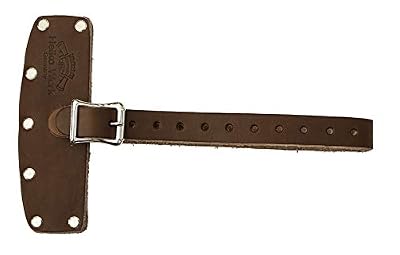
1844 Helko Werk Made in USA Genuine Leather Axe Sheath Size Medium Brown S122
Included for 'Best Axe Sheaths for Safe Carry and Storage' as a relevant option in this category; details come from the product listing.
View on Amazon
Weaver Arborist Axe Guard, One-Piece Top Grain Steer Hide Leather Hatchet Sheath with Adjustable Buckle Strap, Fits Edges up to 5-3/8 in, Tan
Included for 'Best Axe Sheaths for Safe Carry and Storage' because the listing specifies Fits Edges up to 5-3/8 in and Tan, details this guide uses to compare options.
View on Amazon
1844 Helko Werk Made in USA Genuine Leather Axe Sheath Size Large Brown (S126)
Included for 'Best Axe Sheaths for Safe Carry and Storage' as a relevant option in this category; details come from the product listing.
View on Amazon
ESTWING Blue Camper's Axe Sheath, Fits Models E45ASE & E44ASE, No. 9
Included for 'Best Axe Sheaths for Safe Carry and Storage' because the listing specifies Fits Models E45ASE & E44ASE and No. 9, details this guide uses to compare options.
View on AmazonBlade coverage
Look for coverage across the complete sharpened edge, including the toe and heel. On a double-bit axe, a one-sided cover is unsuitable unless the exposed bit is separately protected. The guard should extend beyond the edge rather than ending exactly at it. A practical minimum is 10 mm of material past the cutting edge on each exposed side.
For a curved bit, measure from the highest point of the curve, not from the straight-line width of the axe head. A sheath that fits the center of the blade can still leave the toe exposed. The opening should also prevent the head from sliding sideways until either the edge or poll contacts the ground.
Retention
Hook-and-loop closures are quick and inexpensive, but packed dirt, wood chips, and repeated opening eventually reduce their grip. Leather straps with snaps last longer when kept clean, while a buckle gives the most positive closure but takes more time to operate with gloves.
For a small hatchet carried inside a pack, one closure around the head may be sufficient if the blade pocket is snug. For a heavier axe, choose two retention points: one around the blade or cheek and another around the poll or upper head. The second point limits rotation, which is often the cause of an edge escaping a loose cover.
Attachment options
- Belt loop: Best for a compact hatchet. Check the actual loop width; a 40 mm loop will not comfortably accept a thick 50 mm work belt.
- D-ring or webbing loop: Useful for carabiner-style attachment or securing the axe to a pack, although the sheath should not be allowed to swing freely near legs.
- MOLLE-compatible straps: Convenient on compatible packs, but inspect stitching because a loaded axe creates more leverage than a pouch.
- Lashing slots: A good option for bushcraft packs, truck tool compartments, or custom tie-downs. They also make replacement straps possible.
- No external attachment: Suitable for drawer or toolbox storage, provided the covered axe is stored so the blade cannot press against the sheath wall.
Material comparison: leather, nylon, and polymer
Leather
Full-grain leather gives excellent abrasion resistance and conforms to the shape of an axe head over time. Thick leather also offers a reassuring barrier when the axe is carried with other tools. Its disadvantages are weight, water absorption, and maintenance. Wet leather can stretch, and storing an axe in a damp leather sheath may encourage corrosion.
Prefer leather that is stitched and riveted at high-stress points. Decorative stitching alone is not enough around the closure or belt loop. A 2.5–3.5 mm thickness is a useful range for ordinary hatchets and camp axes; very thin leather is more appropriate for light storage than rough field carry.
Ballistic nylon and other synthetic fabrics
Nylon is usually the best value when low weight and packability matter. A 600-denier fabric can work for light hatchets, while 1,000-denier fabric or a reinforced laminate is preferable for frequent trail use. The fabric should have a separate blade liner or stiffener. Without one, a sharp edge may gradually cut through the fold or force its way out when the sheath is compressed.
Synthetic sheaths dry faster than leather, but hook-and-loop closures collect burrs and debris. Brush the closure clean rather than repeatedly pulling it apart while dirty.
Molded polymer
Polymer provides the most consistent edge protection and is easy to rinse. It is particularly useful for muddy work, vehicle storage, and users who do not want to condition leather. Rigid covers can be noisy against metal and may crack in severe cold or after being crushed under heavy equipment, so look for rounded edges, flexible retention straps, and a drain path.
How to size an axe sheath correctly
Do not choose by handle length alone. Measure the head, the sharpened edge, and the thickness around the cheek and poll.
- Lay the axe on paper and trace the head outline.
- Measure the maximum blade width from toe to heel.
- Measure the total head depth, including the poll if the cover must enclose it.
- Measure the thickness at the cheek, where the sheath opening will sit.
- Add approximately 5–10 mm of internal clearance to width and depth, but not so much that the head rattles.
For example, if a hatchet blade is 92 mm wide and the manufacturer’s sheath has a 6 mm internal side wall on each side, the nominal outside pocket width should be about 104 mm: 92 mm plus 12 mm of wall allowance. If the cover’s listed internal width is only 95 mm, it is undersized even if the axe is described as a “standard hatchet.”
For a curved or flared bit, add another 5–10 mm of allowance at the widest point. A snug fit at the center does not compensate for an exposed toe.
Decision matrix for choosing the right cover
| Your priority | Best fit | Compromise to accept |
|---|---|---|
| Lowest initial cost | 600-denier nylon with reinforced edge binding | Shorter service life if dragged or overloaded |
| Maximum durability | Thick stitched-and-riveted leather or rigid polymer | More weight and bulk |
| Beginner-friendly handling | Close-fitting cover with a buckle or snap plus visible edge guard | Slower to remove than open hook-and-loop |
| Small storage space | Foldable nylon sheath with a flat closure | Less structural protection than a molded cover |
| Daily or weekly use | Leather or heavy synthetic with replaceable strap hardware | Higher purchase price, often about $20–$60 rather than $10–$25 |
| Occasional emergency use | Simple fitted nylon cover, kept clean and inspected | More frequent replacement may be sensible than buying an overbuilt sheath |
Ownership details that affect long-term safety
The first parts to wear are usually the closure, belt-loop stitching, edge binding, and the area where the blade rubs during insertion. Inspect these areas every few uses. If the blade can touch the outside through thinning fabric, stop using the sheath until it is repaired or replaced.
Clean the axe before sheathing it. Wipe away sap and grit, dry the head fully, and apply a very thin coat of suitable protective oil to bare carbon steel. Do not saturate a leather sheath with oil; excess oil can soften it and transfer onto the handle. Let a wet sheath dry open and away from direct high heat, which can shrink leather and warp some polymers.
Never force an axe into a sheath that is tight at the toe or poll. The pressure can cut the pocket from inside and may make the head spring out when the closure is released. Do not rely on the sheath as a substitute for safe axe transport: carry the covered blade away from people, secure the handle in a vehicle, and avoid placing the covered edge where body weight can press against it.
Bottom line
For most campers, the best axe sheaths are reinforced nylon models with full edge coverage, a snug blade pocket, and a secondary buckle or snap. Choose thick leather when abrasion resistance and traditional belt carry matter more than weight. Choose molded polymer for wet or dirty conditions and for storage where predictable rigid protection is the priority. Whatever the material, accurate head measurements, positive retention, and regular inspection matter more than branding or decorative design.
Ready to decide? Our #1 pick for 2026 is the Occasional campsite use.
Live price & availability on Amazon.
Related Reviews & Guides


Best Acoustic Guitar Strings for Every Player
Best LED Truck Bed Lights for Night Work & Camping