Last Updated: October 4, 2026
Choosing the first filter for a new aquarium can feel more complicated than choosing the fish. Beginners often buy a filter based only on the advertised gallon rating, overlook the flow rate, or assume that the biggest filter is automatically the best. Other common mistakes include selecting equipment that is too powerful for bettas or shrimp, forgetting to budget for replacement media, and buying a filter that will not fit behind the tank.
This aquarium filter buying guide for beginners focuses on the specifications that affect daily use: safe water movement, reliable filtration, noise, maintenance, and total cost. Whether you are setting up a one-gallon betta kit or a larger community aquarium, the right filter should provide steady circulation without creating a stressful current.
As an Amazon Associate we earn from qualifying purchases at no extra cost to you.



Decide These 3 Things First
- Your aquarium’s actual water volume: Use the tank’s water capacity, not just its outside dimensions. A tank labeled for 10 gallons may hold closer to 8 gallons after substrate, decorations, and a partially filled water line.
- The fish and invertebrates you plan to keep: Bettas, long-finned fish, fry, and shrimp generally need gentler flow. Active community fish can usually tolerate stronger circulation.
- How much maintenance you will accept: Mechanical media may need rinsing weekly, while cartridges often need replacement every 2–4 weeks. A slightly more expensive filter can be worthwhile if its media is reusable and easy to clean.
As a starting point, look for a filter rated to circulate the aquarium’s full volume about 4–6 times per hour. That means a 10-gallon aquarium commonly needs roughly 40–60 gallons per hour (GPH), although the ideal setting depends on the livestock and filter design.
Size and Flow Rate
Filter size has two separate measurements: the aquarium capacity it supports and the amount of water it moves. Do not treat them as interchangeable. A filter advertised at 105 GPH may be suitable for a 10-gallon aquarium when adjusted or used with a spray bar, but that same flow could be excessive for a small betta tank.
For a general guide, a 5-gallon aquarium usually needs approximately 20–30 GPH, a 10-gallon tank about 40–60 GPH, and a 20-gallon tank about 80–120 GPH. These are starting ranges rather than hard rules. A heavily stocked aquarium may need more biological filtration, while a lightly stocked tank with delicate fish may need less water movement.
Check the filter’s physical dimensions before buying. Compact internal filters may be about 2–3 inches wide and 4–8 inches tall, while hang-on-back models can extend 5–8 inches behind the aquarium. Leave enough clearance for the lid, power cord, and filter basket. A filter that technically fits but prevents the lid from closing is not a practical choice.
Adjustable flow is especially useful for beginners. A flow-control lever, output nozzle, or spray bar lets you reduce turbulence without replacing the entire unit. For a betta or shrimp aquarium, aim for visible circulation without fish being pushed continuously across the tank.
Material and Media Compatibility
Most aquarium filters use molded plastic for the housing, intake tube, impeller cover, and media basket. Look for thick, rigid plastic with seams that fit tightly. Slight flexibility is normal, but a housing that bends easily or has rough, poorly finished edges may be harder to assemble and more likely to leak around connections.
The more important question is what type of filter media the unit accepts. A useful setup normally includes:
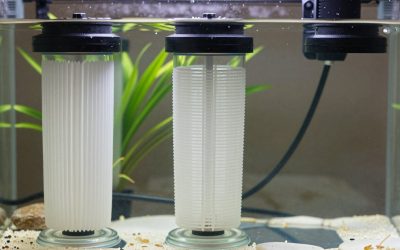
- Mechanical media: Foam or floss that catches uneaten food and debris.
- Biological media: Porous foam, ceramic rings, or similar material where beneficial bacteria can grow.
- Chemical media: Activated carbon or specialty media used for odors, discoloration, or specific water conditions.
Prioritize filters with reusable foam and a separate biological-media compartment. Proprietary cartridges can be convenient, but they add recurring costs and may remove beneficial bacteria when replaced. If a cartridge is the only media option, rinse it gently in removed aquarium water and replace it only when it is falling apart or cannot be cleaned.
For a small aquarium, an internal sponge filter may cost about $8–$20 and require an air pump, while a compact internal power filter commonly costs $12–$30. Hang-on-back filters often offer more media space for approximately $20–$60.
Construction and Installation
A reliable filter should be straightforward to assemble without tools. Look for clearly marked intake and output sections, a secure impeller cover, and suction cups or mounting hooks that hold the unit firmly. Loose suction cups can allow an internal filter to tilt, exposing the intake or creating extra noise.
Internal filters usually sit inside the aquarium and are useful when there is little clearance behind the tank. They typically need to remain fully or partially submerged, depending on the model. Hang-on-back filters save interior space, but the aquarium must have a compatible rim and enough room behind it. A pre-filter sponge on the intake is a worthwhile upgrade for shrimp, fry, and fish with delicate fins.
Before starting the filter, confirm the manufacturer’s minimum water level. Many power filters must be filled with water before plugging in, especially after cleaning. Running a motor dry can damage the impeller or cause it to rattle. Keep the electrical cord lower than the outlet so water cannot run directly into the socket; this loop is commonly called a drip loop.
Comfort and Performance
In aquarium equipment, comfort means low noise and a gentle, predictable current. A filter may be mechanically effective but unsuitable if it produces a constant hum in a bedroom or creates a waterfall that disturbs the fish.
Noise usually comes from three areas: the impeller, vibration against the glass, and falling water. A clean impeller, properly seated cover, and level installation can reduce rattling. If the filter uses a hang-on design, a thin rubber pad beneath the contact points may reduce vibration, provided it does not interfere with stability.
For quiet operation, consider a model with an adjustable flow control, a submerged or extendable intake, and an output that can be directed toward the glass. Sponge filters are often quiet at the filter itself, but the air pump can produce a low hum. An air pump rated for roughly 1–3 watts is common for small sponge filters; the pump’s noise depends heavily on its design and placement.
Do not judge performance only by the GPH number. Flow ratings are commonly measured under ideal conditions and can decrease as media becomes dirty or the lift height increases. A filter with a larger media chamber and easy access may outperform a faster but cramped model in everyday use.
Price Tiers and Total Cost
Budget, approximately $10–$20: This tier includes small internal power filters, basic sponge filters, and compact units for nano aquariums. A Tetra Whisper 27 GPH internal power filter, for example, is the type of product aimed at smaller setups. Expect limited media capacity and simpler flow adjustment. Budget for replacement sponges, airline tubing, or cartridges.
Mid-range, approximately $20–$45: These filters generally offer better mounting hardware, quieter operation, adjustable flow, and more useful media space. A compact hang-on-back filter rated around 50–150 GPH often fits this category. The Tetra Whisper IQ models listed around $20–under $30 illustrate the lower end of this range, depending on size and seller.
Premium, approximately $45–$120 or more: Premium filters are most useful for larger aquariums, heavily stocked tanks, or buyers who want greater media capacity and more refined flow control. Some include surface skimmers, multiple trays, automatic priming, or quieter impeller designs. More features do not eliminate maintenance, so buy them for a real need rather than appearance.
Include operating costs in your budget. Replacement cartridges may cost $5–$15 per pack and can add $30–$100 annually, depending on the filter and replacement schedule. Reusable foam and loose biological media usually cost more initially but can reduce long-term expenses.
Warranty and Replacement Parts
A basic aquarium filter should have at least a one-year limited warranty, although coverage varies by brand and seller. Check whether the warranty covers the motor, impeller, housing, and electrical components. Consumable media and damage from running the unit dry are commonly excluded.
Replacement parts matter more than a long warranty for a product you expect to use for years. Before buying, search the manufacturer’s parts list for impellers, intake tubes, suction cups, lids, and media baskets. An inexpensive filter becomes less attractive if a small broken part requires replacing the entire unit.
Keep the receipt, packaging, and model number. If the motor begins buzzing, the flow drops sharply, or the unit stops restarting after cleaning, inspect the impeller and intake before assuming the motor has failed.
Delivery and Assembly
Most small filters weigh between 1 and 3 pounds and arrive fully or partly assembled. Delivery damage is uncommon but possible, so inspect the housing, power cord, intake tube, and impeller cover before placing the filter in water. A cracked housing or bent electrical plug is a reason to request a replacement rather than attempt a repair.
Allow 10–20 minutes for initial assembly and setup. Wash plastic parts with plain water only; never use soap or household cleaners. Install the media in the order shown by the instructions, fill the filter chamber if required, and test the flow before adding fish. If the unit includes loose carbon, rinse it until the water runs mostly clear.
Spec Checklist
| Spec | Budget | Mid | Premium |
|---|---|---|---|
| Best aquarium size | 1–10 gallons | 10–40 gallons | 40–100+ gallons |
| Typical flow | 10–60 GPH | 50–250 GPH | 200–600+ GPH |
| Typical price | $10–$20 | $20–$45 | $45–$120+ |
| Power draw | 2–6 watts | 3–12 watts | 8–35 watts |
| Media capacity | One sponge or cartridge | Foam plus biological media | Multiple trays or large media chamber |
| Best feature to prioritize | Safe, adjustable flow | Reusable media and quiet operation | High capacity and serviceable parts |
Red Flags
- A gallon rating with no stated GPH or flow-control information.
- A filter that must be replaced entirely when one cartridge or impeller wears out.
- Cracked plastic, loose electrical components, or an unusually hot motor.
- No instructions for priming, media placement, or minimum water level.
- A powerful output with no way to diffuse or redirect the current.
- Claims that the filter eliminates every water-change requirement.
- Replacement media that costs nearly as much as the original filter.
- A design that blocks the lid, light, heater, or feeding opening.
FAQ
How strong should an aquarium filter be for a beginner?
Start with a filter capable of circulating the tank’s volume about 4–6 times per hour. For a 10-gallon tank, that commonly means 40–60 GPH. Choose adjustable flow or add a sponge pre-filter if the fish appear stressed or are constantly pushed by the current.
Is a one-gallon betta tank large enough for a filter?
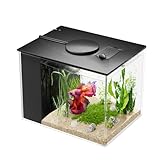
A one-gallon tank can physically use a small internal filter or sponge filter, but it provides very little stable water volume and requires close monitoring. A larger, heated aquarium is generally easier to keep stable. If using a small kit such as a 1-gallon acrylic tank, select the gentlest compatible filter and follow its minimum water-depth instructions.
How often should an aquarium filter be cleaned?
Inspect the intake and output weekly. Rinse clogged foam in water removed during a water change, usually every 2–4 weeks, rather than under chlorinated tap water. Clean the impeller and its chamber about every 1–3 months or whenever flow becomes noticeably weaker.
Should beginners choose an internal filter or a hang-on-back filter?
Choose an internal filter when space behind the aquarium is limited or the tank has no suitable rim. Choose a hang-on-back filter when you want easier access, more media capacity, and a cleaner interior. For either style, prioritize adjustable flow, replacement parts, and media that can be reused.
Ready to decide? Our #1 pick for 2026 is the Best aquarium size.
Live price & availability on Amazon.
Related Reviews & Guides
Best Budget Rimless Aquarium: Top Expert Value Buying Guide
Best Aquarium Kit For Beginners 2026: Top Compared Buyer Guide